
What Is an AI CRM? A 2026 Buyer's Guide for Teams on WhatsApp
Every CRM has an AI now. Here is what an AI CRM actually is in 2026, what separates them, and how to choose one if your leads live on WhatsApp.
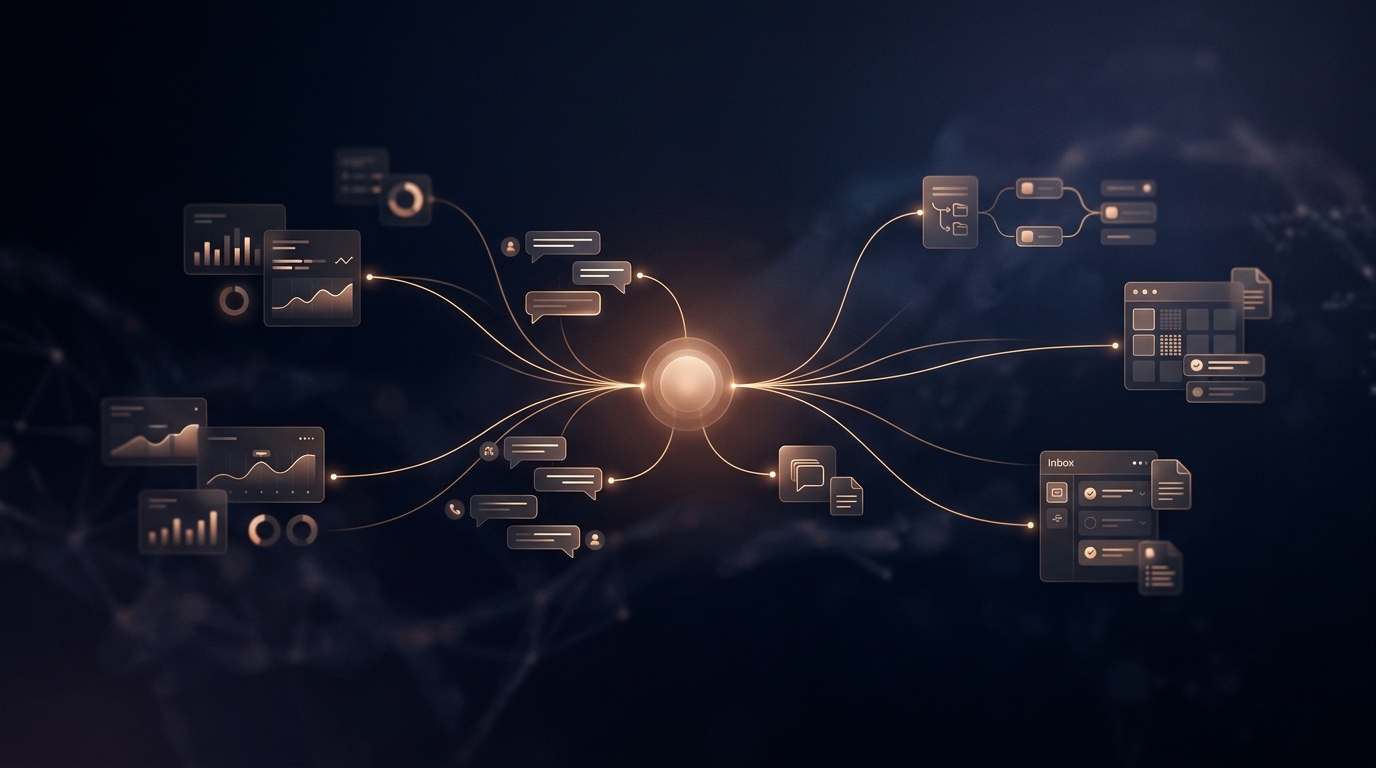
The label "AI CRM" is now on almost every product in the category. HubSpot, Salesforce, Zoho, Pipedrive, and a wave of newer tools all describe themselves this way. That makes the phrase close to meaningless as a filter, because it no longer separates one product from another. If you are choosing a CRM in 2026, the useful question is not whether it has AI. It is what that AI can actually touch inside your business.
This guide explains what an AI CRM is, what changed in 2026, and how to judge one when your customers message you on WhatsApp instead of email.
What is an AI CRM?
An AI CRM is a customer relationship management system that uses artificial intelligence to interpret your data and do some of the work, rather than only storing records and waiting for a human to act. Traditional CRMs were filing cabinets with reminders. An AI CRM reads incoming conversations, drafts replies, scores and routes leads, summarises calls, updates the pipeline, and surfaces what to do next.
In practice, the AI inside a CRM does three jobs: it understands (reading messages, transcribing calls, classifying intent), it generates (writing follow-ups, drafting campaigns, summarising a thread), and it acts (moving a deal stage, assigning an owner, booking a meeting). The first two are now common everywhere. The third, autonomous action, is where products genuinely differ.
What changed in 2026 that made every CRM an AI CRM?
Two things happened at once. Foundation models became cheap and good enough to embed anywhere, and the incumbents shipped agents on top of their existing data.
As of 2026, Salesforce reports its Agentforce product processing billions of agent workflows a month across tens of thousands of customers, HubSpot's Breeze AI is embedded across its hubs and included in most plans, and Zoho's Zia Agent platform ships with hundreds of built-in actions aimed at non-technical users. Gartner has forecast that around 40 percent of enterprise applications will include task-specific AI agents by the end of 2026, up from a tiny fraction the year before. (Figures cited by vendors and analysts as of early-to-mid 2026, and worth re-checking before you buy.)
The takeaway for a buyer is simple. The model is no longer the moat. When everyone has capable AI, the difference is what each AI is allowed to read from and act on. Every CRM has an AI now. The only question is how much of your business it can reach.
What is the difference between an AI assistant and an AI agent in a CRM?
This distinction is where most of the marketing confusion lives, so it is worth being precise.
- An AI assistant waits for a prompt. You ask it to draft an email or summarise a deal, and it hands the output back to you to send or save. It is a faster keyboard.
- An AI agent completes a task end to end. Given "follow up with everyone who went quiet after a quote," it finds those contacts, drafts and sends the messages on the right channel, logs the activity, and moves the deals. It is a co-worker with permissions.
Both are useful. But an assistant only speeds up the person already doing the work, while an agent removes the work. When a vendor says "AI CRM," find out which of these they mean, and on which channels the agent is allowed to act.
How do you evaluate an AI CRM in 2026?
Because the AI itself is now table stakes, evaluate the surface it can operate on. Five questions cut through the noise:
- Which channels can the AI read and reply on? Email only, or WhatsApp, Instagram, and Facebook too? For most small teams outside the US, the enquiries arrive on chat, not email.
- Can it take actions, or only suggest them? Ask for a concrete example of the AI moving a deal, assigning an owner, or booking a meeting without a human clicking approve.
- Does one instruction cross more than one system? A campaign, a pipeline update, and a report are usually three separate tools. Can the AI move between them from a single request?
- What does the AI genuinely cost? Many entry prices exclude the AI tier. Add credits, per-message fees, and add-on modules before comparing.
- Where does the AI stop? If a vendor cannot tell you what its AI cannot do, treat that as a warning, not a feature.
The reach of the AI, meaning the set of systems it can read from and act on, matters more than any single clever feature. A brilliant assistant that only touches your email is worth less to a WhatsApp-first team than a competent agent that touches every channel a customer uses.
Why does channel reach matter more than model quality for WhatsApp teams?
If your leads come from Meta ads, referrals, and walk-ins, they almost always land in WhatsApp. An AI CRM built around email inherits an inbox your customers are not using. The smartest model in the world cannot act on a conversation it never sees.
This is the trap for teams in markets like Malaysia and the UAE, where WhatsApp is the default business channel. A US-designed AI CRM will happily draft emails and score form fills, while the actual enquiry sits unread in a personal WhatsApp on someone's phone at 9pm. The gap is not intelligence. It is access.
So the practical test is whether the AI sits where the conversation happens. An agent that reads the WhatsApp thread the moment it arrives, replies in seconds, qualifies the lead, and assigns it to the right salesperson is doing more real work than a cleverer model bolted onto the wrong channel.
Where an AI CRM is not the right answer
Honesty here is the point, because the category is oversold. An AI CRM is the wrong tool in a few clear cases:
- If your pipeline is email-led and document-heavy (long B2B cycles, procurement, contracts), a record-first CRM built around email threads and deal rooms will serve you better than a chat-native one.
- If you need a highly custom data model with bespoke objects and relationships, a flexible platform like Attio is designed for exactly that, and a chat-first tool will feel rigid.
- If you are an enterprise with strict compliance, audit, and procurement requirements, Salesforce and the other incumbents exist for a reason, and their governance depth is not something a smaller product should pretend to match.
Naming these is not a weakness. It is how you know the rest of the advice is trustworthy. Most small teams do not fall into these buckets, but some do, and they should buy accordingly.
Where Yalla fits
Yalla is the chat-native CRM where the AI does the work, not just the talking. It is built for teams whose enquiries arrive on WhatsApp, Instagram, and Facebook and need to be answered, qualified, and assigned before the lead goes cold.
The connective tissue is the point, not any single module. Yalla Brain acts across pipelines, WhatsApp, Instagram, Facebook, email campaigns and reporting from one instruction. We do not claim the best email engine or the deepest custom-object model. We claim that when a customer messages, the AI can actually reach the channel, the pipeline, and the follow-up in one move, instead of handing you a draft and leaving the work on your desk.
Frequently asked questions
Is an AI CRM worth it for a small business?
For a small team that handles inbound enquiries on chat, yes, because the AI removes the two tasks that cost you deals: slow first replies and dropped follow-ups. The value comes from the AI acting on live conversations, not from analytics you will not read. If your business runs on long email-led sales cycles, the return is smaller and a traditional CRM may serve you better.
Do AI CRMs replace salespeople?
No. In 2026 the realistic role of an AI CRM is to handle the repetitive layer, instant replies, qualification, routing, logging, and reminders, so your team spends its time on the conversations that need a human. It shifts where salespeople spend their hours rather than removing the need for them.
How much does an AI CRM cost in 2026?
It varies widely, and the headline price is rarely the real price. Incumbent AI tiers can run well into the hundreds of dollars per user per month once agents and add-ons are included, while chat-native tools aimed at SMEs sit far lower. Always add AI credits, per-message WhatsApp fees, and paid modules to the base plan before comparing two products.
What is an agentic CRM, and is it different from an AI CRM?
"Agentic CRM" is the 2026 term for an AI CRM whose AI can complete tasks autonomously rather than only suggest them. It is a subset of AI CRM, not a separate category. The useful question is still the same: what is the agent allowed to act on, and on which channels?
What should I ask a vendor on a demo?
Ask them to show the AI taking an action, not writing a suggestion. Have them reply to a live WhatsApp enquiry, qualify it, move the deal, and book a meeting in front of you. If the demo only shows drafts and dashboards, you are looking at an assistant, not an agent.
Free download
From Manual to Automated: The 7-Step Sales & Marketing Roadmap for SMEs
A practical companion to this article — yours in exchange for an email.
Get it free
Yalla is the chat-native CRM where the AI does the work, not just the talking.
See how much of your business it can reach.