AI CRM: What It Actually Does, and the One Thing to Check Before You Buy
An AI CRM promises to do your admin, qualify leads, and answer customers. Here is what that means in 2026, and the one thing to check before you pay.
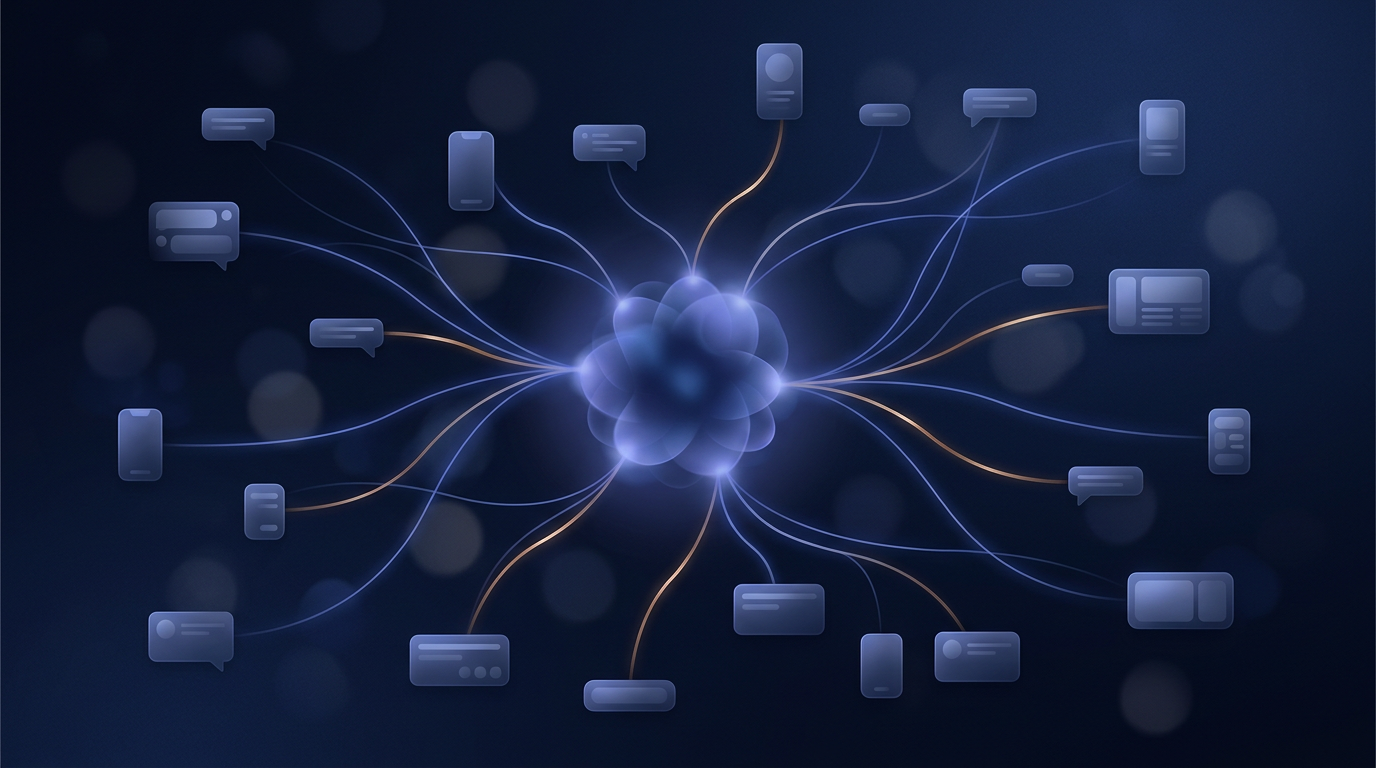
Search "AI CRM" today and every vendor claims one. Salesforce has Einstein, HubSpot has Breeze, Attio has Ask Attio, Zoho has Zia. The label has stopped meaning anything, because it now describes almost every CRM on the market. So the useful question is not "does it have AI?" It is "what can that AI actually touch?"
This piece is a plain answer to what an AI CRM does in 2026, where the real differences hide, and the one thing worth checking before you sign up.
What is an AI CRM?
An AI CRM is a customer relationship management system with machine learning and large language models built into its core, so the software can read your data, decide what to do next, and carry out tasks on its own instead of waiting for a person to click through every step.
The plain-language version: a normal CRM is a filing cabinet that also reminds you to make calls. An AI CRM is meant to be a coworker that reads the file, drafts the reply, updates the record, and books the meeting. Whether a given product actually delivers that or just adds a chatbot to a filing cabinet is exactly what you are buying, and the gap between the two is enormous.
What can an AI CRM actually do in 2026?
Strip away the marketing and the real capabilities fall into five buckets. Most AI CRMs do some of these. Very few do all of them well.
- Data hygiene. Detect duplicate contacts, fill in missing fields, correct company details, and move a deal to the next stage when the underlying activity says it should have moved already.
- Lead scoring and prioritisation. Rank incoming leads by how likely they are to convert, using your own historical close data rather than a rep's gut feeling, so the team works the best opportunities first.
- Conversation intelligence. Summarise long email threads, transcribe and tag calls, flag deals that have gone quiet, and suggest the next best action on a record.
- Drafting and replying. Write the follow-up, personalise it to the contact, and in the strongest systems send it and log it without a human in the loop.
- Autonomous qualification and booking. Answer an inbound enquiry the moment it lands, ask the qualifying questions, and put a booked meeting straight into the calendar and the pipeline.
That last bucket is where the money is. A lead answered within five minutes is many times more likely to convert than one answered an hour later, and most small teams simply cannot staff that speed at 9pm on a Saturday. An AI that qualifies and books while everyone is asleep is worth more than any dashboard.
Why do so many AI CRMs feel disappointing in practice?
Because the AI is only as good as what it is allowed to see and do. This is the part the category page never explains.
Every AI feature runs on two things: the data it can read, and the systems it can act on. Call that its reach. A summarisation feature that can only read the notes a rep bothered to type is weak. One that can read the full WhatsApp thread, the Instagram DM, the email chain, and the pipeline history is strong, because it has something real to summarise. The intelligence is roughly the same across vendors now. What differs is the surface area it is plugged into.
Here is the trap. Most CRMs were built for email and web forms, so their AI is excellent at email and web forms and blind to everything else. If your customers actually reach you on WhatsApp and Instagram, an AI that cannot read those channels is doing clever work on the wrong half of your business. Every CRM has an AI now. The only question is how much of your business it can reach.
What is the one thing to check before you buy?
Before you look at the AI's cleverness, map where your customers actually talk to you, then check whether the AI can read and act on every one of those places from inside the CRM.
Run this test on any product you are considering:
- List your real inbound channels, in order of volume. For most small businesses in Malaysia and the Gulf that list starts with WhatsApp, then Instagram and Facebook, then maybe email and a web form.
- For each channel, ask: can the AI read the full conversation history here, and can it send a reply and update the record here, natively, without a paid middleware connector?
- Count how many of your top channels get a yes.
If the AI only reaches channel three and four on your list while your customers live on channel one, no amount of model quality fixes that. You are buying a smart assistant and locking it out of the room where the work happens.
How much does an AI CRM cost, and where is the hidden line?
The sticker price and the working price are rarely the same, because AI features are increasingly metered separately from the seat.
| Product | Entry pricing (as of Aug 2026) | Where the AI cost hides |
|---|---|---|
| Attio | Free (3 seats), Plus ~$29/seat/mo, Pro ~$69/seat/mo | Ask Attio and enrichment run on monthly credit pools; extra 10,000 workspace credits ~$150/mo |
| HubSpot | Free tier, paid tiers scale steeply | In Malaysia, a serious seat count runs RM3,500+/mo, and the platform is email-first with no native WhatsApp workflow |
| respond.io | ~$79/mo entry, then $159 and $279 | Priced on monthly active contacts, so cost climbs with volume; strong AI but middleware-style setup |
| Wati | Growth from ~$39/mo | The real AI stack with the Astra add-on and Meta message markup lands closer to $200+/mo |
The pattern: read past the headline seat price to how the AI itself is metered. Credit pools, active-contact tiers, and add-on stacks are where a cheap-looking AI CRM becomes an expensive one at your actual volume. Verify current numbers on each vendor's own pricing page before you commit, since these move quarterly.
Where an AI CRM is NOT the answer for you
Being honest about this is the only reason to trust the rest of the page.
- If your pipeline is email-led and relationship-heavy, a record-first CRM built around the inbox will serve you better than a chat-native one. Play to where your customers already are.
- If you need a highly custom data model with bespoke objects and relationships, Attio is genuinely built for that and it is a strong choice for startups and GTM teams who want to shape the schema themselves.
- If your requirement is enterprise compliance, deep audit trails, and procurement-grade security reviews, Salesforce and the large incumbents exist for exactly that reason, and a lean challenger is not the safe pick.
An AI CRM is not a universal upgrade. It is the right tool when your customer conversations are messy, fast, and spread across messaging apps, and the cost of a slow or dropped reply is a lost sale.
Where Yalla fits
For businesses whose customers live on WhatsApp, Instagram, and Facebook, the channel gap above is the whole problem, and it is the one Yalla is built to close. Yalla is the chat-native CRM where the AI does the work, not just the talking. Yalla Brain acts across pipelines, WhatsApp, Instagram, Facebook, email campaigns and reporting from one instruction, so the same assistant that answers a midnight enquiry also updates the deal and books the demo.
We do not claim the smartest model in the category. Model quality has converged, and pretending otherwise would be dishonest. What we claim is the connective tissue: an AI that can read and act on the channels where your customers actually are, instead of the ones a CRM built in another market decided to support.
Frequently asked questions
Is an AI CRM the same as a chatbot?
No. A chatbot answers messages on one channel using scripted or AI replies. An AI CRM connects those conversations to your customer records, pipeline, and reporting, so the same system that replies can also update the deal, score the lead, and book the meeting. The chatbot is one feature; the CRM is the system of record it feeds.
Do I need an AI CRM if I only use WhatsApp?
If WhatsApp is your main sales channel, an AI CRM is arguably more valuable to you than to an email-led business, not less. The catch is that most CRMs treat WhatsApp as an afterthought. Choose one where WhatsApp is a native, first-class channel the AI can read and act on directly, not a bolt-on connector you pay extra to maintain.
What is the difference between an AI CRM and a normal CRM?
A normal CRM stores your data and reminds you to act on it. An AI CRM reads that data, decides what to do next, and carries out tasks such as replying, qualifying, and booking on its own. In 2026 the meaningful difference between AI CRMs is not intelligence, which has largely converged, but how many of your channels and systems the AI is actually allowed to touch.
How do I know if an AI CRM's AI is any good?
Ignore the demo on their sample data and test it on yours. Feed it a real, messy conversation from your busiest channel and see whether it summarises correctly, drafts a reply you would actually send, and updates the right record. If it cannot even read that channel, the quality question is moot.
Yalla is the chat-native CRM where the AI does the work, not just the talking.
See how much of your business it can reach.
Sign up for a free trialor book a free demo