
Your Customers Message at 2am. Your Team Replies at 8.30.
A GP described the gap between when patients message and when staff reply, and what it costs. The arithmetic for any KL service business losing night leads.
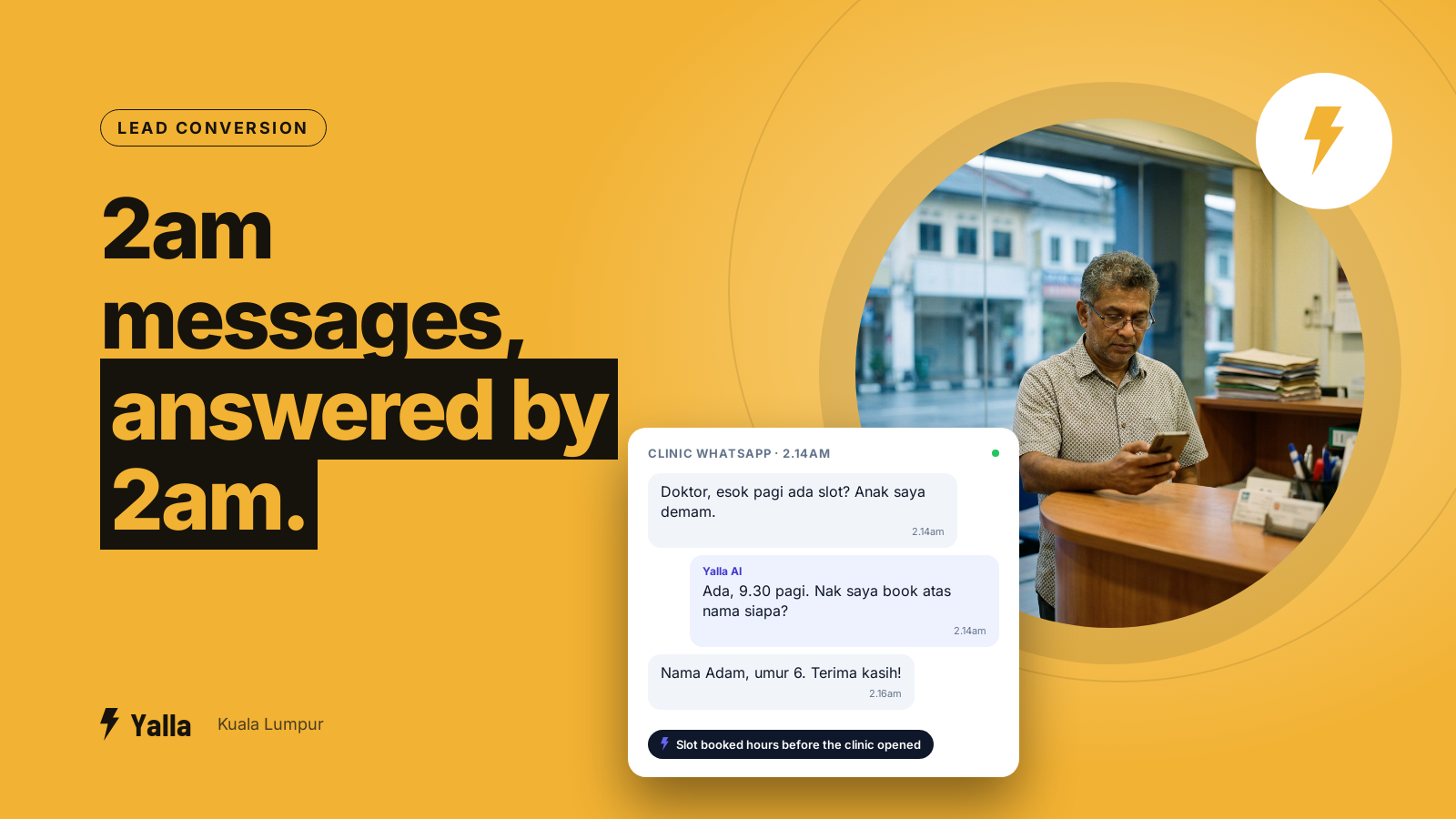
We asked a GP who owns his own clinic what his single biggest operational problem was. He didn't talk about clinical systems or billing. He talked about the time of day.
"When we do these online services, we don't have enough staff to attend to the WhatsApp inquiries. When you do social media engagement, people tend to engage you at night mostly, and it's after our closing hours. So sometimes they text us at 11pm, 12am, sometimes they text us at 2am."
Then he closed the loop himself, without being led:
"Our staff can only reply once they get to work in the morning, around 8:30am, and that's about it. Sometimes you lose the golden time of response. That's our challenge. And I think that also limits our ability to get more consultation slots."
Look at what he did there. He didn't say response times could be better. He tied an eight-hour gap directly to unfilled appointment slots, which is to say, to revenue.
If you run a clinic in Bangsar, a tuition centre in Cheras, a travel agency in Petaling Jaya or a property team in Mont Kiara, you'll recognise that gap. Klang Valley customers do their thinking late. They message after the jam, after dinner, after the kids are asleep. Your office opens at 8.30 or 9.
Why the gap exists, and why it keeps getting wider
Nobody's being lazy. It's a structural mismatch that most service businesses walked into without noticing.
Your marketing runs 24 hours. The Facebook ad you paid for serves at midnight. Your Instagram post gets seen at 11pm, when people are in bed with their phones and finally have time to think about their health, their child's school, a holiday, a new condo. That's when intent peaks.
Your operations run eight hours. Someone unlocks the shop at 8.30.
Every hour of that mismatch is a window where a customer with real intent is holding their phone and you aren't there. And because they're on WhatsApp rather than email, the expectations are different. A message feels like a conversation, and a conversation left unanswered for nine hours feels like being ignored, even if you think of it as a queue.
The leads you paid most for are often the ones that go unanswered. You spend on an ad, the click lands in WhatsApp at 9pm, and nobody replies until it's stale. The ad did its job and the reply didn't.
Free download
The 5-Minute WhatsApp Response Playbook: How to Reply to Every Enquiry Before Your Competitor Does
A practical companion to this article. Free for your email address.
Get it free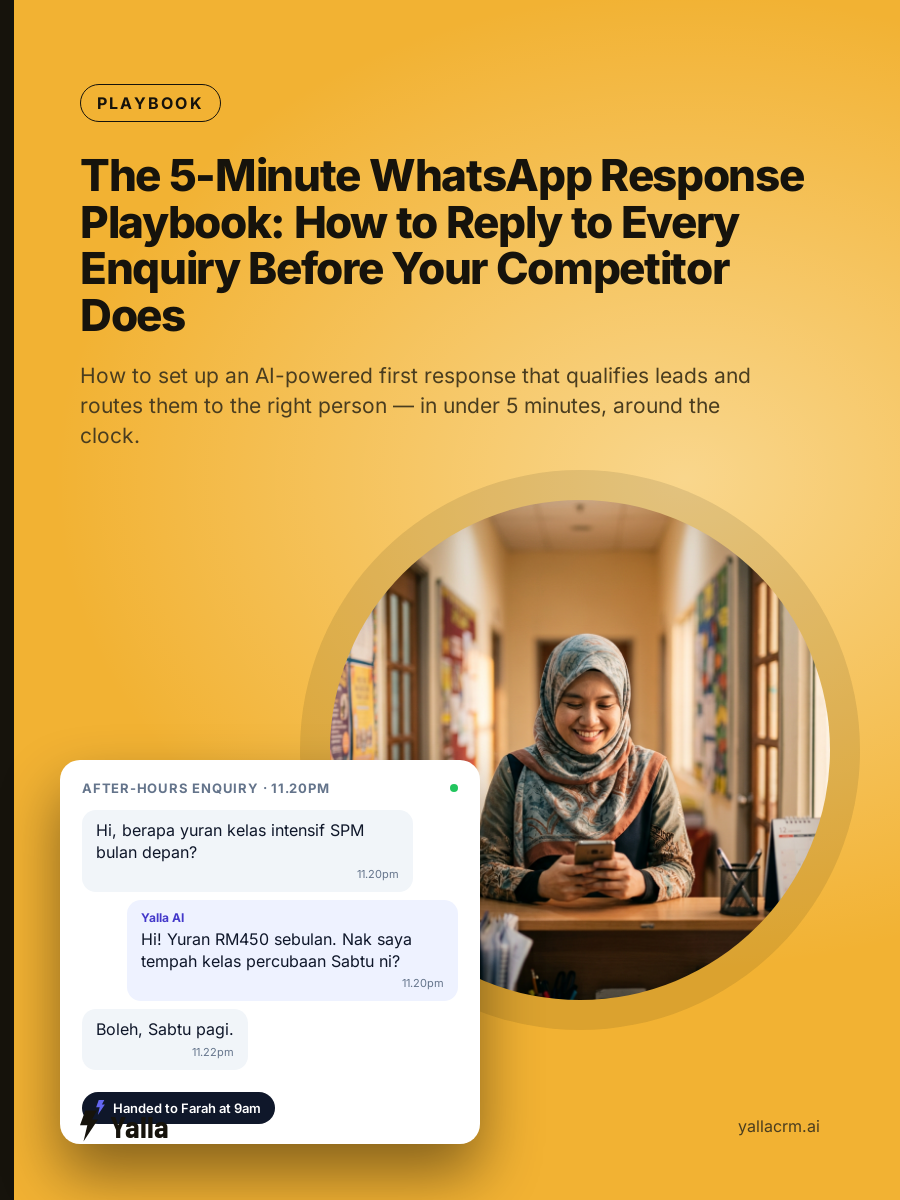
"We already have an auto-reply"
We hear this a lot, so we'll let the same doctor answer it, because he'd already tried:
"Our automated response is only the automated response that tells you that we are open at certain times. This is our location, this is our services. Yeah, that's all."
Yeah, that's all. An opening-hours autoresponder tells the customer they were right to feel ignored. It confirms nobody's coming. It answers a question they didn't ask and none of the ones they did.
The distance between "we're closed, here's our address" and an actual answer is the whole opportunity.
What should happen in the first minute
A good setup does five things when a message lands at 11pm, without anyone awake to trigger them:
- Reply straight away, in the customer's language. If they wrote in Malay or Chinese, the answer comes back in Malay or Chinese. It answers the obvious question and keeps the conversation alive.
- Ask the one or two questions that tell a real booking from a browser, so the morning team walks into context instead of a cold "hi".
- Put the lead on record, tagged with where it came from, so nothing depends on someone remembering to log it.
- Book the slot, if the person is ready and your capacity allows it.
- Hand over to a person when the question needs one, with the whole conversation attached.
Only the first of those is chat. The other four are work: updating a record, tagging a source, booking a calendar, handing over with context. That's the difference between a chatbot and a CRM. One talks. The other acts on what was said.
What can honestly be answered at 2am
This is where most vendors overclaim, so let's be precise. Split your inbound into three buckets.
Bucket one: answerable now. Price ranges, opening hours, location and parking, whether you offer a particular service, what to bring, how long it takes, what the process is. For many service businesses this is a large share of what comes in overnight, and it needs no judgement, only accurate information.
Bucket two: bookable now. If your capacity allows it, a slot can be taken at 2am without a person. Note the if. For some businesses, letting customers book themselves is genuinely a bad idea, and it's worth deciding that before you switch it on.
Bucket three: needs a person. Clinical judgement, a complaint, a negotiation, anything sensitive. Nothing should answer these at 2am. They should be captured, acknowledged honestly ("someone will get back to you first thing, you're first in the queue"), and waiting at the top of a person's morning with full context attached.
Bucket three is the one vendors quietly pretend doesn't exist. Handling it well means admitting that a machine isn't answering, and customers trust that more.
Meta's own rules now push the same way. Since January 2026, the WhatsApp Business API has restricted general-purpose AI chatbots, while task-specific assistants for things like booking, answering customer questions and handing over to staff remain allowed. The design the platform permits is also the one customers prefer.
A simple test for your auto-replies
Read last night's exchanges the next morning and ask whether a customer would have felt helped or fobbed off.
An annoying bot says "Thanks, an agent will contact you soon" and does nothing. A useful one answers the actual question, asks what it needs to, and offers a next step, in the tone a person would use. If your after-hours messages can't pass that morning read, they're a placeholder.
The other half of not being annoying is knowing when to stop. An assistant that handles bookings, simple questions and a bit of qualification, then passes anything complicated to a person with the full thread, is what people actually want at 10pm.
The arithmetic
Do this with your own numbers rather than ours.
- Pull last month's inbound messages and group them by the hour they arrived.
- Count how many came in outside working hours.
- Take your normal enquiry-to-customer conversion rate.
- Assume the after-hours group converts at half that rate. It's a deliberately cautious assumption.
- Multiply the difference by what a customer is worth to you in ringgit. That's roughly what the gap costs you each month.
Say a clinic gets 200 enquiries a month and 80 arrive after closing. If daytime enquiries convert at 20% and a new patient is worth RM300 over their first year, those 80 would produce 16 patients at the daytime rate and 8 at half that. Eight patients is RM2,400 a month, before you count anyone they'd have referred.
The GP above sees fewer than ten patients on a normal day, fifteen on a good one. He doesn't need a large recovered percentage for this to matter to him. Neither, probably, do you.
Where Yalla fits
Yalla is a chat-native CRM built for exactly the 11pm message. The reply, the qualifying questions, the pipeline entry and the booking can all happen before anyone on your team is awake. Yalla Brain works across pipelines, WhatsApp, Instagram, Facebook, email campaigns and reporting from one instruction, so "follow up with everyone who messaged after hours this week and didn't book" reaches the chat, the pipeline and the calendar together.
Honest assessment
- If your after-hours volume is genuinely tiny, don't build for it. Count first, then decide.
- Answering fast is worthless if the answer is wrong. Bucket one only works if your information is accurate and current, which means someone has to keep it that way.
- If your first conversation always needs an expert's judgement before anything useful can be said, the honest job overnight is to capture the enquiry, qualify lightly and get a person on it first thing. Pretending to advise is worse than waiting.
- If your customers don't use WhatsApp and your deals live in long email threads, a record-first CRM will suit you better.
- The businesses that gain most from closing this gap are the ones where the customer is choosing between you and two competitors in the same evening. If that isn't how your customers buy, the urgency is lower.
Free download
The 5-Minute WhatsApp Response Playbook: How to Reply to Every Enquiry Before Your Competitor Does
A practical companion to this article. Free for your email address.
Get it freeYalla is the chat-native CRM where the AI does the work, not just the talking.
See how much of your business it can reach.