
Paying an Agency to Run Your Ads? What an AI CRM Can Take Over, and What It Can't
Klang Valley SMEs paying an agency for ads and posts: what an AI CRM can bring in-house, what still needs a human, and how the ringgit sums work out.
A lot of SMEs in the Klang Valley pay an outside agency every month to run their Facebook and Instagram ads, schedule posts and send a report. And a lot of those owners are now asking the same thing: if the CRM has an AI that writes and publishes, can we bring this in-house and stop paying the retainer?
It's a fair question. Here's the honest answer, including the parts a CRM vendor isn't supposed to say out loud.
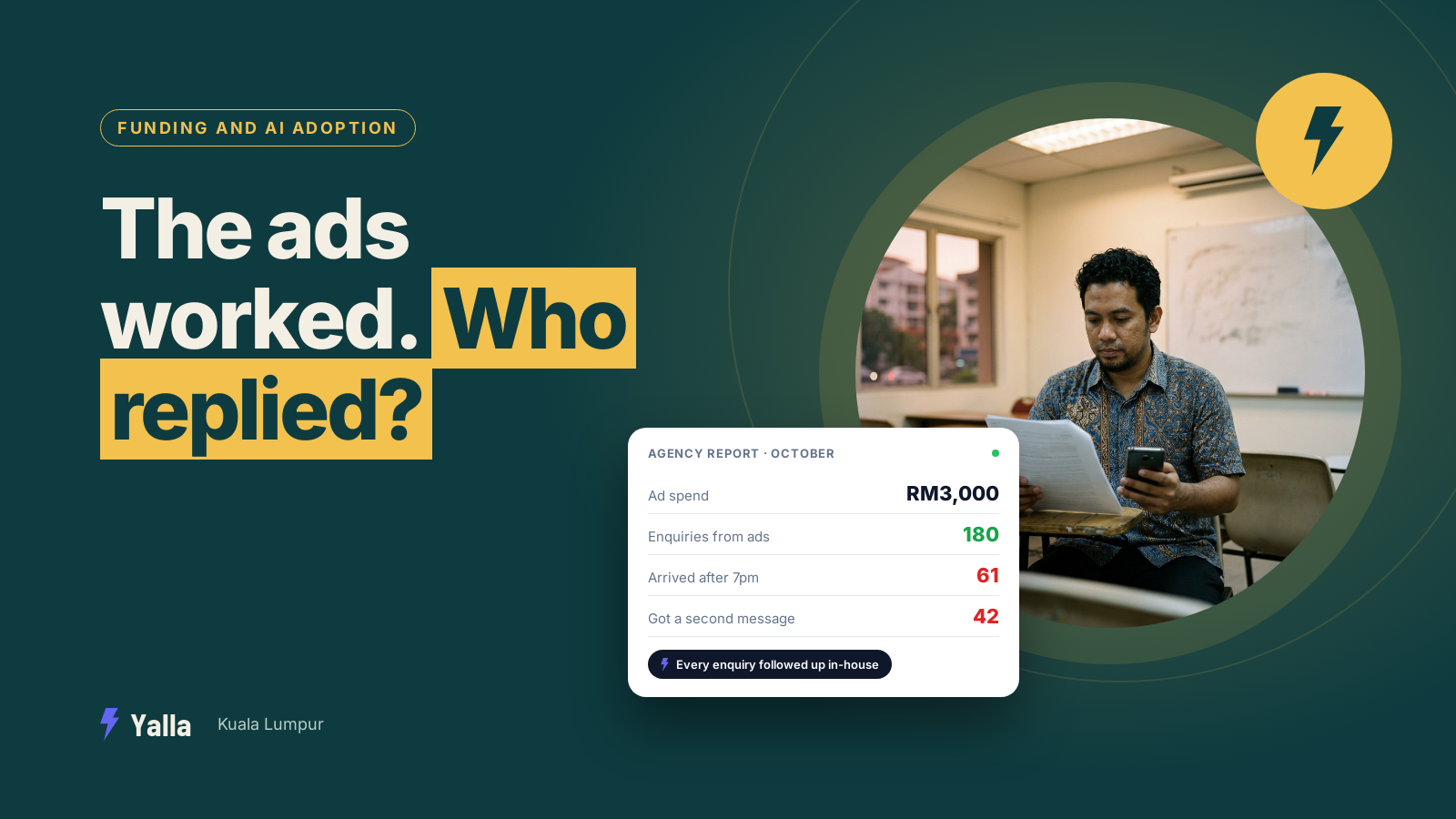
Start with what actually happens after the ad runs. Picture a tuition centre in Subang Jaya paying its agency to run RM3,000 a month of Facebook ads. The monthly report says the campaign produced 180 enquiries. It doesn't say that around a third of those WhatsApp messages arrived after 7pm and sat until the next afternoon, or that many never got a second message. The ads did their job. The follow-up was nobody's job.
That gap, between the campaign and the reply, is where this whole question gets decided.
What your agency actually does for you
Before you decide whether software replaces an agency, be precise about what yours does, because two very different businesses both use the word.
The execution agency runs your Meta and Google ads, schedules your Instagram and Facebook posts, writes captions and email blasts, and sends a report a couple of weeks after the month ends. Most of what you pay for is hours spent on repeatable tasks.
The strategy and creative agency decides your positioning, designs the brand, shoots the campaign and makes the judgement calls about what story to tell. Most of what you pay for is taste and thinking.
AI replaces the first far more easily than the second. If your agency mostly moves posts around a calendar and adjusts ad budgets, a large share of that work can now be automated. If your agency is the reason your brand looks and sounds like something, software won't fix that.
Free download
Agency or In-House? The Monthly Marketing Task Audit
A practical companion to this article. Free for your email address.
Get it free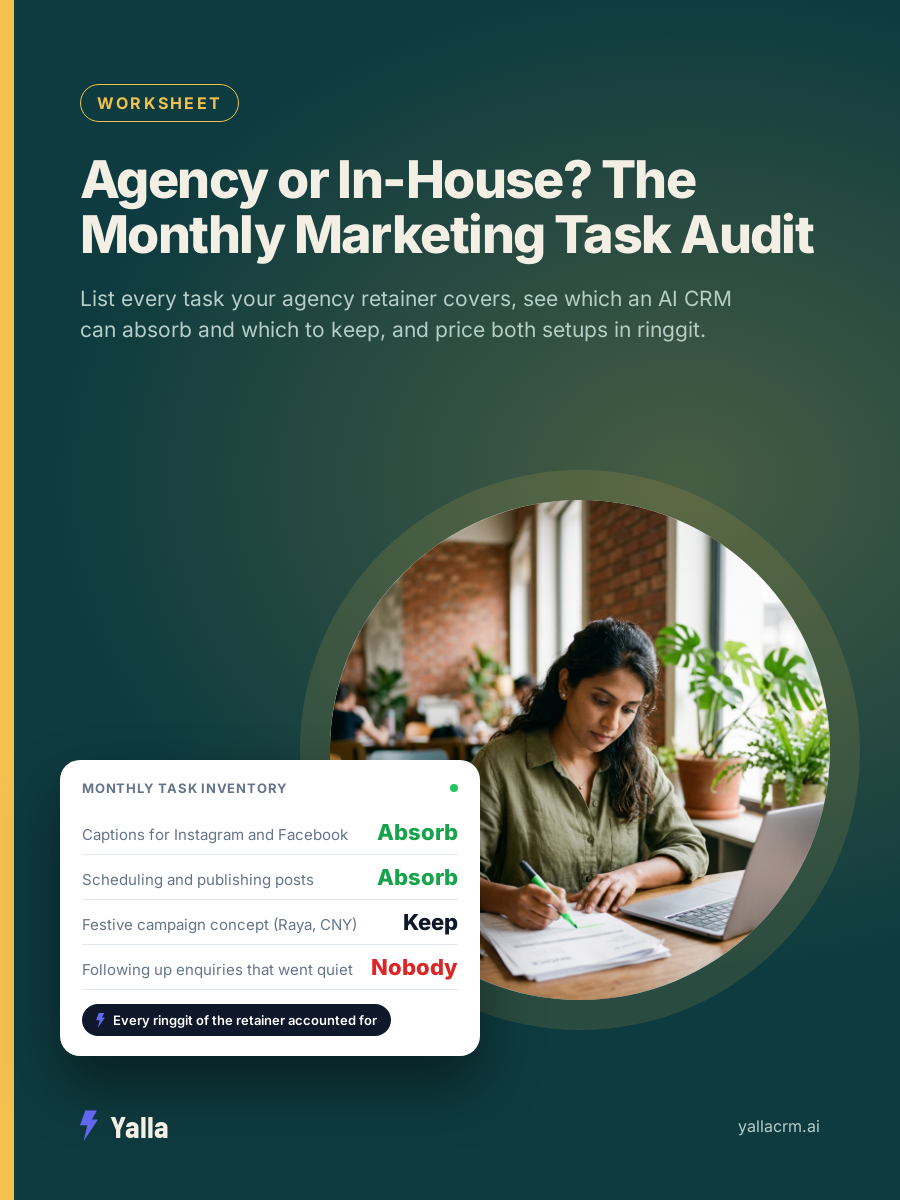
What an AI CRM can take off the agency's plate
Quite a lot of the execution layer:
- Drafting content in volume. Captions, email sequences, ad variations, follow-up messages and first drafts of longer copy. For templated work the quality is already past a tired junior writer. It can draft in Malay and English, and a person who speaks the language should still check anything going out in Chinese or BM before it's published.
- Scheduling and publishing. Posting to Instagram and Facebook and queuing email campaigns without somebody logging into five dashboards.
- Answering the leads the campaign brings in. This is the part agencies almost never touch. The ad runs, the enquiry lands in WhatsApp at 9.30pm, and it sits there until someone on your team notices.
- Reporting on what happened. Which campaign produced enquiries, which enquiries became conversations and which conversations became paying customers, in one place, instead of a slide deck that arrives late and stops at clicks.
The useful way to think about it is what each side's tools can see. An agency's tools see your ad accounts and your content calendar. They usually don't see your WhatsApp inbox, your sales pipeline or your customer records. That's where leads leak, and it's the part an in-house AI CRM is built to cover.
Yalla Brain acts across pipelines, WhatsApp, Instagram, Facebook, email campaigns and reporting from one instruction. No single one of those is better than a specialist tool. The point is that one system touches all of them, so the ad, the reply, the follow-up and the report stop being four separate jobs owned by four people who don't talk to each other.
Where an AI CRM won't replace your agency
This is the part that matters, because the limits are what make the rest believable.
Strategy and positioning. No AI decides what your business should stand for, which segment to go after next quarter, or why a customer in Bangsar should pick you over the firm two streets away. It carries out a plan. It doesn't have one.
Original creative and brand. AI writes competent copy and makes competent images. It doesn't art-direct a campaign that makes people feel something, and it doesn't build a brand from nothing. If that's what you buy from your agency, keep buying it.
Cultural judgement for big campaigns. A Hari Raya, Chinese New Year or Deepavali campaign lives or dies on tone. An experienced person who knows the audience catches things a model won't. Use the AI to produce the variations and handle the replies, and keep a human on the concept.
Results don't come from the tool. Someone still has to point the AI at the right work, read what it produces and check the numbers. A tool nobody owns produces nothing.
If your agency is a real strategic partner, don't fire them. Stop paying agency rates for execution a CRM can now do, and keep them for the thinking.
Is it cheaper than an agency?
For the execution layer, usually yes. But do the sum properly.
Here's an illustration. Say your retainer is RM6,000 a month, and when you break it down with the agency, roughly two thirds of the hours go on posting, ad adjustments, captions and reporting. That's the part an AI CRM can absorb. The remaining third, the strategy and the creative, is the part worth keeping, perhaps as a smaller monthly engagement or a few hours of senior time.
On the other side of the ledger, you'll pay for the CRM, for AI usage if it's metered in credits, and for Meta's own WhatsApp charges. From 1 October 2026 Meta also bills for service messages, the free-form replies inside the 24-hour window, so the WhatsApp line isn't zero. You pay Meta whichever setup you choose.
The bigger saving usually isn't the invoice. It's the leads you stop losing. An agency can run a flawless campaign and still watch half the enquiries go cold because nobody replied in time. When the same system that runs the campaign also answers the enquiry straight away, and follows up on day two and day five, the ad spend you're already paying for works harder.
What a sensible setup looks like
For most SMEs the answer isn't one or the other. It's a hybrid, and the shape is fairly consistent.
- Close the reply gap first. Before you move a single post in-house, make sure every enquiry the current campaigns produce gets answered, assigned and followed up. A campaign that produces enquiries nobody answers is worse than no campaign.
- Bring execution in-house. Content drafting, scheduling, campaign sends, lead replies, follow-up sequences and reporting all in one system your team controls.
- Keep a specialist for the thinking. Five to ten hours a month of real strategy and creative direction from someone good, rather than a full retainer for work the software now handles.
- Give it an owner. One person on your team who reviews what the AI drafts, checks the weekly numbers and decides what to change.
Where Yalla fits, and where it doesn't
If your sales happen in chat and your marketing keeps producing WhatsApp enquiries that go cold before anyone follows up, moving execution in-house to one system is a clear win. You can point Yalla Brain at content, campaigns and replies from a single instruction, and see in one report which campaign produced which customer.
If your marketing is email-led and record-heavy, a record-first CRM will fit that shape better. If you need bespoke, award-level creative, that's still a job for a human agency, not any CRM. And if you genuinely value your agency's strategic input, reclaim the execution and keep the strategy rather than cutting them loose and hoping software fills the gap.
Frequently asked questions
Can AI completely replace a marketing agency?
For execution agencies that mostly schedule content and run ad budgets, AI plus a good CRM covers most of the work. For strategy and creative agencies, no, because AI carries out a plan rather than deciding one. Most businesses end up with a hybrid: AI for the repeatable work and a specialist for a few strategic hours a month.
What does an AI CRM do that an agency usually can't?
It answers the leads your marketing produces. Agencies run campaigns but rarely touch your WhatsApp inbox or sales pipeline, so enquiries arrive and go cold. An AI CRM that covers both the campaign and the inbox closes that loop, which is where most wasted ad spend disappears.
Will I still pay Meta if I bring marketing in-house?
Yes. WhatsApp charges are billed by Meta, separately from any CRM, so you pay them with an agency, an AI CRM or both. What changes is the software and labour cost around them.
Is it risky to move marketing off an agency?
The main risk is assuming the tool produces results on its own. Move execution in-house step by step, keep a person on strategy, and check the numbers monthly rather than switching everything off in one go.
Free download
Agency or In-House? The Monthly Marketing Task Audit
A practical companion to this article. Free for your email address.
Get it freeYalla is the chat-native CRM where the AI does the work, not just the talking.
See how much of your business it can reach.