
Best AI CRM in Malaysia for 2026: 8 Platforms Compared for Sales Teams
Eight AI CRMs compared for Kuala Lumpur sales teams by what the AI can actually do: pipeline, WhatsApp, social, campaigns and reporting, with prices in ringgit.
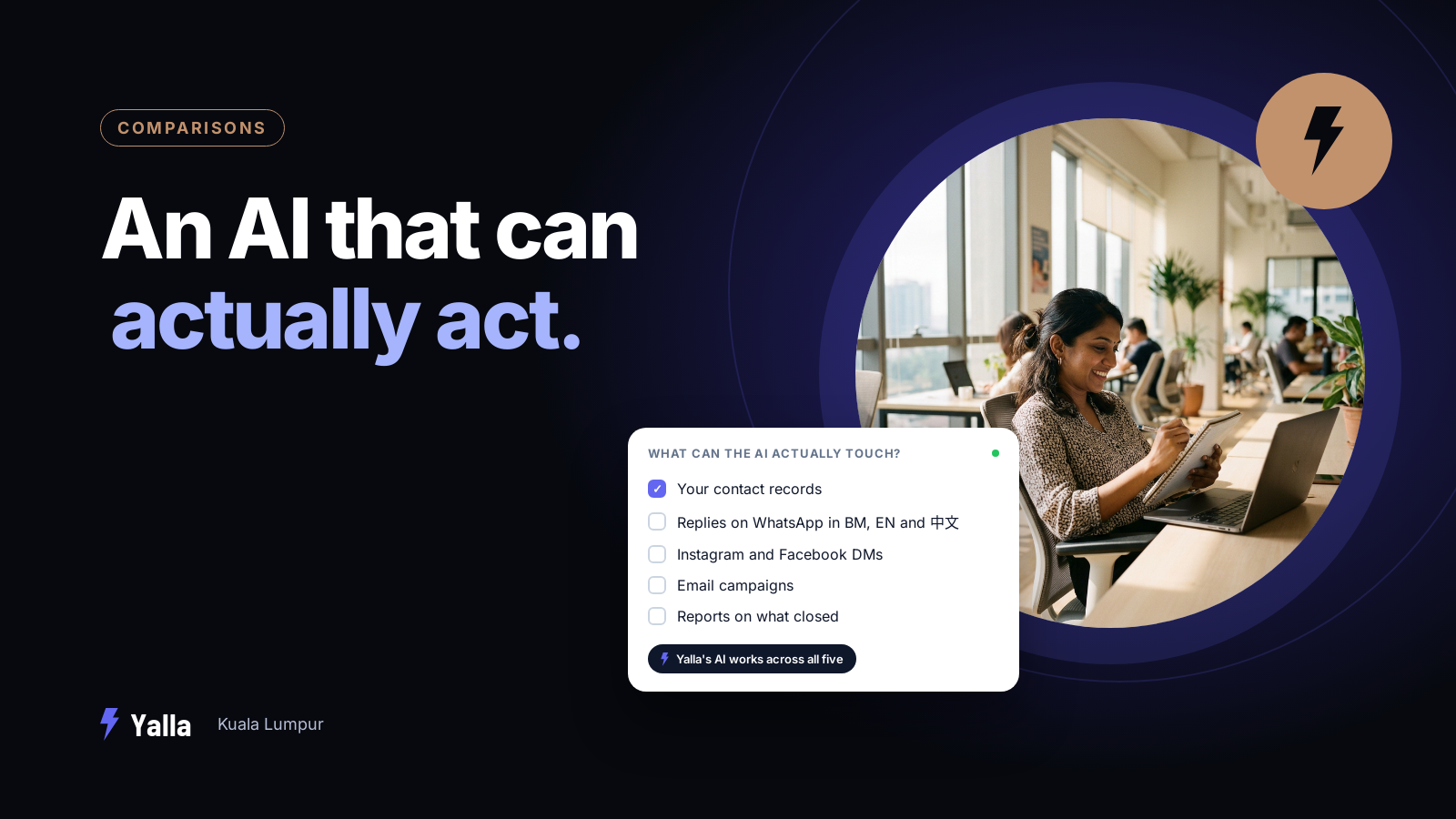
In 2026 every CRM ships an AI. HubSpot has one, Salesforce has one, Attio built its whole product around one, and Wati, Kommo and respond.io all have AI agents that answer WhatsApp messages. So "does it have AI" stopped being a useful question some time ago.
For a sales team in Kuala Lumpur, the useful question is what that AI can actually touch. Most enquiries here arrive on WhatsApp, Instagram and Facebook, often in a mix of Malay, English and Chinese, and they're handled by a small team who also have other jobs. An AI wired only to your contact records can tell you where last month's sales came from. An AI wired to your records, your WhatsApp, your social channels, your email campaigns and your reporting can do something about next month's.
The cost of choosing badly is real. The admissions office of an international school in the Klang Valley told us why they cancelled a well-known platform:
"We're only using one third of the functions and we're paying a lot of money for it."
And a bespoke furniture maker who spent a year having custom software built for his business gave it a one-line review: "Actually it's even worse than Excel."
This page compares eight AI CRMs by how much of the business their AI can act on. We call that reach.
What reach means
Reach is the set of systems an AI agent can read from and act on. It has three levels, and most CRMs only have the first:
- Read. Can the AI see the data? Nearly all of them can.
- Act on records. Can it update, score, route and build views without you configuring every step? Some can.
- Act on the business. Can it send the message, publish the post, run the campaign and build the report? Very few can.
The reason is architectural, not a question of how good the AI is. An agent can only act on systems its product actually contains. A CRM with no publishing has no agent that can publish. That's why reach predicts results better than model quality does: a great model attached to a narrow product is still a narrow product.
Free download
The AI CRM Shortlist Worksheet: Three Platforms, One Ringgit Answer
A practical companion to this article. Free for your email address.
Get it free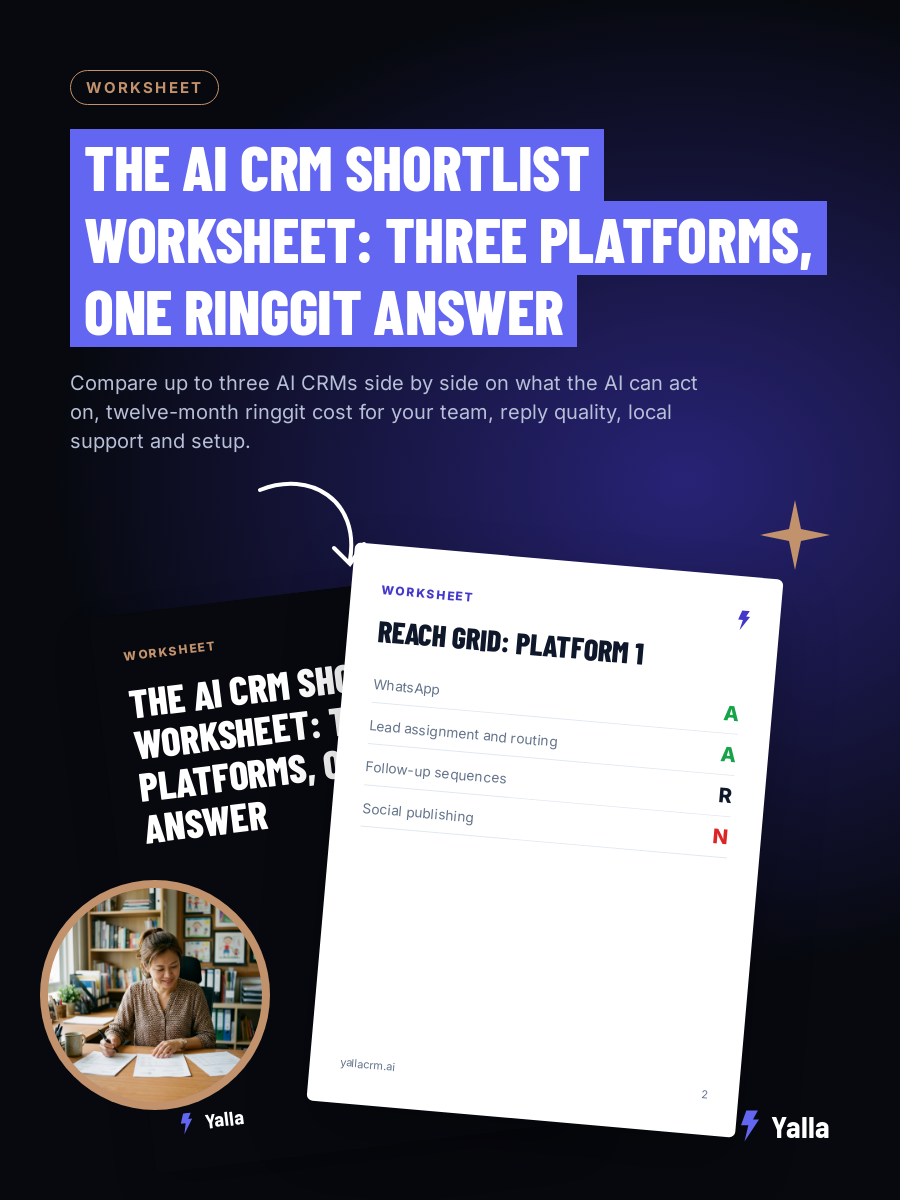
The comparison
| CRM | What its AI can reach | Best for |
|---|---|---|
| Yalla | Pipeline, WhatsApp, Instagram, Facebook, email marketing, social publishing, custom reporting | Teams whose revenue happens in chat and who want the AI to run the work, not only reply |
| Attio | Records, enrichment, scoring, routing, briefing, call intelligence | Technical B2B teams with email-led pipelines who want a flexible data model |
| respond.io | Omnichannel inbox, routing, workflow automation | High-volume support and sales teams across many messaging channels |
| Kommo | Messaging inbox, visual sales pipeline | Small sales teams that close in DMs and want a configurable pipeline |
| Wati | WhatsApp inbox, broadcasts | Businesses that need WhatsApp support and campaigns cheaply |
| HubSpot | Records, marketing and sales modules | Marketing-led teams already committed to HubSpot |
| Salesforce | Records, at enterprise size | Large organisations with compliance requirements and admin staff |
| GoHighLevel | Records, marketing modules, agency tooling | Agencies reselling a white-labelled marketing stack |
Yalla: the widest reach in chat-led sales
Reach: pipeline, WhatsApp, Instagram, Facebook, email marketing, social publishing, custom reporting.
Yalla Brain is an AI agent wired to every module in the platform rather than sitting beside one. Because the platform contains the channels, the campaigns and the reporting, a single instruction can cross all of them. Yalla Brain acts across pipelines, WhatsApp, Instagram, Facebook, email campaigns and reporting from one instruction.
Ask it where your sales are coming from and it builds the report, instead of you hunting for a dashboard someone set up last year. Ask it to follow up everyone who went cold after the Raya promotion and it works the pipeline and the WhatsApp threads together.
Where Yalla is not the answer: if your pipeline runs on email and calls rather than chat, a record-first CRM will fit you better. If you need a data model you define object by object, Attio is stronger. If you're an enterprise with procurement and compliance requirements, buy Salesforce.
Best for: businesses whose revenue happens in chat.
Attio: the strongest record-first agent
Reach: records, enrichment, scoring, routing, briefing, call intelligence.
Attio is the most serious agentic CRM built on a records-first design. Its data model is made of objects and attributes you configure yourself, rather than a fixed contacts-and-deals layout, and its agents handle enrichment, scoring, routing and briefing. It also exposes an MCP server, so other AI tools can act on the CRM.
The limit is architectural. Attio's agents act on Attio, and Attio is a system of record. There's no WhatsApp-native selling, no social publishing and no campaign layer for the agent to reach into. Its answer is breadth of access, reaching the CRM from Slack, Notion or ChatGPT, rather than breadth of action.
It also assumes you'll design the schema. That suits a technical revenue team. For an owner-operator in Subang with four salespeople, it's overhead.
Pricing is set in US dollars per seat, roughly RM120 a seat a month at current rates for the first paid tier, with a free tier for very small teams.
Best for: technical B2B teams with email-led pipelines.
respond.io: the deepest messaging operation
Reach: omnichannel inbox, routing, workflow automation.
The most capable pure conversation platform on this list: WhatsApp alongside Instagram, Messenger, TikTok and more, with AI agents that qualify leads and trigger workflows, and serious routing.
The limit is that it's a conversation platform rather than a business system. It has broadcasts and a reports module, but the reports are fixed dashboards of team and broadcast performance rather than a builder the AI can drive, and there's no social publishing or email marketing layer for the agent to act on. It also assumes someone will configure and administer it. Powerful in the right hands, but it makes you the operator of the system.
Entry pricing is set in US dollars, roughly RM330 a month at current rates, tiered on monthly active contacts.
Best for: high-volume teams with someone dedicated to running the platform.
Kommo: a pipeline attached to messaging
Reach: messaging inbox, visual sales pipeline.
Kommo puts a proper visual sales pipeline behind WhatsApp and other messengers, with lead stages and an automation builder. For a small team closing in DMs, the pipeline is a natural fit.
The AI is bot-and-automation shaped rather than agentic: it replies and triggers rules you've defined. And per-user pricing means cost climbs with headcount, which is the wrong direction if the point of the AI is that fewer people do manual work.
Best for: small sales teams willing to build and maintain a pipeline.
Wati: WhatsApp inbox and broadcasts
Reach: WhatsApp inbox, broadcasts.
Wati is a focused WhatsApp platform: shared inbox, no-code chatbot builder, broadcast campaigns and AI agents for repetitive conversations. Entry pricing is set in US dollars, roughly RM250 a month at current rates as of August 2026, on annual billing with three users and Meta's message charges billed separately. At that price it does the job well.
It's fundamentally an inbox and broadcast tool. The pipeline, the follow-up discipline and the rest of the operation stay manual or get wired together with integrations.
Best for: businesses that need WhatsApp support and campaigns cheaply.
HubSpot, Salesforce, GoHighLevel: AI added to a system built for typing
Reach: records and the modules the platform already had.
These are the platforms Attio built its argument against, and the argument holds. They were designed for people to type into, with AI added afterwards. The AI can summarise a record and draft an email, but the architecture underneath assumes a person doing the work and the software remembering it. WhatsApp usually arrives through an add-on or a connector.
GoHighLevel is the interesting case for breadth, because it does have marketing modules and channels. But its AI works on records and campaigns rather than running the whole stack from an instruction, and the platform is designed for agencies to resell rather than for an owner to run the business through.
Best for: teams already committed to the ecosystem, with the admin resource these platforms assume.
Questions worth asking a vendor in KL
Features on a comparison page only get you so far. On the demo, ask:
- Can the AI read and reply in Malay, English and Chinese, including a customer who switches mid-message? Test it with a real thread from your own inbox.
- What will it cost in ringgit for your team size and your busiest month, including AI credits and Meta's WhatsApp charges?
- Who helps you set it up? A tool your team never adopts is the most expensive one on the list, as that school found.
- What happens to a message at 11pm on a Saturday? Drafted for the morning, or answered and booked now?
How to score a CRM's reach yourself
Run this on any shortlist, including ours:
- List the systems your revenue actually touches: channels, campaigns, pipeline, reporting.
- For each one, ask whether the CRM's AI can act on it, or only read it.
- Ask what has to be configured by hand before the AI is useful at all.
- Ask whether pricing scales with seats. If the AI is meant to do the work, per-seat pricing charges you for the headcount it's supposed to save.
If the answer to step 2 is "records only", you've bought an assistant. If it covers the systems where your revenue actually happens, you've bought something closer to an operator.
FAQ
What makes an AI CRM different from a CRM with AI added?
Where the AI sits and what it can act on. Added AI sits beside a system designed for people to type into, and can usually only summarise or draft. A CRM built for AI is designed to be read and written by an agent, and the better test is how much of your business that agent can act on.
Which CRM has the most capable AI in 2026?
It depends what you need it to touch. Attio has the strongest agent for record-first work: enrichment, scoring, routing. Yalla has the widest reach across the systems where chat-led revenue happens: WhatsApp, social, campaigns, pipeline and reporting from one instruction.
What's the best WhatsApp CRM with AI for a Malaysian business?
Wati is the cheapest WhatsApp inbox with AI. respond.io is the deepest multi-channel messaging operation. Kommo adds a visual pipeline. Yalla is the one where the AI reaches past messaging into publishing, campaigns and reporting, so the follow-up actually gets done.
Is Attio a good alternative to HubSpot?
Yes, for technical B2B teams with email-led pipelines who want a flexible data model. If your revenue happens in chat rather than email, neither is the right shape.
Does an all-in-one CRM mean every module is worse?
Historically, often yes, which is why best-of-breed tools won and integrations filled the gaps. What changed is that an AI agent working across the whole stack connects the parts better than integrations did. Check whether the AI genuinely acts across every module, or whether "all-in-one" just means several products under one login.
Last verified: 11 August 2026. Ringgit figures are converted from US dollar list prices at about RM4.20 to the dollar. Pricing and features change often, so check each vendor's site for current figures.
Free download
The AI CRM Shortlist Worksheet: Three Platforms, One Ringgit Answer
A practical companion to this article. Free for your email address.
Get it freeYalla is the chat-native CRM where the AI does the work, not just the talking.
See how much of your business it can reach.