
Why CRM Rollouts Fail: Your Team Was Handed a Toolkit and Left to Build It
A KL school group, a hospital marketing team and a furniture maker all bought good software and still gave up on it. Why, and four questions to ask first.
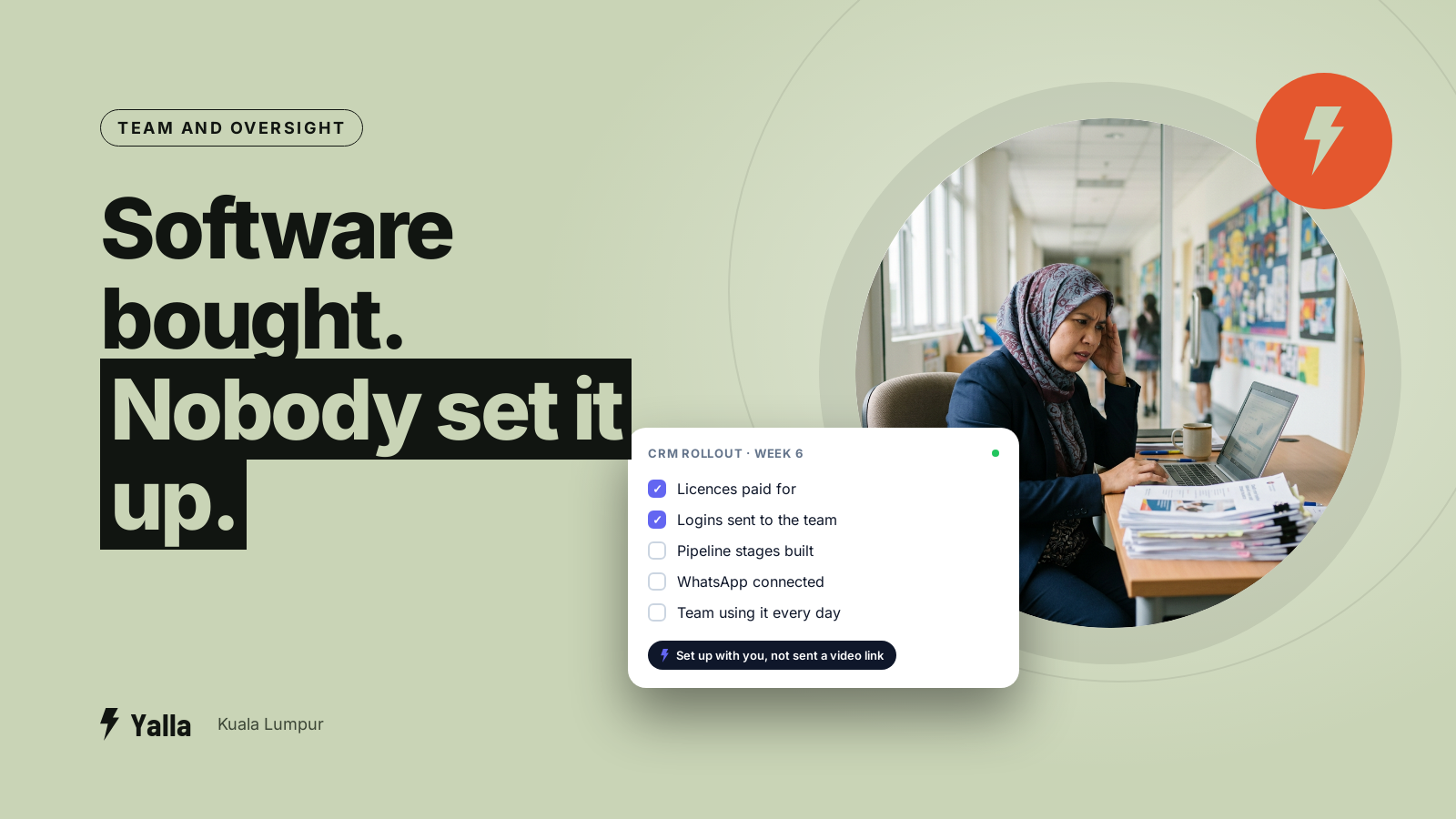
This is the story we hear more than any other on sales calls around KL this year, and hardly anyone in our category writes about it.
A marketing lead at a five-campus international school group in Malaysia, explaining why they were looking to switch CRM:
"We didn't quite get the support that we wanted at the beginning, so we were left in the dark without any support."
Then she reached for an analogy we still haven't been able to improve on:
"It's like an electrician job. You call an electrician, you would expect them to come with the tools and set it up for you or fix the problem. But it was different. When we explained that we have an issue, what they do is they just throw us tons of YouTube videos and PDF documents. Oh, this is how you can do it. Here you go, here's the resources. And you do it yourself, you fix it yourself."
And her conclusion:
"We're kind of fed up with that, because we pay a lot of money to them. And it's not that the tools aren't good, it's because we don't know how to use the tools that they have. We don't have the right guidance, we don't have the right support, and we had enough."
Read the middle of that again. It's not that the tools aren't good. She's explicitly not blaming the product. She's blaming the handover.
The same story from other businesses
A private hospital group we met through a BNI chapter, on a WhatsApp automation platform they'd tried before us: "The setup is quite challenging, because we have to set the workflow like, they ask this keyword, what might be our answer if they say that." We asked whether the vendor had helped build it. "No, we need to set it ourselves."
A bespoke furniture maker we met through BNI went further than most. He paid a software company to build him a costing system from scratch:
"So then two years ago I start to engage one software company to develop a software. Then of course that take another about a year time for them to understand the business, come up with the software."
"So last year about July, when we use the software, and I would say it's so un-user-friendly, then it takes up a lot of time."
"Actually it's even worse than Excel."
Two years from the first conversation to a system his team found slower than the spreadsheet it was meant to replace. His team still runs on Excel.
An independent travel agent, thirty years in the trade, on a marketing tool someone sold him: "They will teach us how to do it and ask us to post on our own, which I do not know how to post, and that's a lot of restriction. That's why I just forget about it."
That's why I just forget about it. That's what churn sounds like from the inside. Nobody sends a cancellation email. Someone quietly stops opening the tab, and the subscription keeps renewing for months.
Free download
The 30-Day CRM Rollout Plan
A practical companion to this article. Free for your email address.
Get it free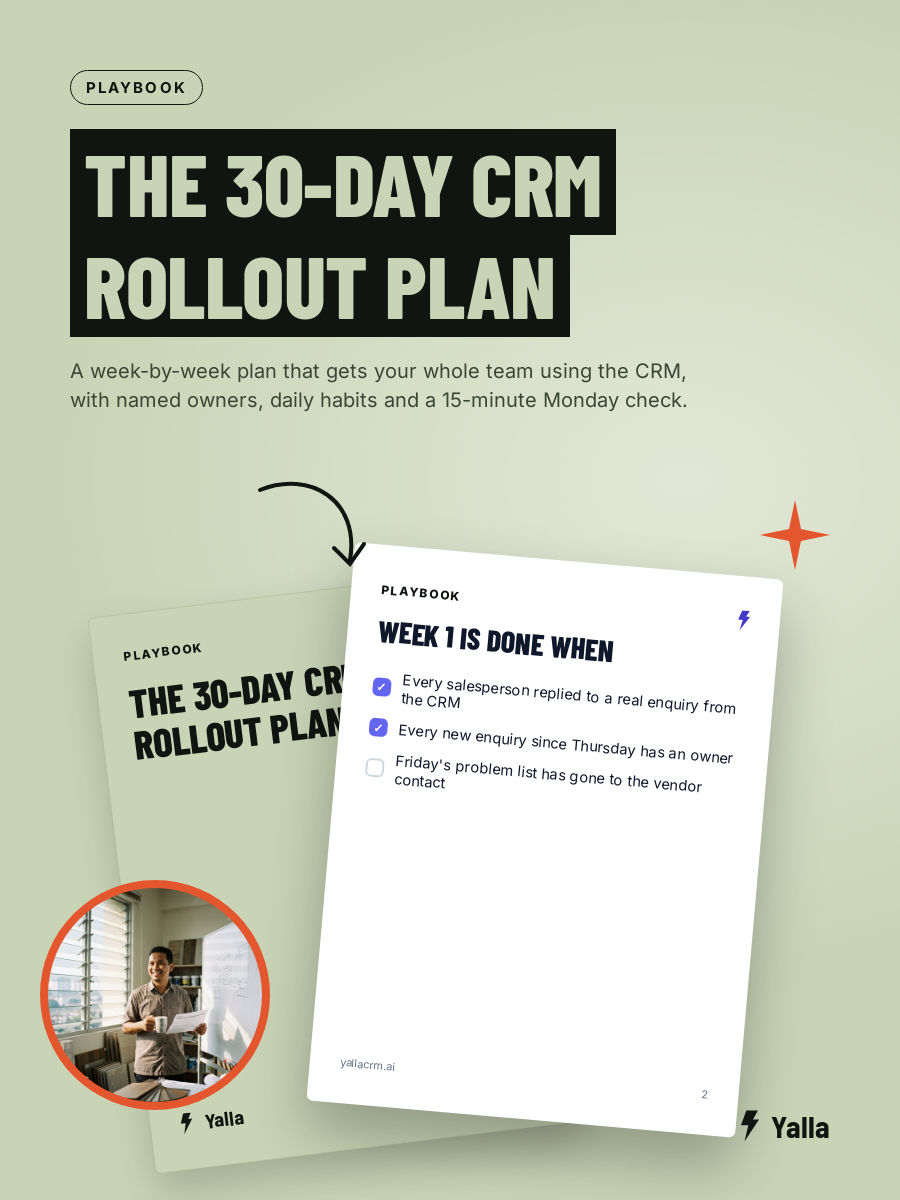
Why this keeps happening
Software companies are paid to ship a builder, because a builder sells to ten thousand customers with one codebase. Actually configuring a five-campus school's admissions pipeline, or a Petaling Jaya clinic's patient follow-up, serves exactly one customer.
So the industry solved its own problem and handed yours back to you, in the form of documentation, video libraries, certification courses and a community forum. All of it is useful. All of it moves the work from the vendor's side of the table to yours.
A company with an operations team can absorb that. An admissions office of four people can't, and neither can a hospital marketing team of three or a one-man travel agency. The school group told us plainly: "We're talking about non-technical... being not technical necessarily in our team to be using this. So it will definitely take some time."
They were right. It took so much time that they gave up and went shopping.
What it costs when the rollout stalls
The subscription is the visible part. Say you're paying RM400 a month for a platform, and a year in only one of your five salespeople logs in. You've spent close to RM5,000 on a tool that sits beside the spreadsheet your team actually uses.
The larger cost is the second attempt. A team that's been burned once is slower to trust the next system, and a manager who pushed the first one has less credit to spend on the second. Another international school in the Klang Valley described where that ends up, talking about an admissions platform it later cancelled:
"One of the biggest issues we have is we're only using one third of the functions, and we're paying a lot of money for it."
Paying full price for a third of the product is the most common end state we see, and it's usually a handover problem that got blamed on the software.
The tell, before you buy
Ask these during the sales process. The answers tell you more than the demo does.
- "Who builds the first version, you or us?" If the answer involves the word "enablement", it's you.
- "What happens when it breaks in month four?" Month one, everyone's attentive. Month four is the real answer.
- "Can I speak to a human?" The head of edtech at that five-campus school group told us, in the middle of a demo: "I was hoping that it's a real human, because everything is AI. We will get frustrated. Like, can I get to talk to a real human?" She was evaluating an AI product at the time. She wasn't contradicting herself. She was stating a requirement.
- "What share of what you're showing us will we actually use?" Then ask them to show you only that part.
What a decent handover looks like
None of this needs a big consultancy project. For a team of five to fifteen people, a handover that works usually has four parts:
- Your first pipeline is built with your data. A demo account full of sample contacts teaches your team nothing about their own week.
- Real enquiries go through it in the first week, while the vendor is still paying attention and can fix what breaks.
- There's one named person on their side. You should be able to message them directly, and know roughly how fast they'll answer when something stops working.
- Someone checks usage at month three. Whether the software is up matters less than whether your salespeople are actually logging in, and who's gone back to their own phone and a spreadsheet.
If a vendor can't describe their version of those four, you already know how the rollout will go.
The uncomfortable part
Every vendor reading this, us included, has to answer for it. So here's our position.
Setup work that a customer can't do themselves has to be done by someone, and that someone costs money. A vendor who says otherwise is subsidising it for now, hiding it in the price, or about to send you a video library. Implementation labour always exists. What matters is which side of the table it sits on, and whether anyone said so out loud before you signed.
For a KL business with a small team, the honest test is simple. If nobody on your side has a spare afternoon a week for the first two months, you need a vendor who'll build the first version with you, sitting in your office if that's what it takes. If you do have that person, a good builder might be exactly right, and cheaper.
Ask us the four questions above. Ask everyone else too.
Free download
The 30-Day CRM Rollout Plan
A practical companion to this article. Free for your email address.
Get it freeYalla is the chat-native CRM where the AI does the work, not just the talking.
See how much of your business it can reach.