
You Already Paid for the Customer Database Your Team Isn't Using
KL businesses sit on years of past customers they never contact. Four ways a database goes dead, and a plan to wake it up that starts with 200 contacts.
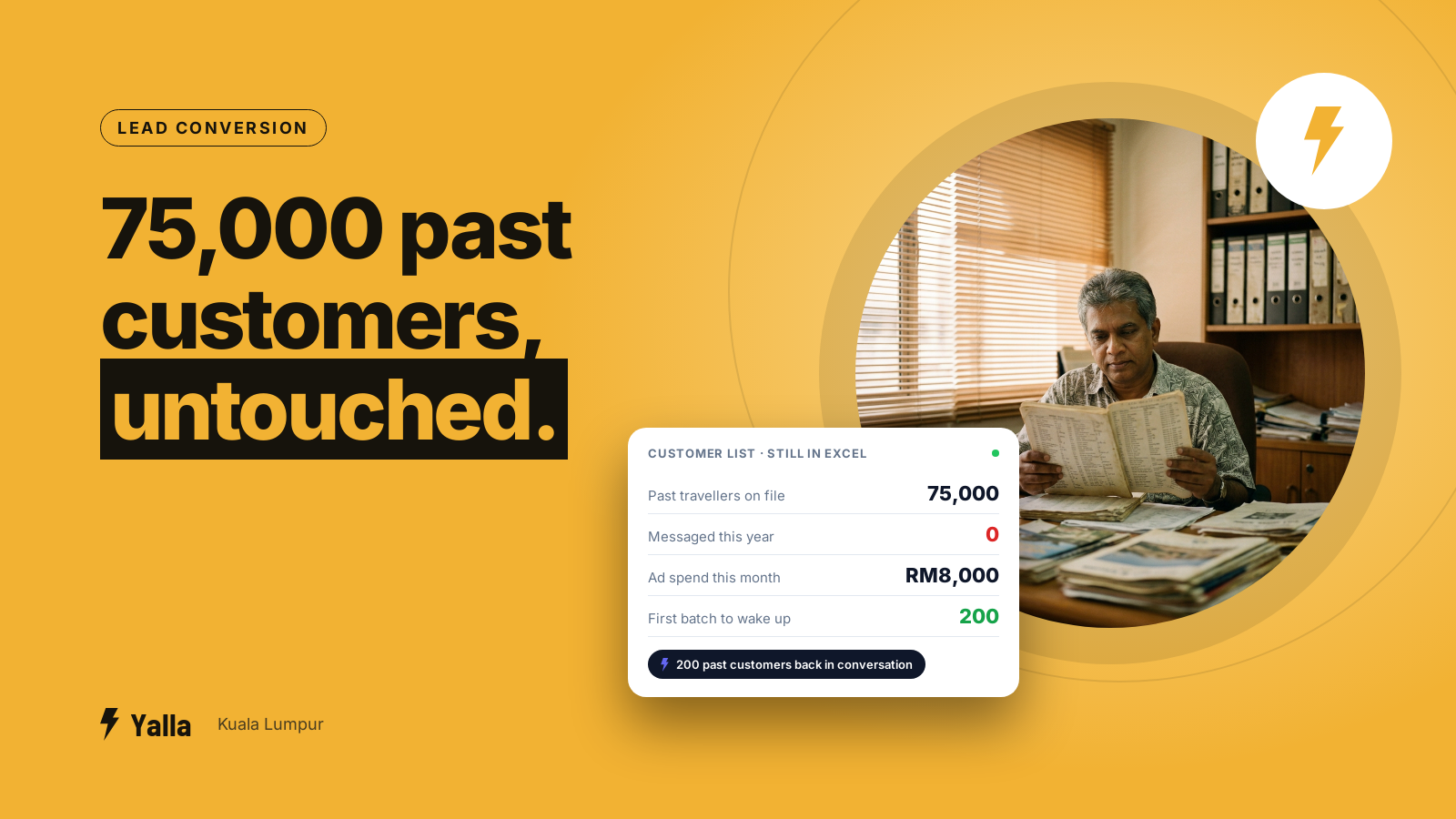
A travel agency told us they had 75,000 contacts.
Eighteen years of travellers. People who had already trusted them with money, already been somewhere, already come back or not. For a business that age, it's the most valuable marketing asset it owns.
We asked what state the data was in.
"I mean, they are in Excel."
And a moment later, from a colleague:
"It's not arranged."
Seventy-five thousand relationships in a spreadsheet, unarranged. Present, paid for, and unusable, which in some ways is worse than losing them.
Picture the owner of a fifteen-person business in Subang spending RM8,000 a month on Facebook and Instagram ads to find new customers, while a list of people who already bought from her sits untouched in Excel or a clinic system. It's a common shape around the Klang Valley, and it's an expensive one.
The four ways a database goes dead
We've now seen this in four distinct forms, and each needs a different fix.
Too messy to import. The travel agency above. The data exists, but the columns don't agree, phone numbers are in five different formats, and duplicates are everywhere. Every migration attempt stalls on a clean-up nobody has time for.
Locked in the wrong system. A private hospital group we met through a BNI chapter keeps its patient records in a clinical system, which is excellent at being a clinical system and can't run a campaign. Their marketing lead: "If we require to send email, we have to download the system manually and use it. Send it manually." The list is right there. Getting it out means a manual export, every single time. She wasn't short of patients to talk to, either: "We need to link with our patient database where we have thousands of patients... follow up with them, create an engagement until the event day so that we can keep them, refresh their mind, so that they will not miss."
Scattered across files nobody can trace. A bespoke furniture maker we met through BNI runs his costing and his supplier history on spreadsheets, and he's content with that, up to a point: "So we have been using Excel, we are happy with Excel. But the issue is Excel in the long run, you have 10, 20 files, then it's all not traceable." The same happens with what lives in chat: "Sometimes we have issue like, we screenshot one photo, send to the vendor and say that hey, what is the estimate price for this? Then maybe six months later or even eight months later, then we ask the similar thing. All this is a bit difficult to trace." The information exists. Nobody can find it when it matters.
Complete, and simply never used. The most painful version. A budget hotel operator: "I have their numbers, I know their names, I knew when they checked in, et cetera. But there is no follow-through after that to touch base with them." Nothing is broken. Nobody ever got round to it.
Free download
The Past Customer Reactivation Kit: Who to Message First and What to Say
A practical companion to this article. Free for your email address.
Get it free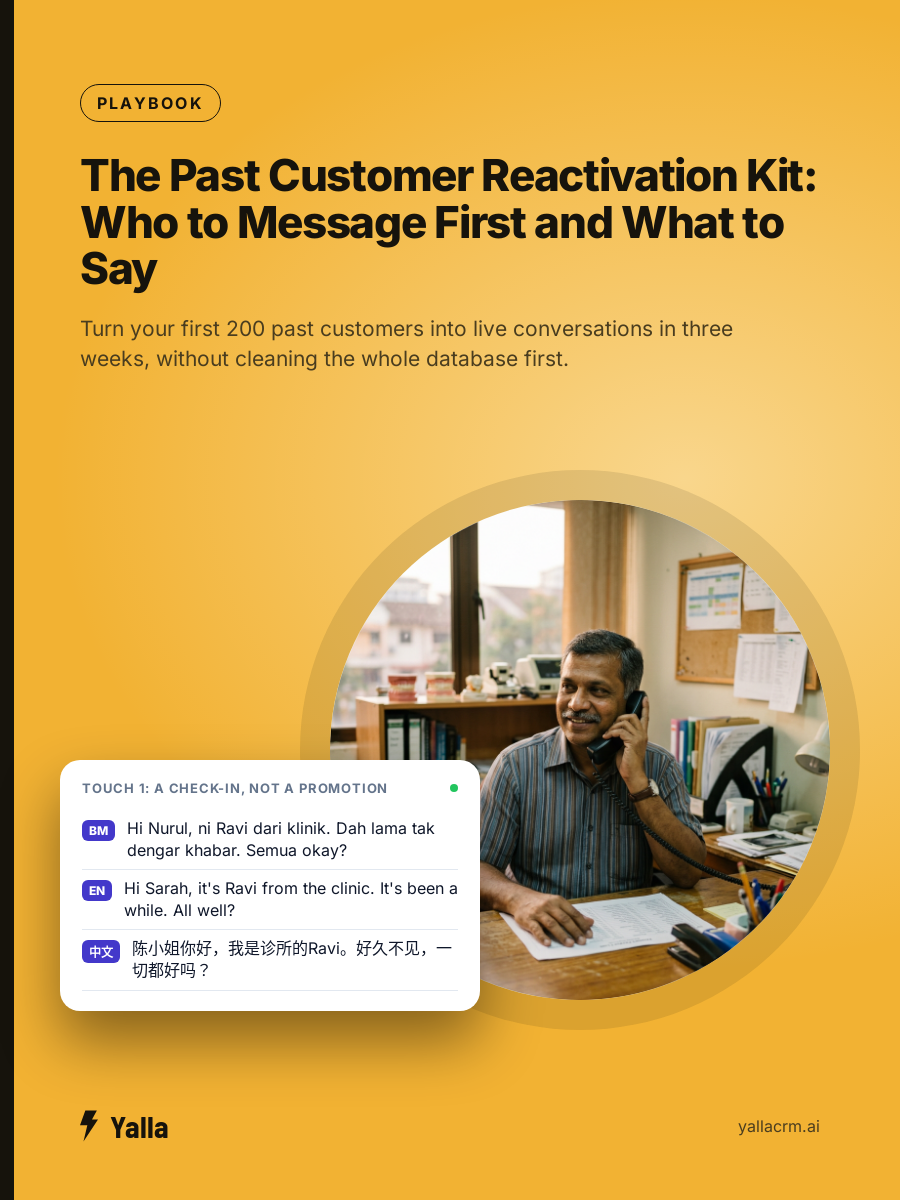
Why "just import it and start messaging" fails
The reason it hasn't happened is almost never technical. The people who would do it are the people doing everything else.
The travel agency again, on why their setup kept stalling: "Because I told them, can we update this after office? Because we're doing the sales as well." And: "I didn't get time to attend this onboarding, because in the daytime I have clients to deal with."
That's the defining constraint of a service business with ten or twenty staff. There's no admin layer. The person who would configure the system is the person bringing in the revenue, and revenue wins every time, which is the correct call.
So any plan that begins "first, clean 75,000 rows" is really a wish.
A sequence that actually gets started
This is ordered so that value turns up before the boring part.
1. Don't clean it. Take one slice. Pick the 200 most recent customers. Recent data is cleaner, and recent customers remember you. It's a morning's work.
2. Send one thing that isn't a promotion. For a hotel, a note asking how the stay was and whether they're planning another trip. For a school, an update on the application. For a clinic, a reminder that a follow-up is due. You want a reply, because a reply turns a dead row into a live conversation and proves the number still works.
3. Write it in the language they used with you. A Klang Valley list is usually a mix of Malay, English and Chinese speakers. If the original enquiry came in Malay, the first message back in two years should too. It costs nothing, and it reads like it came from someone who remembers them.
4. Let the replies clean the data. Every response confirms a contact. Every failed delivery marks a dead one. You're now cleaning the database as a side effect of using it, instead of as a condition for starting.
5. Segment before you go wider. One message for everyone rarely works. Split what's left by what they bought, when, and how they found you, and write a different follow-up for each group. With one slice proven and a working process, the remaining rows become a volume question rather than a risk.
6. Fix the intake so it stops happening. The database got messy because nothing captured contacts properly at the point of contact. The hospital group's sign-ups ran from WhatsApp, to a Google Form, to manual re-registration: "So when they sign up we have to refer that Google form and manually register... So they have to register in the hospital system. So that's manual." Three systems, two manual steps, every patient. Until that's closed, you're bailing out a boat with a hole in it.
Picture what this means for a clinic in Puchong. If its ads cost RM40 for each new patient enquiry, then even a handful of past patients booking a check-up from one polite message is the cheapest marketing it will do all quarter.
One honest warning
The hospital group ran into a wall when they tried exactly this. Their marketing lead: "Number of WhatsApp being sent out, they have limit." And then the question behind it: "More than 200 it will be blocked, right?" A travel agency, separately: "We can't use that number in the ads. One time we tried two different ways, but it got blocked later."
Waking up a dormant database means messaging lots of people who haven't heard from you in a long time, which is precisely the pattern that gets business numbers restricted. Outside WhatsApp's 24-hour window you also can't send free-form messages at all. You need approved templates, sent through the official Business Platform, to people who've agreed to hear from you. Doing this without understanding the rules is how businesses lose the channel they were trying to bring back to life.
Honest assessment
- If your contacts are more than about three years old and you've never messaged them, expect a low response rate and some annoyance. Consent and recency matter, legally under Malaysia's PDPA and practically.
- Thin data can't be enriched by software alone. If all you recorded was a name and a phone number, fix how information is captured from now on rather than hoping a clever tool can fill it in backwards.
- This has a ceiling. A dormant database gives you a one-off windfall and a modest ongoing lift. It won't replace generating new demand.
Free download
The Past Customer Reactivation Kit: Who to Message First and What to Say
A practical companion to this article. Free for your email address.
Get it freeYalla is the chat-native CRM where the AI does the work, not just the talking.
See how much of your business it can reach.