
Leads Stuck Between the Chat and the Pipeline? A Gallabox Alternative for KL Teams
For KL teams that have outgrown Gallabox's inbox and bot flows: what it does well, when to stay, what to compare, and what switching actually involves.
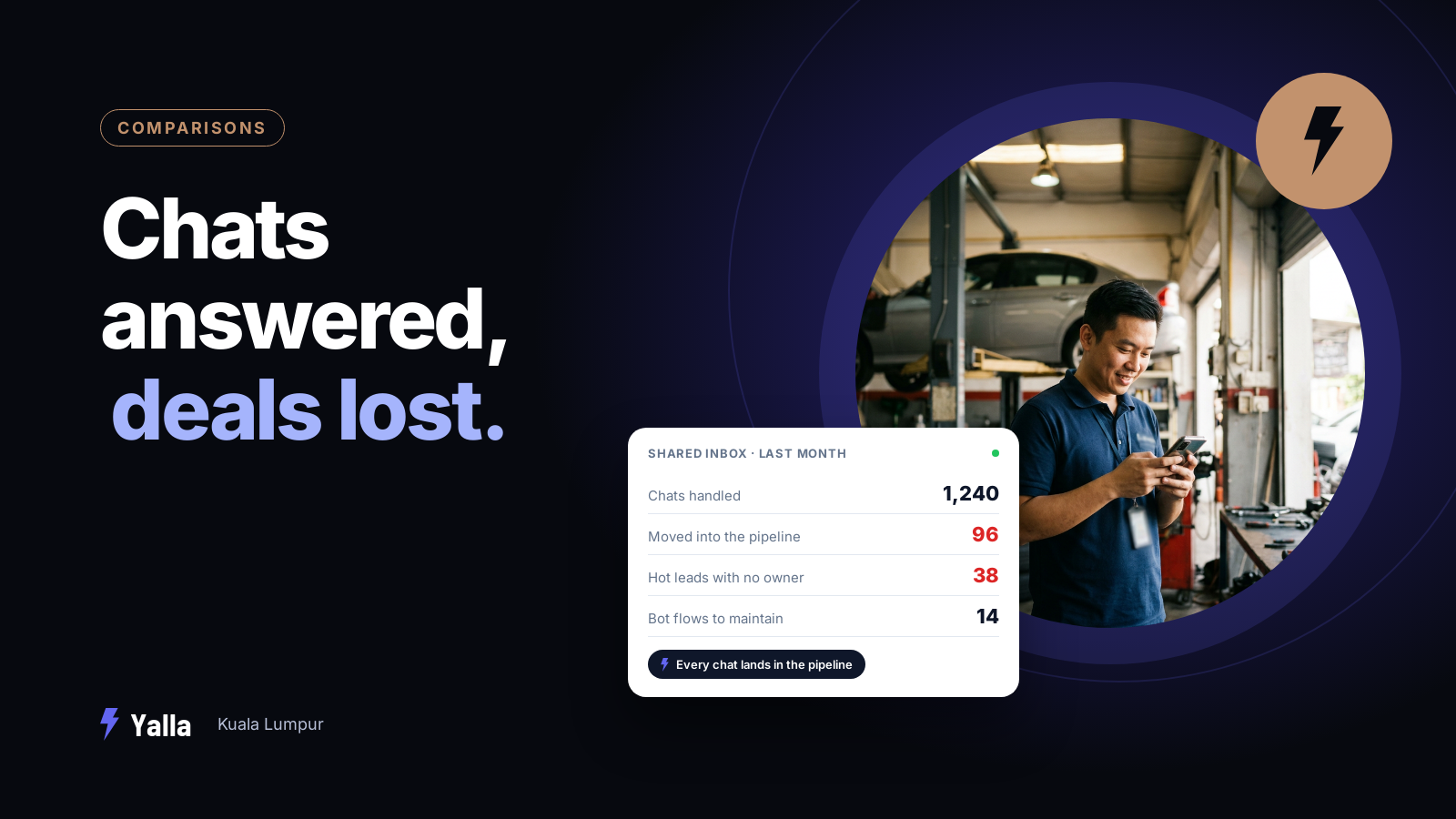
If your team has run on Gallabox for a year, you already know the category. You know what a WhatsApp shared inbox is, you've built at least one no-code chatbot flow, and you've sent broadcasts to a contact list. You aren't shopping for an education. You're shopping for a decision: renew, or move.
This is written for a KL team that has used a WhatsApp platform long enough to feel its edges. Say a car accessories dealer in Shah Alam, or a travel agency in Cheras with four consultants answering the same number. It covers what Gallabox is good at, why teams start looking elsewhere, what to compare, and when the right answer is to stay where you are.
What Gallabox is, and what it's good at
Gallabox is a WhatsApp Business API platform built around a shared team inbox, a no-code chatbot builder, broadcast campaigns, and WhatsApp commerce features like catalogues and order flows. As of August 2026 it sits in the same category as WATI, respond.io and Interakt: software that puts a WhatsApp number into a multi-agent inbox and layers automation and campaigns on top.
What it does well is real. For a small team living inside WhatsApp, getting off a single phone and into a shared inbox where several people can answer, tag and route conversations is a genuine upgrade. Anyone who has watched staff pass one handset around the office knows why. The bot builder lets non-technical staff put together a qualifying flow without a developer, and the broadcast tooling turns a contact list into a campaign channel. If that's the whole job, Gallabox does the whole job.
The fairest description of its category is a WhatsApp engagement layer. It's very good at the conversation and the campaign. What a switcher is really asking is whether the conversation is the whole business, or just the front door to it.
Free download
Switching Your WhatsApp Platform? The Migration Planning Checklist for KL Teams
A practical companion to this article. Free for your email address.
Get it free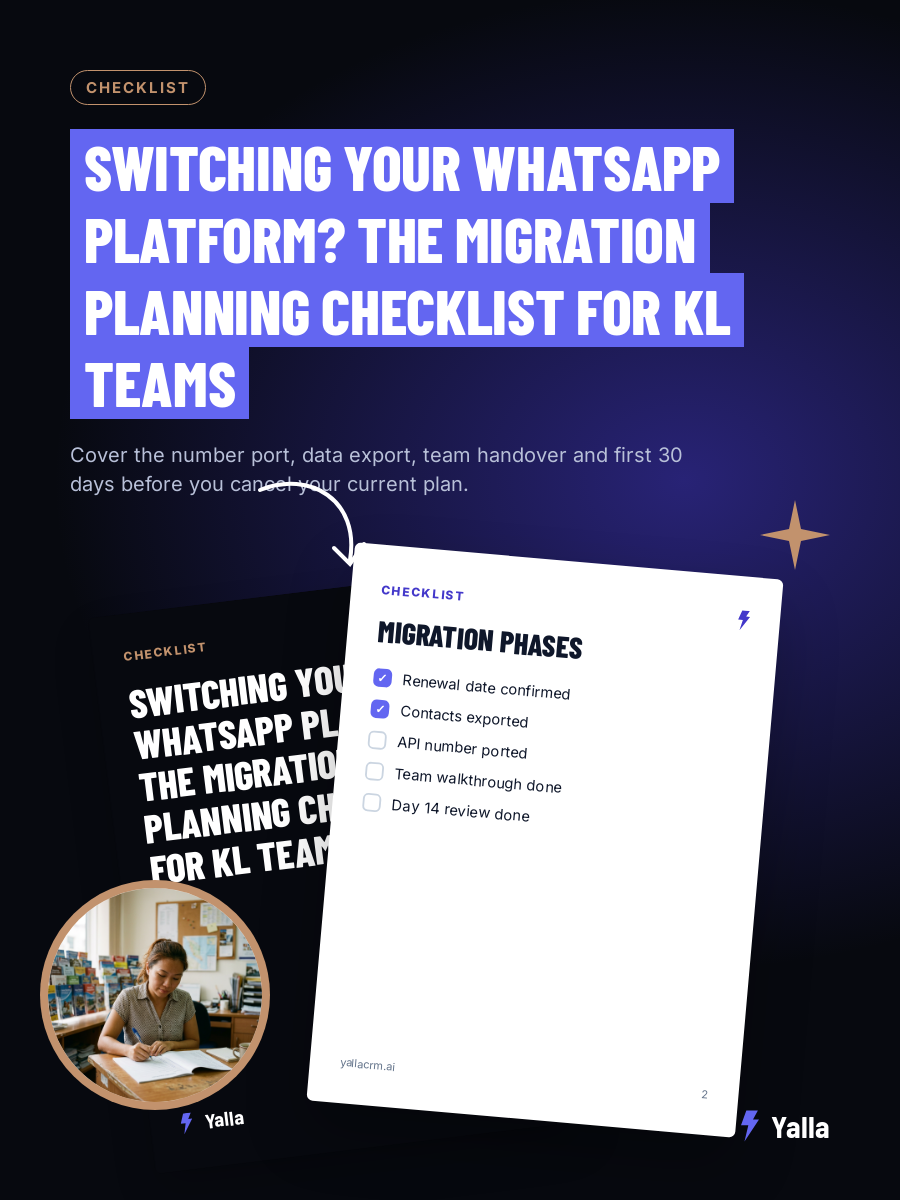
Why teams start looking for a Gallabox alternative
Teams rarely leave a WhatsApp inbox because the inbox is bad. They leave because the work grew past it. A few patterns come up again and again.
The gap between talking and doing. A WhatsApp engagement tool captures and replies to conversations well. But once a qualified lead needs to move into a pipeline stage, get an owner, receive a follow-up sequence and appear in a revenue report, you're often reaching for a second system or exporting data by hand. The conversation lives in one place and the deal in another.
Channel sprawl. A business that started on WhatsApp adds Instagram DMs, then Facebook Messenger, then email campaigns. A tool built mainly around WhatsApp can bolt these on, but they tend to feel like separate rooms rather than one desk.
The automation ceiling. A no-code bot flow is excellent for a fixed script. It's much weaker when a customer writes something the script didn't expect, which in KL happens constantly. A buyer switches from English to Malay halfway through, sends a voice note, or asks two questions at once. Scripted flows break on that. You want software that reads what the customer actually said, decides what should happen, and acts across more than one system without a person relaying the instruction.
None of this is a knock on Gallabox specifically. These are the natural edges of any tool whose centre of gravity is the WhatsApp conversation rather than the whole customer record.
What to compare when leaving Gallabox
The reflex is to compare feature lists and monthly prices. That's the wrong test, because in 2026 the feature lists have largely converged and every serious tool advertises an AI. How much of your business that AI can reach is where they differ.
So compare on coverage. Put one blunt question to any alternative: once a customer sends a message, how much can the software do next on its own, without a person copying information between screens? Can it move the deal, assign the owner, send the follow-up, update the report and message on the next channel from a single instruction? Or does it hand you a nicely captured conversation and stop?
That's the difference that survives a busy sales week. A brilliant reply tool wired to one channel loses to an ordinary one wired to everything, because most of what a small business needs done sits in the gaps between tools.
Gallabox or a chat-native CRM: the real difference
Gallabox is a WhatsApp platform with CRM-like features around the edges. A chat-native CRM inverts that. The customer record and the pipeline are the centre, and the chat is how the record gets created and moved along. It sounds like a small distinction. In daily use it decides almost everything.
Yalla is a chat-native CRM where the AI does the work as well as the talking. In practice an instruction doesn't stop at the reply box: Yalla Brain acts across pipelines, WhatsApp, Instagram, Facebook, email campaigns and reporting from one instruction. A WhatsApp engagement layer can't easily match that coverage, because its job was always the conversation rather than the system behind it.
| What you're comparing | WhatsApp engagement platform (Gallabox category) | Chat-native CRM (Yalla) |
|---|---|---|
| Centre of gravity | The WhatsApp conversation | The customer record and pipeline |
| Where the deal lives | Often a separate CRM or a manual export | In the same system as the chat |
| Multi-channel | WhatsApp-first, others bolted on | WhatsApp, Instagram, Facebook and email as one desk |
| Automation model | No-code scripted bot flows | AI that reads intent and acts across systems |
| Reporting | Conversation and campaign metrics | Pipeline and revenue reporting from the same data |
Read the table as a shape rather than a scoreboard. If the WhatsApp conversation genuinely is your whole business, the left column is a fit.
When Gallabox is still the better choice
Switching is often the wrong move, so here's when.
Stay with Gallabox, or something like it, if the WhatsApp conversation is the entire job and you don't run a real pipeline. If your team answers enquiries, sends the occasional broadcast and closes inside the chat without stages, owners or forecasts, a full CRM is weight you won't use.
Stay if your workflow is commerce-led inside WhatsApp, with catalogues and order flows at the core, and you've no plans for structured sales or multi-channel campaigns. That's close to what the category was built for.
And to be even-handed: Yalla isn't the universal answer. If your pipeline is email-led and document-heavy, a record-first CRM like HubSpot or Salesforce will serve you better. If you need a highly custom data model with bespoke objects, Attio is built for that. If enterprise compliance and procurement dominate the decision, Salesforce is the safer institutional choice.
Switch when the conversation has become the front door to a business that has outgrown one channel and a scripted bot, and when copying information between an inbox and a CRM has started to show up as leads that went quiet and deals nobody owned.
What switching actually involves
The two real costs of leaving any WhatsApp platform are the number and the history.
Migrating a WhatsApp Business API number between providers is a defined process as of August 2026, but it needs planning so you don't lose messaging continuity, and you should confirm the current steps with both your old and new provider before you commit. Exporting contacts and conversation history is the second job, and it's worth doing before a renewal locks you in for another term.
Then there's the one nobody talks about: whether your team will actually use the new thing. A system can win on every line of the comparison table and still lose if it's slower for the people answering the number all day. Picture the Cheras travel agency moving its four consultants across. If replying to a customer now takes three clicks instead of one, they'll drift back to their own phones within a fortnight, and the owner will be paying for a CRM nobody opens.
So during the trial, have the people who answer the WhatsApp number every day run real enquiries through it, and listen to what they say. If the new system is slower for them than the old one, the migration hasn't paid for itself, whatever the feature list says.
The automation rebuild is usually easier than switchers fear. Moving from scripted bot flows to an AI that reads intent tends to mean rebuilding less, because you're replacing a maze of branching scripts with plain instructions about what should happen. Fewer flows to maintain is part of why people switch in the first place.
Time the move to a renewal date, not a busy week, and run the two systems side by side for a short overlap so nothing drops between them.
FAQ
Is Gallabox a full CRM?
As of August 2026, Gallabox is best described as a WhatsApp engagement and commerce platform with CRM-like features. It centres on the shared inbox, chatbots, broadcasts and WhatsApp catalogues. Teams that need pipeline stages, deal ownership and revenue reporting in the same place as the chat often pair it with a separate CRM or move to a chat-native one.
What's the best Gallabox alternative for a team that runs a real sales pipeline?
If your team qualifies leads and moves them through stages rather than closing entirely in the chat, a chat-native CRM is the closer fit, because the conversation and the deal live in one system. Apply the coverage test: how much can the software do after a message arrives, without a person copying data between screens?
Do I lose my WhatsApp number and chat history if I switch?
Not if you plan the move. A WhatsApp Business API number can be migrated between providers, and contacts and history can be exported, but confirm the current process with both providers first and schedule the switch around a renewal date rather than a busy sales period.
Is a chat-native CRM overkill if we only use WhatsApp?
It can be. If the WhatsApp conversation really is your whole business, with no pipeline, no multi-channel campaigns and no revenue reporting, a lighter WhatsApp engagement tool fits better. The move makes sense once the chat has become the front door to a business that also runs Instagram, Facebook, email and a structured pipeline.
Free download
Switching Your WhatsApp Platform? The Migration Planning Checklist for KL Teams
A practical companion to this article. Free for your email address.
Get it freeYalla is the chat-native CRM where the AI does the work, not just the talking.
See how much of your business it can reach.