
Nobody's Job Is Remembering the Follow-Up
Most lost leads were interested and nobody was reminded. What happens to KL businesses when follow-up rests on memory, with real admissions numbers.
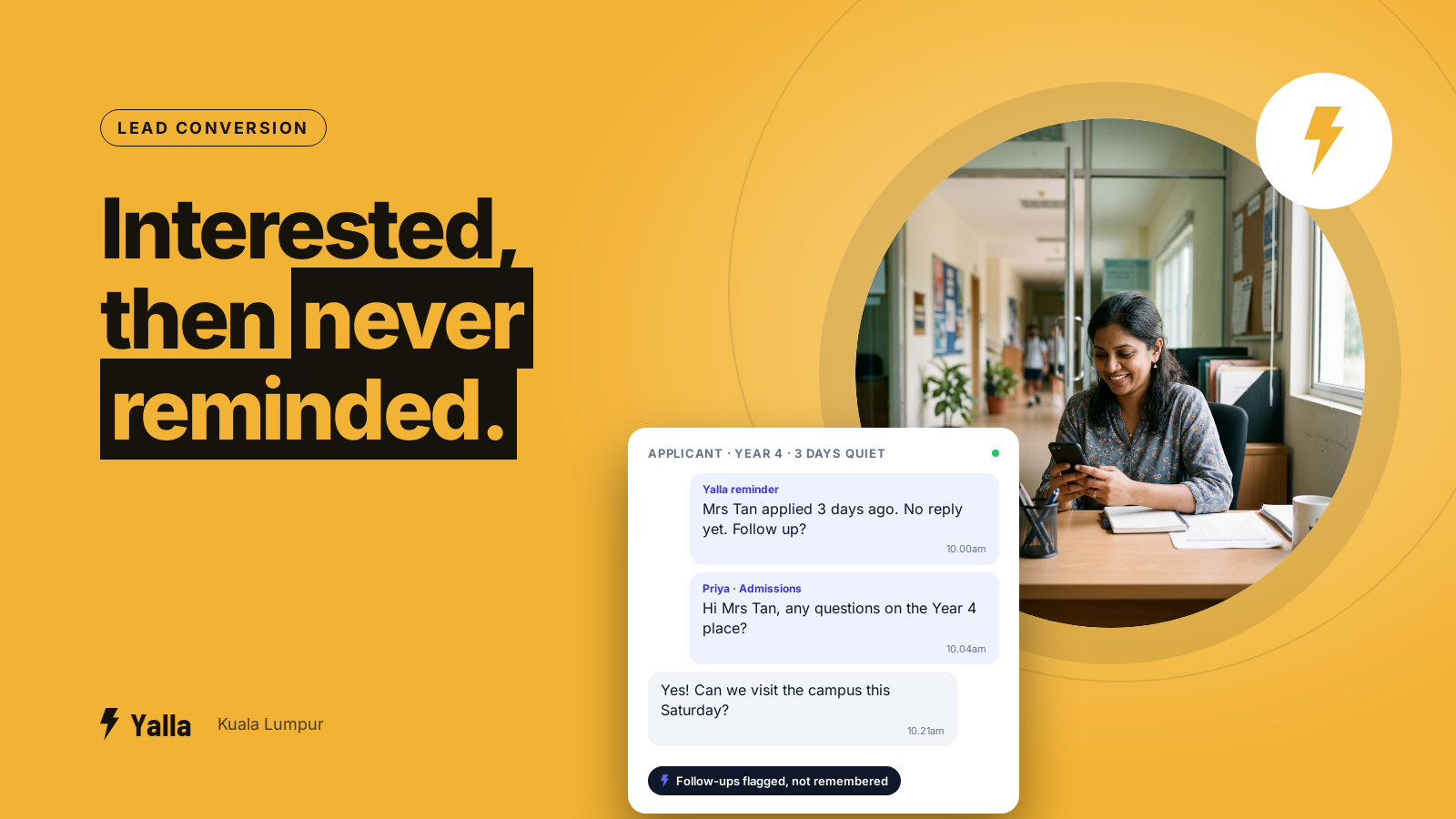
Ask a KL business owner why they lose customers and you'll usually hear about price, or competition, or bad timing.
Then you look at the pipeline, and the truth is duller and much easier to fix.
An admissions manager at an international school in Malaysia, describing where applicants go:
"There are people in this stage of application that we could follow up better. But because you do not have that visibility or a reminder... for example, notification, this person has applied at this time, has it come back to us? If a system could do that, normally it can notify: it has been three days, do you want to follow up? Those kinds of things."
Nobody lost interest. Nobody was reminded.
Schools happen to be where we have the clearest evidence, but the pattern is the same in a Bangsar clinic, a Puchong renovation contractor or a property agency in Mont Kiara. Somebody raised their hand, somebody on your team meant to get back to them, and the only thing standing between the two was a person's memory.
The number nobody wants to say out loud
At a five-campus international school group in Malaysia, we asked where applicants drop off. The answer:
"It drops off about... it ranges probably about 50%, 40%."
Where? "After initial inquiry. At the very beginning."
Four or five in every ten people who raised their hand disappear at the first step. And here's the part worth sitting with: he described this as normal for the sector. "I believe it's quite similar to the same industry as well."
He may well be right. Which would mean a whole industry has got used to losing close to half its interested prospects at the earliest and cheapest point to save them.
Put ringgit on it for your own business. Say you spend RM5,000 a month on ads and events and it brings in 100 enquiries. If 40 of them vanish before anyone has a proper conversation, RM2,000 of that spend never had a chance. Your numbers will be different. The shape usually isn't.
Free download
The Follow-Up Reminder Rules Template: Five Rules to Switch On This Week
A practical companion to this article. Free for your email address.
Get it free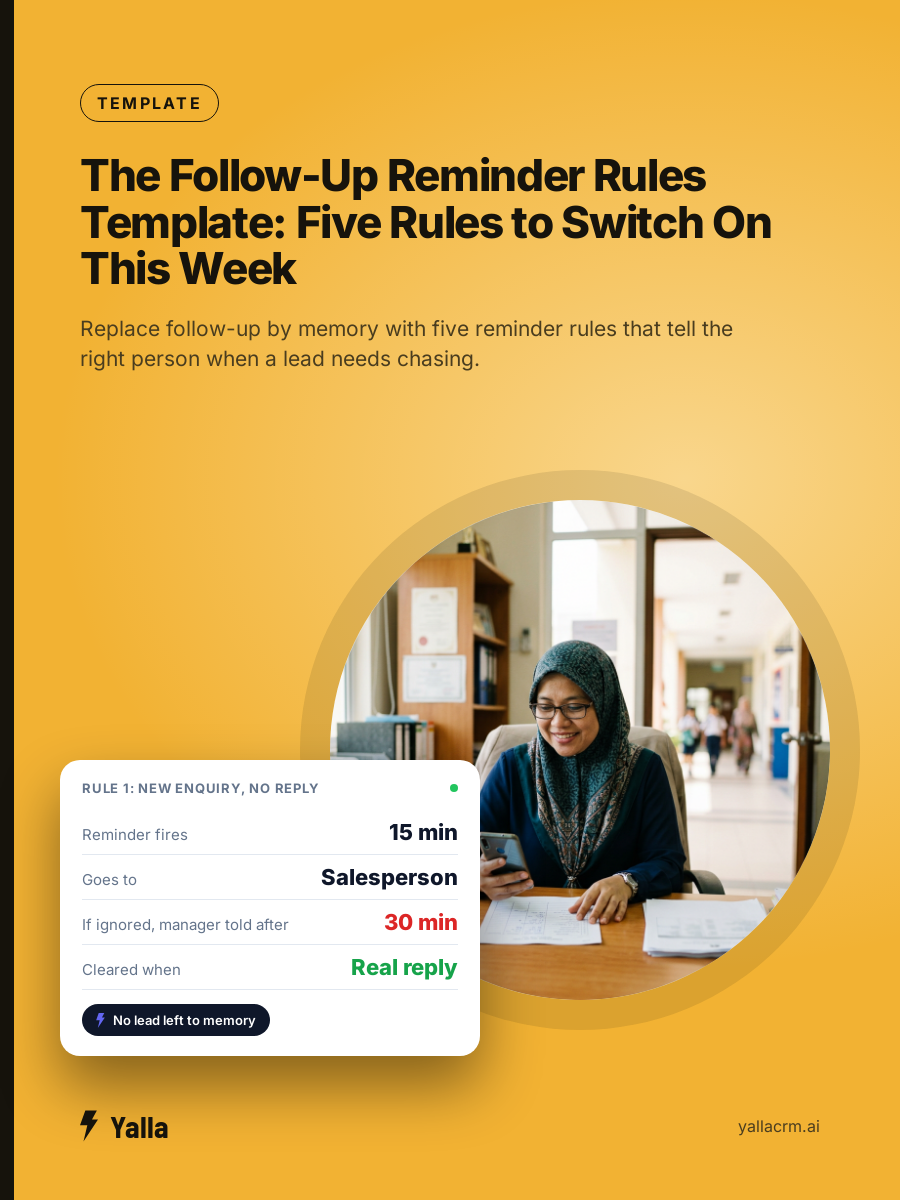
What following up actually rests on
At the same school group, we asked what moves a lead from one stage to the next. The answer wasn't a workflow:
"We don't move them along. So we have certain SLAs in place at different stages. If it doesn't move or it doesn't get picked up within a certain period of time, the owner of that week gets a problem."
Read that carefully. Nothing moves the lead forward. There's a person who's supposed to remember, and a consequence if they don't. The system is a person, and the backup system is a telling-off.
This isn't a criticism of that team. They'd built the most sensible process they could with the tools they had. It's an observation about what happens when memory is holding up the whole structure.
Two more shapes of the same problem came up in our admissions conversations.
The lead who says they never enquired. "We come across leads which will say, oh, I didn't submit an inquiry. Or there are times when we try to reach out to them, there's no response." When the first contact comes days after the form, the prospect has genuinely forgotten. Delay does more than lower your chances. It makes you sound like a cold caller.
Warm but not ready has nowhere to live. "We call them and they say, oh yes, I am keen on the school tour, I'm not ready to book a slot yet. So where does that update happen?" This is the most valuable state a prospect can be in: interested, just not yet. In most service businesses there's no field for it, so it lives in someone's head until it doesn't.
How this plays out outside schools
The same three leaks show up everywhere. Some illustrations, not case studies:
- A clinic in Bangsar gets a WhatsApp enquiry about a health screening package. The receptionist replies with prices and the chat goes quiet. Nobody's job is to check back in a week, so nobody does, and the patient books somewhere near their office in KL Sentral.
- A renovation contractor in Puchong sends a quotation after a site visit. The homeowner says they'll discuss it with their spouse. The quote sits in a PDF on one salesperson's phone. Three weeks later he's on leave, and the homeowner signs with someone else.
- A property agent in Mont Kiara meets a buyer at a viewing who says they're keen but waiting on a loan approval. That fact is in the agent's head. If the agent moves on, it leaves with them.
None of these are about effort. Everyone involved was working hard. What was missing was a prompt at the right moment.
The diagnostic
Three questions. They're uncomfortable on purpose.
- What happens to an enquiry that nobody touches? If the honest answer is "nothing", you have a leak, and no amount of better ads will fix it.
- Who decides that day four is the day to chase? If the answer is one person's judgement, it will be inconsistent, because busy people are inconsistent.
- Where does "interested, not now" live? If the answer is "in a colleague's memory" or "we just try again eventually", you're losing your warmest prospects to the least organised part of your process.
What fixing it looks like
Deliberately unambitious, because the ambitious versions don't get implemented.
Automate the reminder before you automate the message. The school above didn't ask for AI. They asked to be told that three days had passed. A nudge to a person is easier to trust and easier to switch on, and it captures most of the value.
Give "not now" a home. One status, with a date attached. When the date arrives, someone gets prompted. That single field recovers more revenue than most automation projects.
Make speed structural. First replies slip because they depend on someone being free. Any first response that doesn't need a free person, even an honest holding reply with a real commitment in it, stops the "I never enquired" problem.
Then measure by stage, not in total. The 40 to 50% figure was only useful because it was attached to a stage. An overall conversion rate tells you nothing about where to step in.
A starting set of reminder rules might look like this. Adjust the timings to your own sales cycle.
| Situation | Reminder fires after | Goes to |
|---|---|---|
| New enquiry with no reply | 15 minutes during working hours | The assigned salesperson, then their manager |
| Enquiry replied to, customer went quiet | 3 days | The assigned salesperson |
| Quotation or fee schedule sent | 2 days, then 7 days | The person who sent it |
| "Interested, not now" | The date the customer gave | Whoever owns the contact |
| Tour, viewing or appointment booked | 1 day before | The customer, with a copy to the owner |
Honest assessment
- Automated follow-up on a bad list just makes you a nuisance to more people. Fix the quality of what comes in first.
- Some drop-off is healthy. If a prospect was never going to buy, losing them early is efficient. The goal is to stop losing the ones who would have.
- This is one of the few problems where software genuinely does most of the fixing, because the reminder either fires or it doesn't. It still only helps if someone acts on it. If your team has no capacity, a reminder is just a new source of guilt. Sort out capacity first, then automate.
Free download
The Follow-Up Reminder Rules Template: Five Rules to Switch On This Week
A practical companion to this article. Free for your email address.
Get it freeYalla is the chat-native CRM where the AI does the work, not just the talking.
See how much of your business it can reach.