
Your KL Enquiries Arrive in Malay, English and Chinese. Which Ones Go Unanswered?
In the Klang Valley one inbox gets Malay, English and Chinese in the same hour. Why the language nobody on shift reads is where leads leak, and what fixes it.
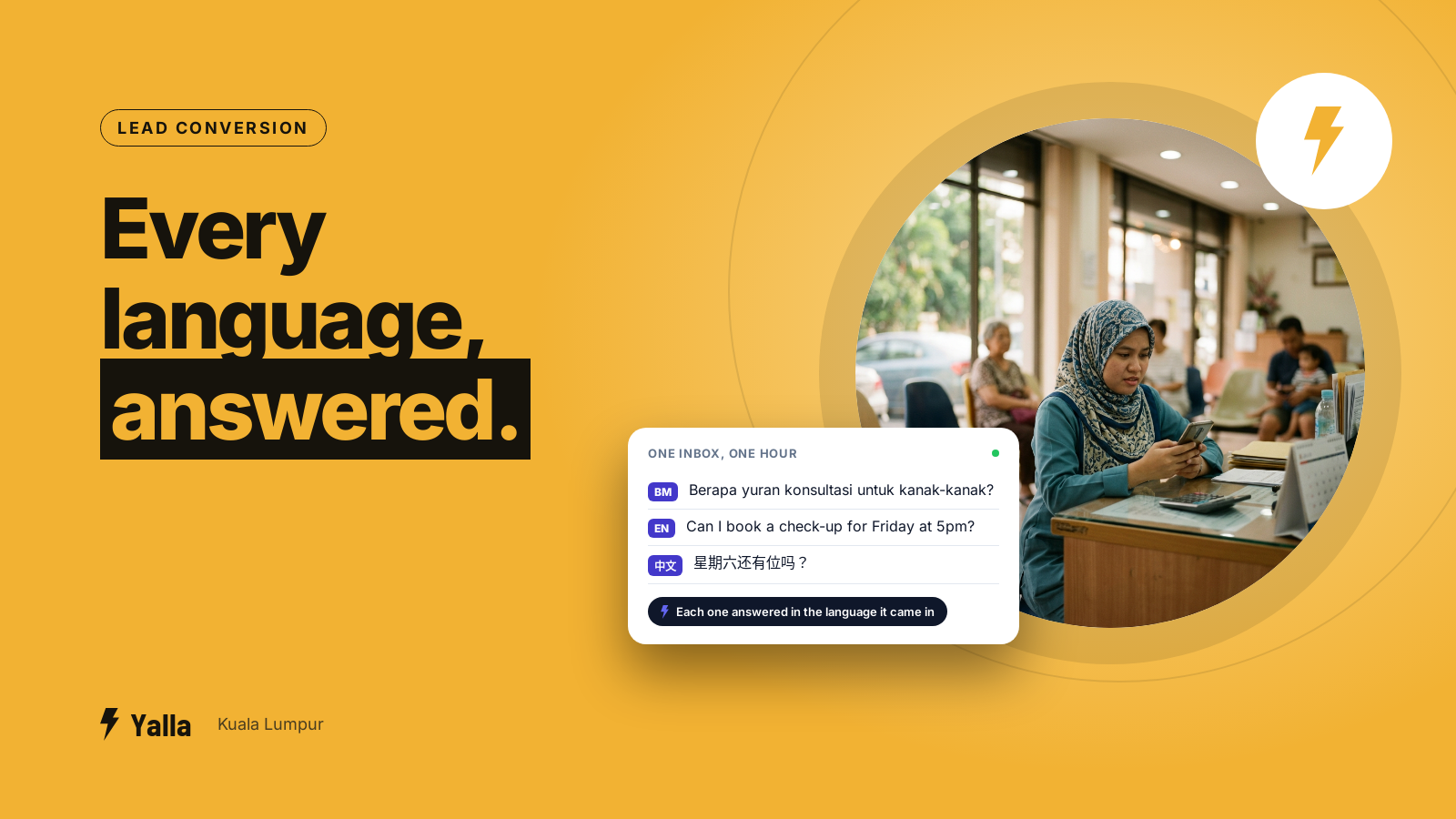
Picture a clinic in Bangsar on a Tuesday afternoon. Within the same hour, one inbox gets a question about fees in Bahasa Malaysia, a booking request in English, a "还有位吗?" asking if there's still a slot on Saturday, and a message that starts in English and finishes in Malay halfway through the sentence. The person on the front desk reads two of those comfortably.
That's an ordinary afternoon for a business in the Klang Valley. Customers don't sort themselves into language queues. They message in whatever they think in, and they expect a reply that reads as if a person who speaks it wrote it.
We've seen how teams cope. At one international school in Malaysia, parent enquiries are sorted by hand every morning, and a family whose first language isn't English goes to whichever colleague shares it. It's careful and well meant, and it exists entirely in one person's head. When that person is on leave, or the colleague who reads Mandarin is at an open day, the enquiry waits.
Why enquiries in the "other" language leak more
Every point of friction gets multiplied. An enquiry that arrives after hours waits for the morning. An enquiry in a language your staff are shaky in waits for the morning, and for the one colleague who reads it to be on shift, and for them to have time.
There's also a quieter cost, which is hesitation. When a message arrives in a language a salesperson isn't confident in, they park it. They'll get to it when they can concentrate, or paste it into a translator, or when the colleague who's better at it is free. Parked messages are where pipelines quietly die. The intent was real, and the only thing that failed was that nobody felt sure enough to answer in the moment.
If you're running Facebook or Instagram ads into WhatsApp, you pay twice for that. Say your ads cost RM30 an enquiry. The enquiry that sat for a day because it came in Chinese cost exactly as much as the one your team answered in two minutes, and it's far less likely to turn into a sale, because the parent or patient has probably messaged two other providers in the meantime.
The usual instinct is to hire for the gap. That works until the volume in one language is too thin to justify a salary and too heavy to ignore.
Free download
Reply Scripts for the 10 Enquiries Every KL Business Gets
A practical companion to this article. Free for your email address.
Get it free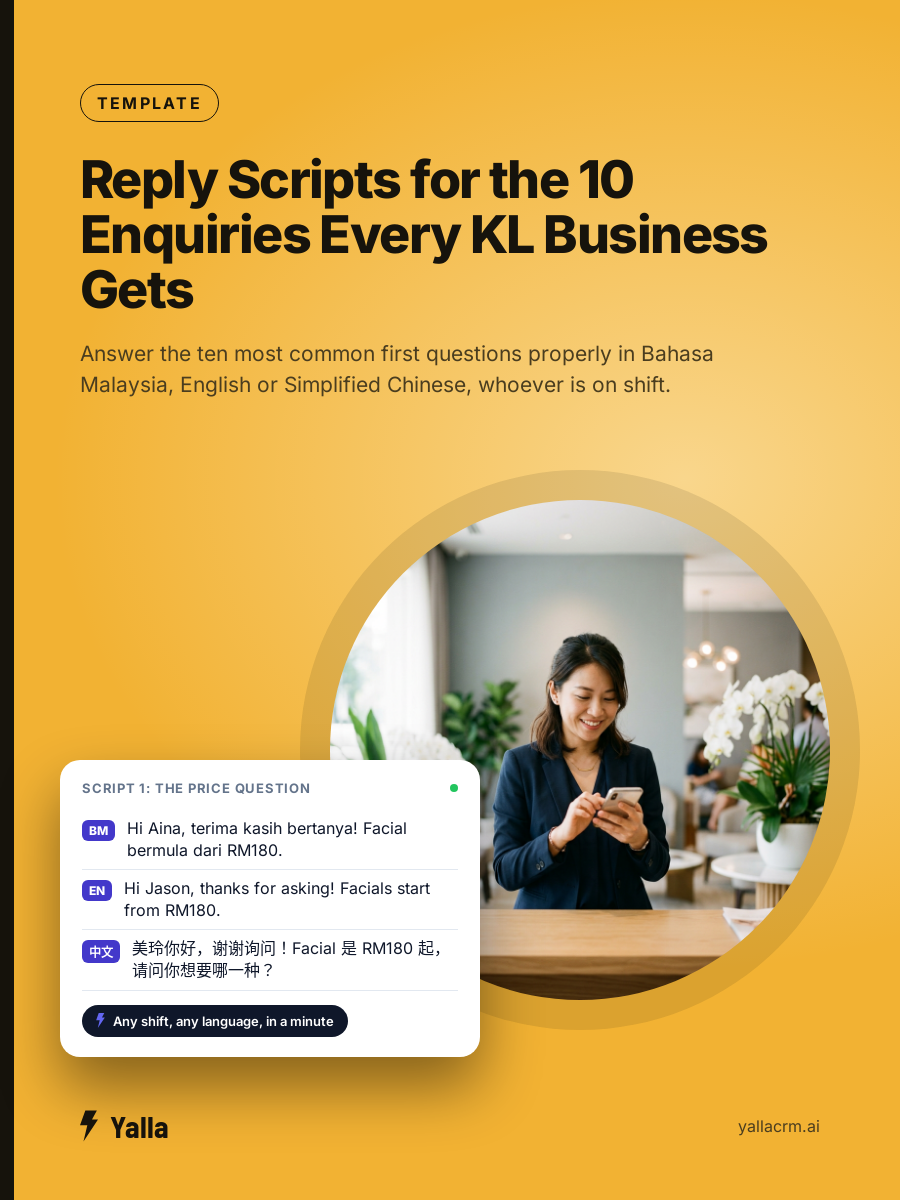
Replying in three languages is the easy part
Most WhatsApp tools you'll be shown in a KL demo will say they reply in Bahasa Malaysia, English and Chinese, and most of them can. Language detection and translation are now built on the same class of large language models, so a greeting in Malay is trivial for all of them.
The hard part is what has to happen in the customer's language after the greeting. Quoting the right price for the right package, in Malay, with the correct terms. Booking the appointment. Chasing a deposit. Explaining the cancellation policy. Each of those pulls information from somewhere else in your business, and the answer has to come back accurate and in the right language.
Then there's how people in KL actually type. A lot of messages are Manglish, English and Malay mixed in one sentence, with a Hokkien or Cantonese word dropped in, sent as a voice note. "Supports 30 languages" on a feature page tells you very little. What matters is whether the tool holds up on a real, code-switched, half-slang message about your own product.
What breaks when a customer switches language mid-chat
This is where the difference shows, and it rarely shows in the greeting.
A parent asks about school fees in English, then switches to Malay to ask whether there's a sibling discount. A buyer asks about a sofa in Chinese, then sends a voice note in Manglish asking if it comes in grey. In a translate-only setup, the words get converted but the conversation loses its memory. The context resets, and the AI answers the new message as if the earlier one never happened. The customer notices immediately.
The other common failure is on your side. The AI replies fluently in Malay, but quotes last month's price, because the price it "knows" is written into a static script rather than read from your live price list. Fluent and wrong is worse than slow and right. A confident wrong number in someone's own language is the fastest way to lose their trust, and you usually only find out after the deal's gone.
Translating a message versus handling an enquiry
A translation feature reaches one thing: the words in the current message. It doesn't know your pipeline stages, it can't assign the lead to whoever handles that product, it won't send the follow-up on Thursday, and it has no idea this person enquired last month.
Handling the enquiry means acting on it. When a Chinese-language message arrives about a specific package, the useful sequence looks like this:
- Detect the language and answer the first question in Chinese straight away.
- Save the person as a contact, tagged with the service they asked about.
- Put them in the right pipeline stage and assign them to the salesperson who owns it.
- Schedule the follow-up, in Chinese, so nobody has to remember.
If your tool only does the first step, your team still does the rest by hand, and the language barrier just moves from the first reply to every reply after it.
It helps to compare tools on that list, rather than on whose translation sounds nicer. Ask which of your systems the AI can read from and act on once it has understood the message: your price list, your calendar, the contact record, the pipeline.
When a human takes over in a language they don't speak
The AI won't handle everything, and it shouldn't. When a conversation needs a person, that person often doesn't speak the customer's language. Your best closer might work in English while the customer writes in Chinese.
A good multilingual CRM handles this with agent-side translation. The incoming message is shown to your salesperson in their language, and whatever they type is delivered to the customer in the customer's. The customer never sees the join, and your salesperson never has to paste back and forth between tabs.
Both halves have to work together. The AI handles the routine enquiry in the customer's language, and when a human steps in, they can carry it on in a language they don't personally speak. Without that, every escalated Chinese or Malay chat becomes a queue for the one team member who reads it, which is exactly the morning-sort problem the school has.
In Yalla, one AI works across the whole workspace, so "reply in the customer's language, tag them by the service they asked about, add them to the new-enquiry stage and assign them to Aisyah" is one action. Your salesperson reads the conversation in their language, the customer gets answered in theirs, and the record is clean for whoever picks it up next.
Keeping the answers right in every language
The discipline that keeps an AI accurate in English is the same one that keeps it accurate in Malay and Chinese.
- One knowledge base, not three. Write your fees, packages and policies once. If you keep separate Malay and English scripts, they'll drift apart within a month.
- Live prices, not remembered ones. Connect the AI to the price list your team actually uses.
- Clear handover rules. Tell it exactly when to pass a conversation to a person: complaints, refunds, anything medical, anything over a certain value.
- Test with real messages. Before you trust a tool, send it five enquiries copied from your own inbox, including a Manglish one and a voice note.
Where this isn't the answer
If your enquiries really do arrive in one language, you don't need to weigh multilingual features at all. Choose on pipeline fit and price.
If you need certified translation of contracts, medical reports or regulatory documents, an AI reply layer is the wrong tool. That's a job for professional translators.
A multilingual CRM earns its place in the common KL case: a team fielding real-time enquiries in two or three languages, without a fluent person standing by for each of them from 9am to midnight.
Free download
Reply Scripts for the 10 Enquiries Every KL Business Gets
A practical companion to this article. Free for your email address.
Get it freeYalla is the chat-native CRM where the AI does the work, not just the talking.
See how much of your business it can reach.