
Most of Your Enquiries Aren't Ready to Buy. How to Find the Ones That Are.
How KL sales teams qualify leads automatically in the first minute of the chat, so salespeople spend their day on real buyers and not on browsers.
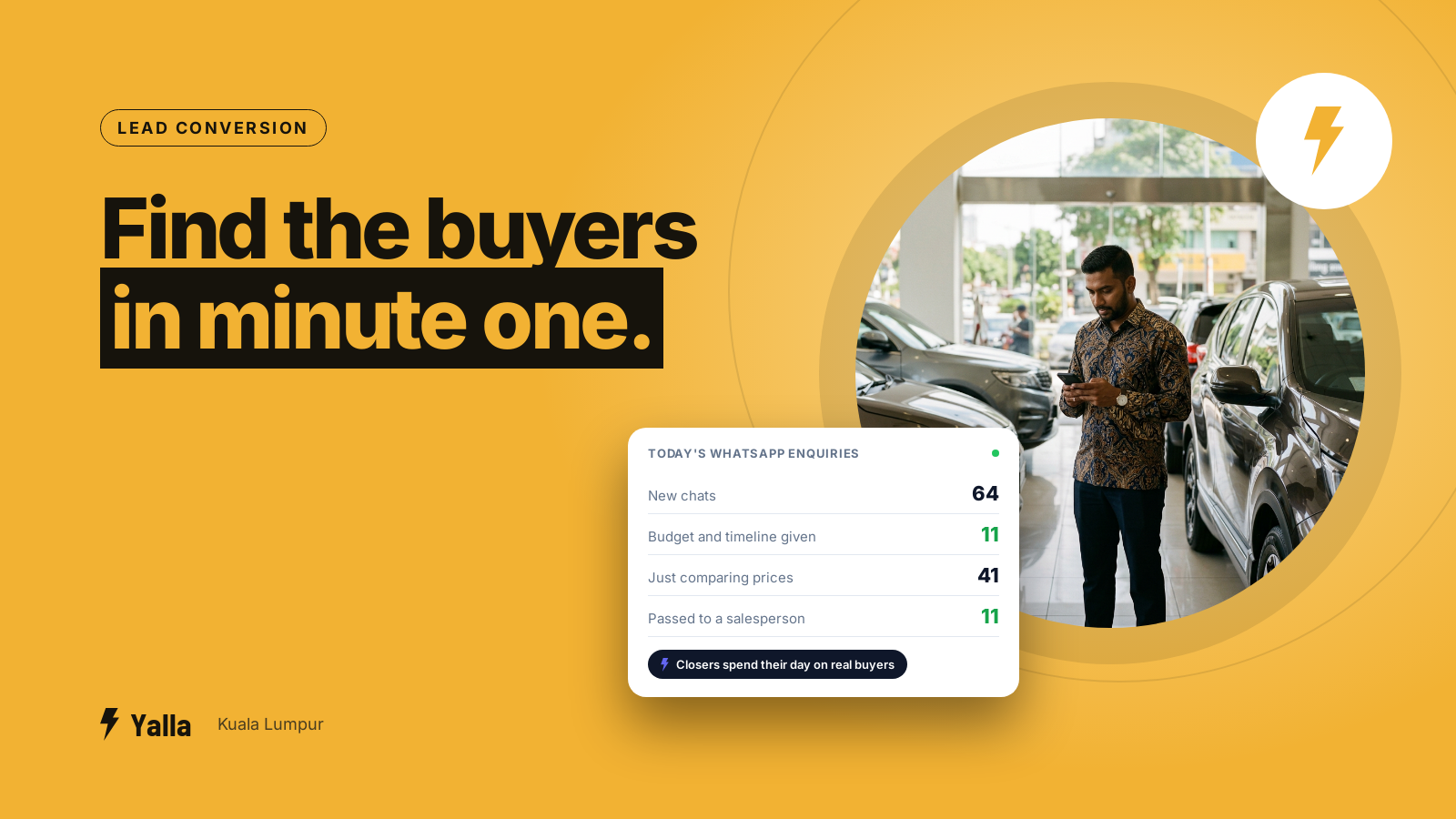
Your sales team in KL probably isn't short of enquiries. It's short of time to work out which ones are real.
Every message arrives looking the same. A buyer with budget and a deadline, and someone idly comparing prices from their sofa in Shah Alam, both show up as a grey bubble saying "Hi, is this still available?" Your salesperson can't tell them apart until they've spent ten minutes on each. Across a busy day, that's your best closers doing triage.
This article is about qualifying leads automatically: what "qualified" should mean for your business, how to set it up so the sorting happens in the first minute of the chat, and where automatic qualification quietly goes wrong.
Why the good leads get buried
Without some kind of qualification, every enquiry gets the same treatment. The serious buyer waits in the same queue as the browser, and because speed of reply is the biggest lever you have, the serious buyer suffers most. By the time your team reaches them, they've heard back from someone else.
There's a second cost that's easy to miss. When a team spends all day on enquiries that never go anywhere, they start to believe the leads are bad. Then the ads get blamed, the budget gets cut, and nobody notices that the real problem was sorting.
Replying faster to everyone won't fix that on its own. Sort first, then spend human time only where it pays.
Free download
How to Stop Your Team Chasing WhatsApp Enquiries That Never Convert
A practical companion to this article. Free for your email address.
Get it free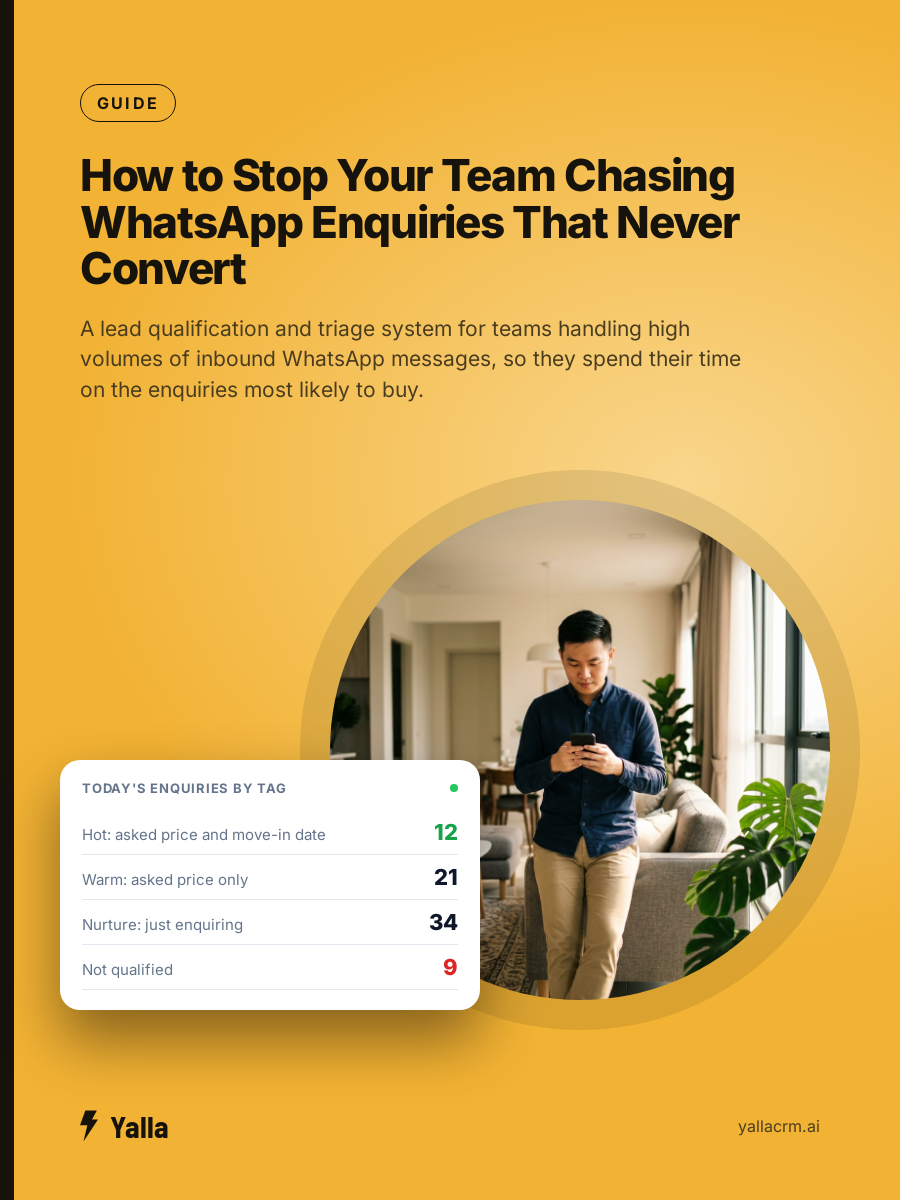
What a qualified lead looks like
Qualifying means deciding, before a salesperson invests time, whether this person is worth it. For most Klang Valley businesses selling on WhatsApp, a qualified lead clears four checks:
- They want something you actually sell.
- They can afford it, or at least they're in the right price range.
- They mean to buy within a timeframe you care about.
- You can reach them again.
Everyone else is a browser, a wrong fit, or a "just checking prices" message that won't turn into revenue this quarter. That doesn't make them worthless. It means they need a different track.
WhatsApp is a good place to do this sorting, which is a little ironic given it's where the flood comes from. People abandon web forms. They'll happily answer a friendly question in a chat. The channel that swamps you with unqualified enquiries is also the easiest one to sort them in, as long as something reads every reply instead of waiting for a person to get round to it.
The four questions worth asking
Keep it to the questions that actually change what happens next. For most teams that's four:
- Fit. What exactly are you looking for? This filters out wrong-product and out-of-area enquiries first, because they're the cheapest to rule out.
- Budget or package. Which option or price range suits you? You're not demanding a number in ringgit, just checking they're in the room.
- Timing. When do you need this by? A deadline is the strongest buying signal you'll get in a chat.
- Who decides. Is this for you, and is anyone else involved? This tells the salesperson how to handle the follow-up.
The trap is asking too much. Every extra question loses people. You want the minimum set that separates a hot lead from a browser, not a full discovery call run by a bot.
Language matters here as well. A lot of KL enquiries come in Malay, some in Chinese, many in a mix of all three with English. A qualifier that only asks its questions in formal English will lose people who'd have answered happily in the language they started in.
How automatic qualification works, step by step
You put an AI agent at the front door. It opens the conversation, asks the qualifying questions naturally, reads the answers, scores the lead, writes what it learned on the contact record, and passes the ones that matter to a person. The sequence that works:
- Reply straight away and open the conversation. The first message goes out in seconds, day or night. It acknowledges the enquiry and asks the first question instead of dumping a menu of options.
- Ask what a good salesperson would ask, one question at a time, conversationally. Nobody likes an interrogation.
- Read the answers for intent rather than just collecting them. "Maybe next year, still comparing" and "we need this before month end" are very different leads, and the agent should treat them differently.
- Score and tag the lead against your criteria, so the record already says hot, warm or not now before anyone opens it.
- Pass qualified leads to the right person immediately. A ready buyer should reach a salesperson or a booking link while they're still in the chat. Sorting is worth nothing if the good lead then sits unassigned.
- Keep the not-yet leads warm without a person. They go into a timed follow-up so they come back when they're ready.
Done well, nobody on your team opens a cold record again. Every chat they pick up already has a score, a few answers and a history attached.
Picture a property agency in Mont Kiara getting sixty WhatsApp enquiries a week from a new listing. Maybe fifteen are serious buyers with financing sorted, another twenty are renters who clicked the wrong ad, and the rest are browsing. Without qualification, three agents split all sixty. With it, those fifteen go to the agents within minutes, the renters get pointed to rental listings, and the browsers get a gentle follow-up in a month.
What automatic qualification should never do
Two failure modes matter more than the rest.
The first is disqualifying too hard. A rigid bot that hears "just looking" and ends the conversation throws away people who would have warmed up. Not yet isn't no. Those people belong in a follow-up track.
The second is pretending to be human. If the agent claims to be a person and gets found out, you've damaged trust at exactly the moment you were trying to build it. Let it be a helpful assistant that gathers the basics and hands over cleanly. Being passed to the right specialist should feel like good service.
Some enquiries should skip qualification altogether. A returning customer, a referral from someone in your BNI chapter, a large account you recognise by name: send those straight to a person. Qualification is for the unknown flood, not for people you already know are worth your time.
There's a newer problem too. An admissions team at a Malaysian international school told us some of their incoming leads weren't real at all:
"AI is too common already and it's too easily done, that the leads are not genuine."
A short qualifying exchange helps here as well. A form filled in by a bot rarely holds up a two-minute conversation.
When a bot isn't the answer
If every enquiry genuinely needs judgement, say bespoke B2B work where scope rather than a checklist decides fit, automatic qualification will frustrate more people than it helps. The same goes for low volume. If you get five enquiries a day, a good person reads them faster than you could design a flow, and the flow isn't worth building.
Automatic qualification earns its place when there are more enquiries than your team can read properly and the qualifying questions are consistent enough to ask the same way each time. That describes a lot of WhatsApp-led sales teams in the Klang Valley, but not all of them.
The sorting only matters if something acts on it
Qualifying a lead produces a decision: this one is hot, give it to Aisyah now, and put that one on a two-week follow-up. The decision is worthless unless something can act on it across the business, not just inside the chat window.
A qualifier that can score a message but can't assign the lead, move it along the pipeline, start the follow-up and update the record has handed you a label and left the work to a person. The value sits in the link between reading the message and doing the next five things automatically.
In Yalla, the AI does that work itself. Yalla Brain works across pipelines, WhatsApp, Instagram, Facebook, email campaigns and reporting from one instruction, so a qualified lead gets scored, assigned, staged and put on a follow-up schedule without anyone carrying it between systems. That's the point of qualifying automatically: taking people out of the part of the job that never needed them.
Frequently asked questions
How is lead qualification different from lead routing?
Qualification decides whether a lead is worth pursuing and how hot it is. Routing decides who handles it. They happen in that order: score and tag first, then send the qualified ones to the right salesperson. Do one without the other and you either send hot and cold leads to the same person, or score leads that then sit with nobody.
Will an AI qualifier annoy my customers?
Not if it's quick, honest and brief. Customers mind slow replies and long forms far more than a short exchange of two or three relevant questions followed by a real person. The annoyance comes from bots that loop, pretend to be human, or refuse to hand over.
Can I qualify leads without losing the ones who aren't ready yet?
Yes, and you should. Leads that don't qualify today go into a timed follow-up instead of the bin, so they come back into your pipeline when their timing changes. Throwing away not-yet leads is the most common and most expensive mistake in automatic qualification.
How quickly should qualification happen?
The first reply should go out within seconds, and the qualifying questions should be answered in the same conversation while interest is high. Done automatically, it happens at 2am during the Deepavali break exactly as it does at 11am on a Tuesday.
Free download
How to Stop Your Team Chasing WhatsApp Enquiries That Never Convert
A practical companion to this article. Free for your email address.
Get it freeYalla is the chat-native CRM where the AI does the work, not just the talking.
See how much of your business it can reach.