
Why Your Quotes Go Quiet After You Send Them, and a Follow-Up That Runs Itself
For KL businesses that quote on WhatsApp: why quotes go quiet once the price is sent, and a follow-up routine that doesn't rely on anyone remembering.
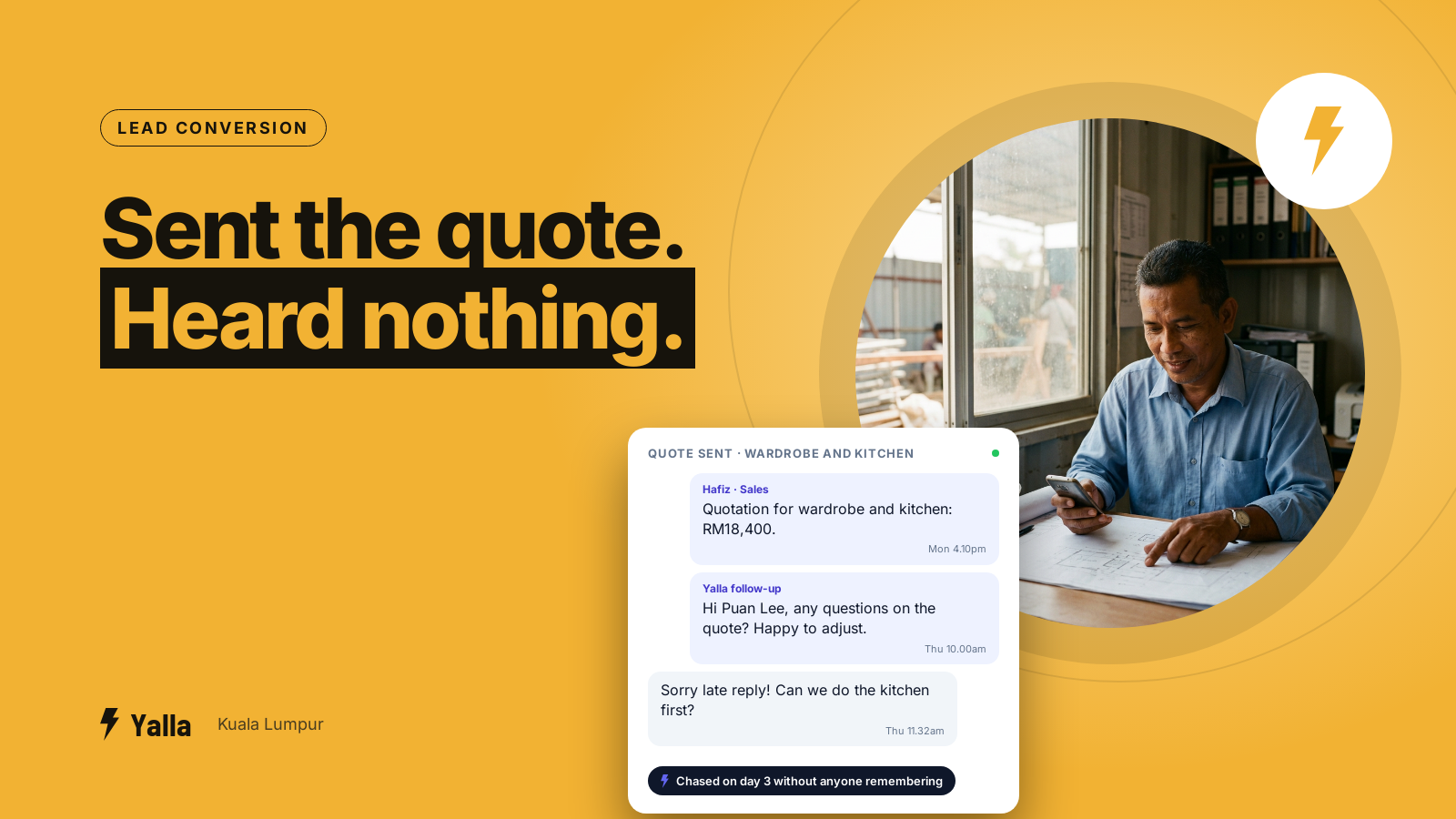
Picture a joinery firm in Puchong, or an interior contractor working out of Mont Kiara. A client asks for a price on WhatsApp. Someone spends most of an afternoon costing it, sends the number over, and watches the blue ticks appear. Then the chat goes still.
Nobody knows if the price was too high, if the client is waiting on two other quotes, or if their director is on leave until after Deepavali. Somebody meant to chase it on Thursday. Thursday became three weeks, and by then it felt awkward to ask.
That silence after the quote is where a lot of Klang Valley businesses lose work they'd already done the hard part of winning. This article is about the silence: why it happens, what it costs, and a follow-up routine that doesn't depend on anyone's memory. If your problem is getting the quote out in the first place, we've written about that separately. This one starts the moment the number has been sent.
What happens to a quote after you send it
A bespoke furniture maker we met at a BNI one-to-one described the life of a quote better than any sales book we've read. He makes custom pieces for hotels. Every chair has a fabric supplier and a wood supplier, sometimes metal as well, and nothing is a standard item. For him, sending the quote is barely the start.
"The client said that, well it's a bit pricey, how we can lower the cost by reselect some material. Then we have to do the entire cost structure again."
So the first reply to a quote often isn't yes or no. It's a request for a requote. That requote needs the same care as the original, and it arrives at a moment when everyone on the team assumes the job is "with the client".
Then there's the long tail:
"Sometimes we have issue like, we screenshot one photo, send to the vendor and say that hey, what is the estimate price for this? Then maybe six months later or even eight months later, then we ask the similar thing. All this is a bit difficult to trace."
He was talking about his suppliers, but the client side works the same way. A hotel group that went quiet in March comes back in October asking about "the same chairs as last time". Someone has to dig through a phone to find what was quoted, in which fabric, at what price. If they can't find it, the job gets costed from scratch and everyone hopes the number matches.
His own summary: "So that is how the pain come in, and was always tied up with a lot of all these issue. And that is not including during the execution time."
Free download
How to Send, Track, and Follow Up on Quotes Through WhatsApp Without Losing the Deal
A practical companion to this article. Free for your email address.
Get it free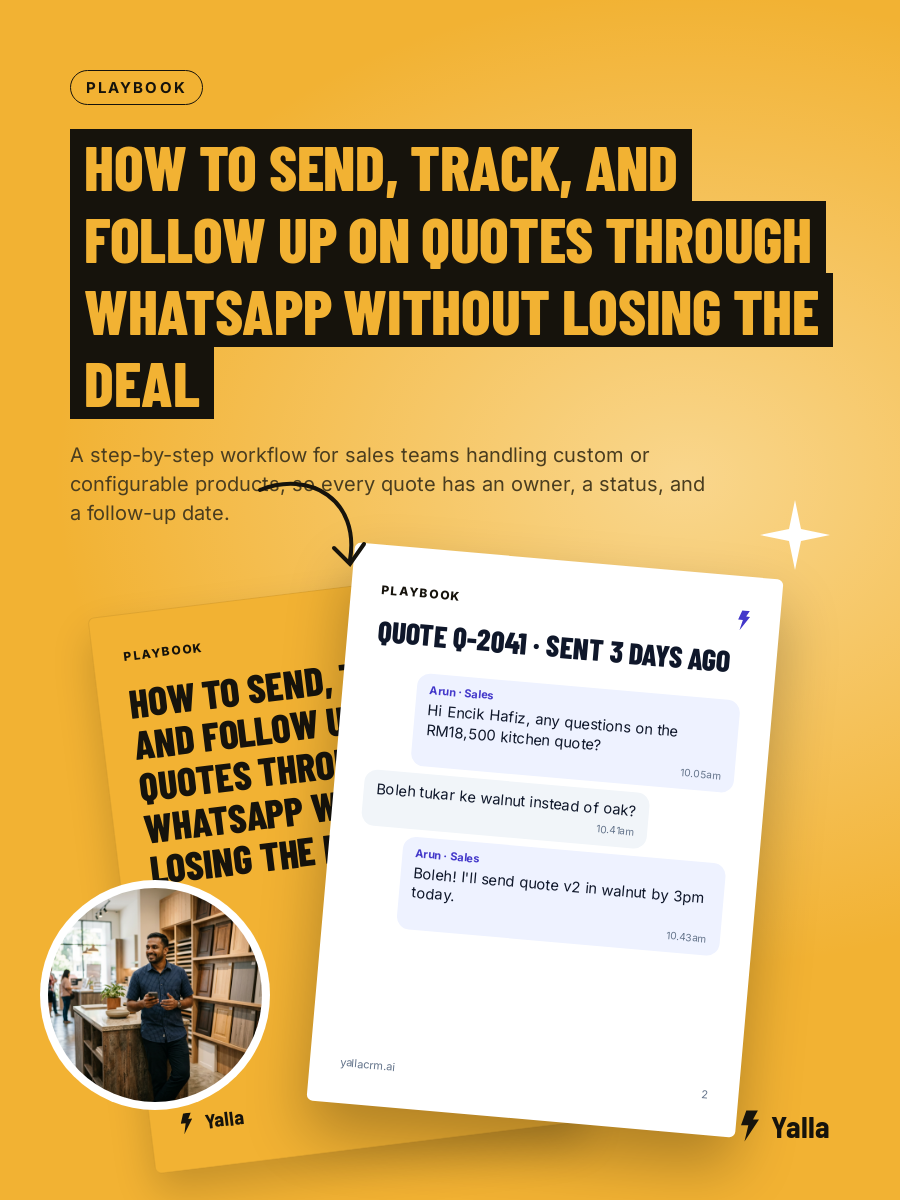
Why quotes go quiet
Sending the quote feels like the end of your part of the job, so that's where attention drops. The client, meanwhile, has stopped asking questions and started comparing, checking with a partner or waiting for a budget sign-off.
That is exactly when a short, well-timed message helps, and exactly when your team is least likely to send one. Chasing feels pushy. There are newer enquiries to answer. And the quote isn't anybody's task, because nobody's calendar says "chase the fourteen quotes from last week".
Three moments decide most of it:
- The first two days. The client is still comparing. A quick "did that come through okay?" keeps you in the conversation while the decision is live.
- Around a week. "Let me think about it" slides into forgetting unless something brings it back.
- The long tail. Quotes from last quarter that everyone has written off, which one message would reopen. The furniture maker's six-to-eight-month gap is a fair picture of how long a quote can stay alive in project work.
We don't have a trustworthy Malaysian benchmark for how many follow-ups a quote needs, and we'd rather not borrow a number someone else made up. Your own data is better anyway. Take last quarter's quotes, split them into the ones that got a second message and the ones that didn't, and compare how many of each closed.
Why the spreadsheet can't chase for you
Plenty of Malaysian SMEs price in Excel and there's nothing wrong with that. A spreadsheet is a very good calculator.
What it can't do is notice that a quote has had no reply for three days. It doesn't know the client read the message, or that they wrote "I'll confirm after I check with my boss". It can't see the chat at all. So the follow-up depends on someone scrolling back through WhatsApp, spotting the cold ones and reopening each chat by hand.
Requotes make it worse. Version one is in one file and version two in another, and the WhatsApp thread has a screenshot of version one plus a voice note about a cheaper fabric. When the client finally replies "ok, can proceed", which price did they agree to?
Keep pricing wherever you price. The chasing needs to live somewhere that can see the conversation.
A follow-up routine that runs without anyone's memory
This is small enough to set up this week. Every step is a rule, which means a system can run it for you.
- Log the quote as it goes out. The enquiry moves to a stage called "Quote sent", with the amount, the date and the person who owns it. If it isn't logged, nothing downstream can chase it.
- First nudge at 48 hours. Short and human: "Hi Mr Tan, just checking the quote came through okay. Happy to go through any line on it." Write it in Malay or Chinese if that's how the client writes to you.
- Something useful around day five to seven. Skip "have you decided?" Send a photo of a similar job, a note that the workshop has a slot opening in November, or an answer to the objection you suspect is coming.
- A permission-to-close message around day ten to fourteen. "Are you still looking at this, or shall I close it off for now?" It gives the client an easy way out, and a fair number reply that they're still keen and apologise for the delay.
- Park the silent ones, don't delete them. Anything still quiet goes on a monthly re-open list. Once a month, one message goes to that list.
- Log every requote as a new version on the same deal. When the client asks for a cheaper material, the new number goes on the same record, marked as the live one, with the old version kept for reference. Eight months later, when they come back, it's all there.
None of this needs your memory. It needs your judgement once, when you set the rules. After that it runs.
Where AI helps, and where it shouldn't
A plain timer gets some calls wrong. If the client replied "I'll confirm Monday", a blind 48-hour chase makes you look needy.
An AI agent that reads the thread can hold that follow-up. It can draft the day-five message around what this particular client asked for, answer a simple question at 9pm ("can deliver before CNY or not?"), and flag the conversations that need a person to reprice. It can also watch every open quote at once, which nobody handling a full inbox can do.
What it shouldn't do is invent a price. Repricing custom work is a human job, and in a business like the furniture maker's it should stay that way.
This is the part of the job we built Yalla for. The WhatsApp thread, the pipeline stage and the quote amount sit in one place, so "follow up every quote with no reply for three days, unless the client said they'd come back to us" is an instruction you set once. The owner gets one dashboard of every open quote, how old it is and who owns it, without having to ask anyone for an update.
When not to automate it
If you send three quotes a month, you don't need a system. A reminder on your phone will do.
If your deals are long tenders decided by a procurement committee, a WhatsApp nudge sequence will feel cheap. Those need a person, a relationship and probably a proper tender log.
If your clients decide by email and PDF rather than chat, sort out that side first.
Where this pays is in the middle: a team sending dozens of quotes a month over WhatsApp, in fit-out, furniture, renovation, events, equipment or professional services. The volume is too high to chase from memory, and each lost job stings.
Frequently asked questions
How soon should I follow up after sending a quote?
Within about two days, while the client is still comparing options. After a week you're relying on them to remember you.
How many times should I follow up a quote?
Four or five touches over two weeks, then a monthly check-in, is a sensible place to start. Test it against your own close rate rather than trusting anyone's benchmark, including ours.
Will automated follow-ups sound robotic?
They will if the same message fires whatever the client said. Vary the messages, write them the way your team actually talks, and let the system skip a step when the client has already replied.
Do I have to stop quoting in Excel?
No. Keep pricing where it works for you. What changes is that each quote gets logged against the client, and the chasing happens on time.
Free download
How to Send, Track, and Follow Up on Quotes Through WhatsApp Without Losing the Deal
A practical companion to this article. Free for your email address.
Get it freeYalla is the chat-native CRM where the AI does the work, not just the talking.
See how much of your business it can reach.