
Booked but No-Show: How to Get People to Turn Up to Appointments and Classes
A hospital group wanted 150 couples at one class. How KL businesses get people who booked weeks ago to turn up, with reminders they can reply to.
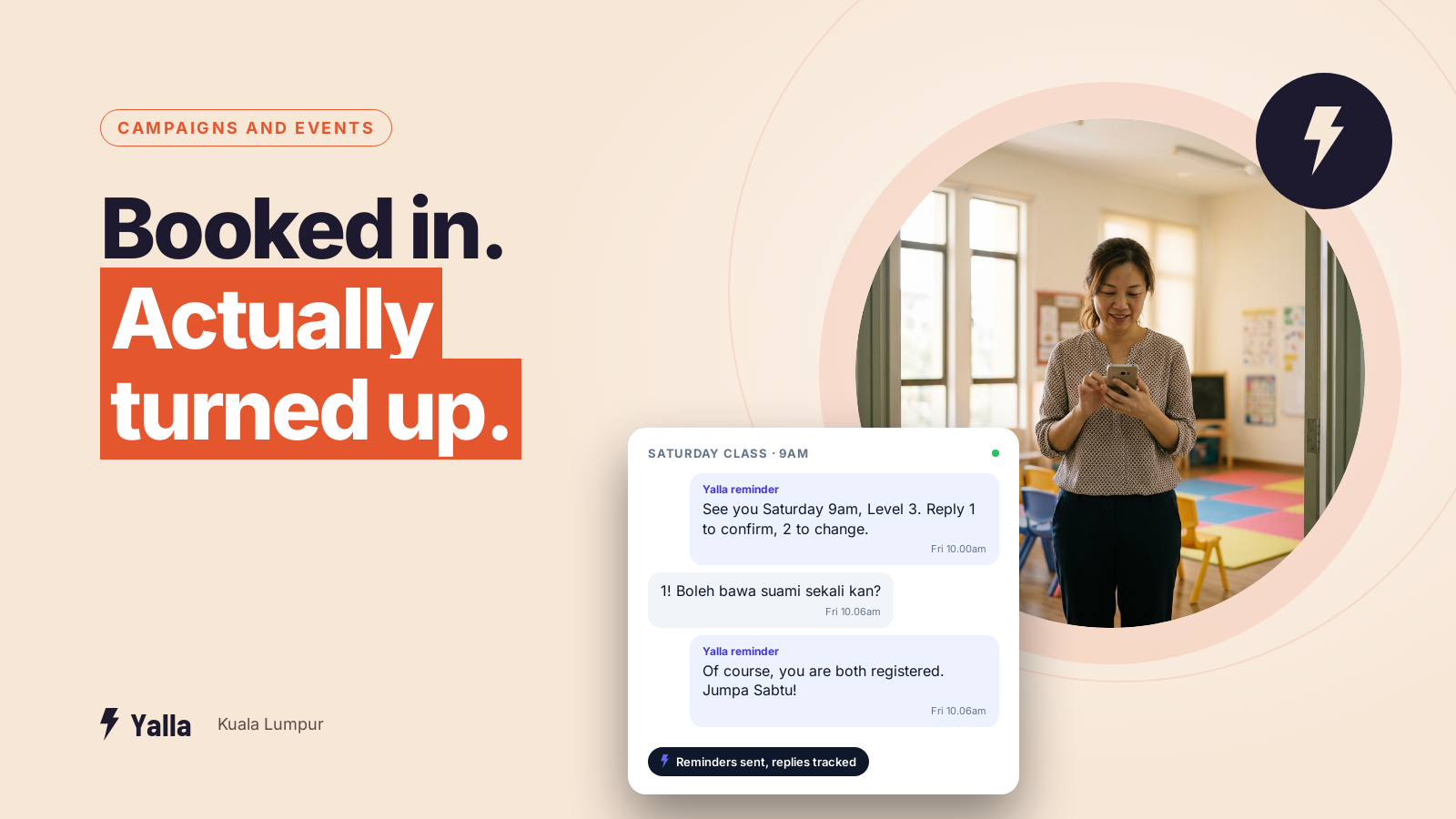
The marketing lead at a private hospital group we met through a BNI chapter told us about a campaign her team had just launched. It was a parentcraft class, and they wanted 150 couples in the room at the end of July.
"So moving towards that event our strategy is to contact to reach our existing patient data through email and WhatsApp which have been done manually, and prospect from social media advertising and social media boosting."
Getting people to sign up was only the first job. The harder one was getting 150 couples who'd registered weeks earlier to actually turn up on a Saturday morning. In her words, the team needed to "follow up with them, create an engagement until the event day so that we can keep them, refresh their mind, so that they will not miss."
That gap between registered and turned up is one of the most expensive leaks for any KL business that runs on bookings: clinic appointments, consultations, property viewings, school open days, workshops, BNI visitor days. You paid for the lead, you got the booking, and then you lost it to silence. This article is about closing that gap.
Why people book and then don't come
Most no-shows aren't people who were never going to come. They booked when their interest was highest, often late at night or straight off an ad, and then ordinary life wore it down. By the day itself, the reason they booked has gone fuzzy, something else has landed in the diary, or they've simply forgotten.
The longer the gap between booking and the day, the worse it gets. A physio appointment in Subang booked for tomorrow has a day to decay. A class booked a month out, like the hospital's, has four weeks. That's why events and classes need more than a reminder the day before. They need a reason to keep the date in mind all the way through.
Before you fix anything, measure it. Take your last two months of bookings and count how many showed. That's your baseline, and it's the only number that matters here. Published no-show rates from other countries and other industries tell you very little about a Saturday class in Cheras.
Free download
The Event Reminder Sequence: From Registration to a Full Room
A practical companion to this article. Free for your email address.
Get it free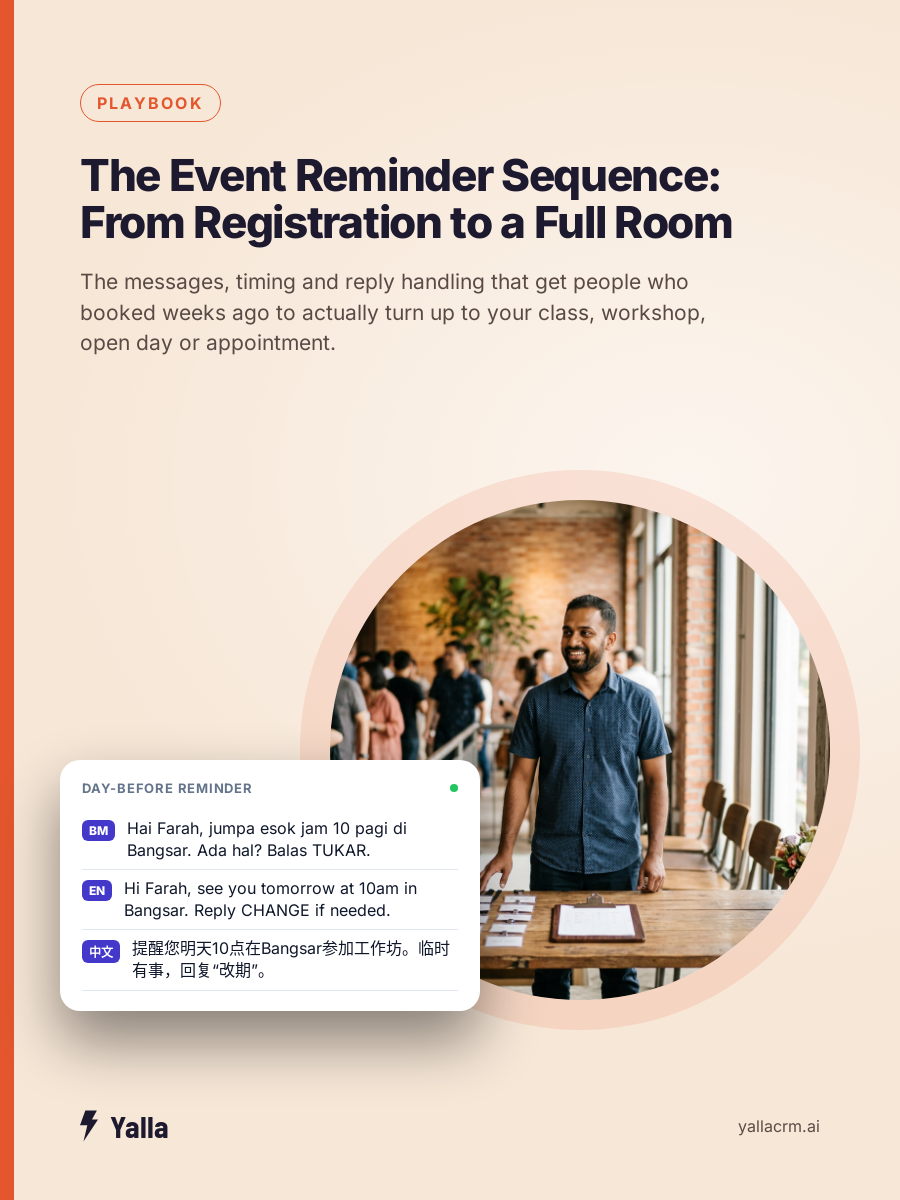
What the manual version looks like
The hospital's process is worth looking at closely, because a lot of businesses run something similar.
"The WhatsApp we have link for Google form for sign up. So when they sign up we have to refer that Google form and manually register... So they have to register in the hospital system. So that's manual."
A patient messages on WhatsApp, gets sent a Google Form, fills it in, and then somebody on the team retypes that form into the hospital system. The existing patients are in one place and the new ad leads are in another. Email reminders meant exporting from one system and sending by hand. She wanted all of it in one platform, open to the three departments that touch the patient:
"And this platform should be able to be accessed by customer service department, billing department and marketing department. As for the three main touch points."
Every manual step is a point where a reminder doesn't get sent, because the person who'd send it is busy retyping forms.
Why a plain reminder isn't enough
One reminder helps. Most booking tools will send "don't forget your appointment" for you. The trouble is what happens next.
The patient reads it and replies "can I change to next Saturday?" That reply lands in an inbox where it waits until somebody notices. The tool that was meant to save the booking has created another unanswered message. The ping is automated, and the part that actually matters, rescheduling and updating the record, still sits with a busy human.
A reminder is a one-way alert. Follow-up is a loop: remind, catch the reply, act on it, update the record, and keep the person warm if the date moves.
A sequence that gets people to turn up
Think of it as two jobs running at the same time: stop people forgetting, and keep their reason for booking fresh.
When they book, within minutes:
- Confirm the date, time and place in the same channel they booked from, with a one-tap way to reschedule.
- Send one short "here's what to expect" message: where to park, which entrance, what to bring. It makes the appointment feel real.
Between booking and the week before (for classes and events):
- One message that reminds them why they booked. For a parentcraft class, that might be a two-line note from the midwife running it. Most reminder tools skip this entirely, and it's the one that rebuilds the intent that faded.
- If the gap is long, one more useful touch a week or two later. Keep it relevant and keep it rare.
The day before:
- A clear reminder with the time, the location or link, and the reschedule option right up front. Moving the booking should be easier than ignoring it.
Two to three hours before:
- A short final nudge with a map pin. In KL traffic, "leave by 9 if you're coming from Puchong" is genuinely useful, and this is the message that catches the "oh, that's today" crowd.
If they miss it:
- A friendly follow-up the same day offering another slot, with no guilt trip. A missed appointment isn't a dead lead unless you treat it like one.
Send each message in the language the person used with you. If they booked in Malay, remind them in Malay.
The mechanics have to be right for this to work. The sequence should start automatically from the booking date, move when someone reschedules, and stop the moment they arrive, so nobody gets "see you soon!" an hour after they walked in.
Sending to hundreds without getting blocked
The hospital's marketing lead had already hit this one:
"More than 200 it will be blocked, right?"
She's right to worry. Blasting reminders from a phone running the ordinary WhatsApp Business app, to people who haven't saved your number, is a reliable way to get a number restricted. For a campaign aimed at thousands of existing patients plus new ad leads, reminders need to go through the official WhatsApp Business API.
On the API, anything you send outside the 24 hours after a customer's last message has to use a template Meta has approved. Appointment reminders usually sit in the utility category, which is charged per message and costs less than marketing templates. New numbers start with a daily cap on how many people you can message first, and the cap rises as you keep sending messages people actually want. Plan the campaign around that, and don't leave 1,000 reminders to the night before.
Old database and new leads, in one list
The most useful sentence on that call was her description of the core problem:
"So if we can have that in one platform to manage from existing data and from the potential leads that comes in from the ads, it's more effective I think."
For any campaign aimed at a room, a class, a seminar or an open day, you're usually working two lists at once: people who already know you, and people who just clicked an ad. If they live in different systems, the sequence runs twice, by hand, and someone gets reminded three times while someone else gets nothing. Put both lists in one place, tag everyone by campaign, and run a single sequence off the booking.
Where Yalla fits
Yalla puts the WhatsApp conversations, the booking, and the contact's status in one place. The reminder sequence runs off the booking date. When someone replies to move their slot, the reply lands in a shared inbox assigned to a named person, and AI replies can handle the simple reschedules straight away. Marketing, customer service and billing all see the same record, which was exactly what the hospital asked for, and the manager can see registrations against attendance on one dashboard without chasing anyone for a spreadsheet.
When you don't need any of this
- If you take a handful of bookings a week and personally text every one, the reminders built into your calendar tool are plenty.
- If your no-shows are about commitment rather than memory, a deposit at booking will move the number more than any sequence.
- If you're a clinic whose reminders must live inside your patient management system, look at what that system offers before adding anything.
- If most no-shows were never good fits, work on who's booking first. Reminders fix forgetting. They don't fix a weak offer.
Frequently asked questions
How many reminders should I send before an appointment?
Three or four for an ordinary appointment: confirmation on booking, the day before, and a few hours before, plus the same-day follow-up if they miss. Classes and events booked weeks ahead can take one or two extra touches in between, as long as each one is useful.
What's a normal no-show rate?
It varies too much by business to quote one figure honestly. Measure your own over the last two months, change one thing, and measure again.
Won't automated reminders feel impersonal?
They do when they're generic and one-way. They feel like service when they use the person's name, mention what they booked, arrive in their language, and let them reply to move the date.
What happens when someone replies to reschedule?
That's the moment that matters most. The reply should reach a person or an AI agent that can move the booking, update the record and re-time the reminders. If your setup can't do that, it's probably where most of your no-shows are coming from.
Free download
The Event Reminder Sequence: From Registration to a Full Room
A practical companion to this article. Free for your email address.
Get it freeYalla is the chat-native CRM where the AI does the work, not just the talking.
See how much of your business it can reach.