
Paying for Channels Your Team Doesn't Use? A respond.io Alternative for KL Businesses
respond.io's contact-based pricing can climb in a busy month. A KL team's guide to auditing your channels and bill before you renew or move, and when to stay.
If you're reading this, your team probably already runs on respond.io. You know what a shared inbox is, you've built at least one automation, and you don't need omnichannel messaging explained. You're doing the less comfortable maths: is what you pay, and the way you pay it, still worth what you get?
That question comes up a lot in the Klang Valley, partly because respond.io is a home-grown success. It was founded in Malaysia, plenty of KL teams signed up early, and a good number of them are now a year or two in, looking at a renewal. This guide is for that reader, weighing renewal against a move, and it says where respond.io is still the better tool.
Why teams look for a respond.io alternative
Missing features come up less than you'd think. The usual trigger is the bill, and more specifically the shape of the bill.
respond.io prices on monthly active contacts (MAC), tiered into plans. As of August 2026 the plans are priced in US dollars and sit at roughly RM330, RM670 and RM1,170 a month at current rates, before overages and message costs.
What catches switchers out is rarely the headline number. It's what happens when a good month of marketing pushes your active-contact count over the tier you bought. The platform is designed to grow with your contact volume, which also means the price grows with your success. Run a big Raya promotion or an open-day campaign and the entry plan can end up costing well beyond its sticker price. Teams who didn't model that feel it as a surprise rather than a decision. Check your own tier and overage terms before you decide anything, because these numbers move.
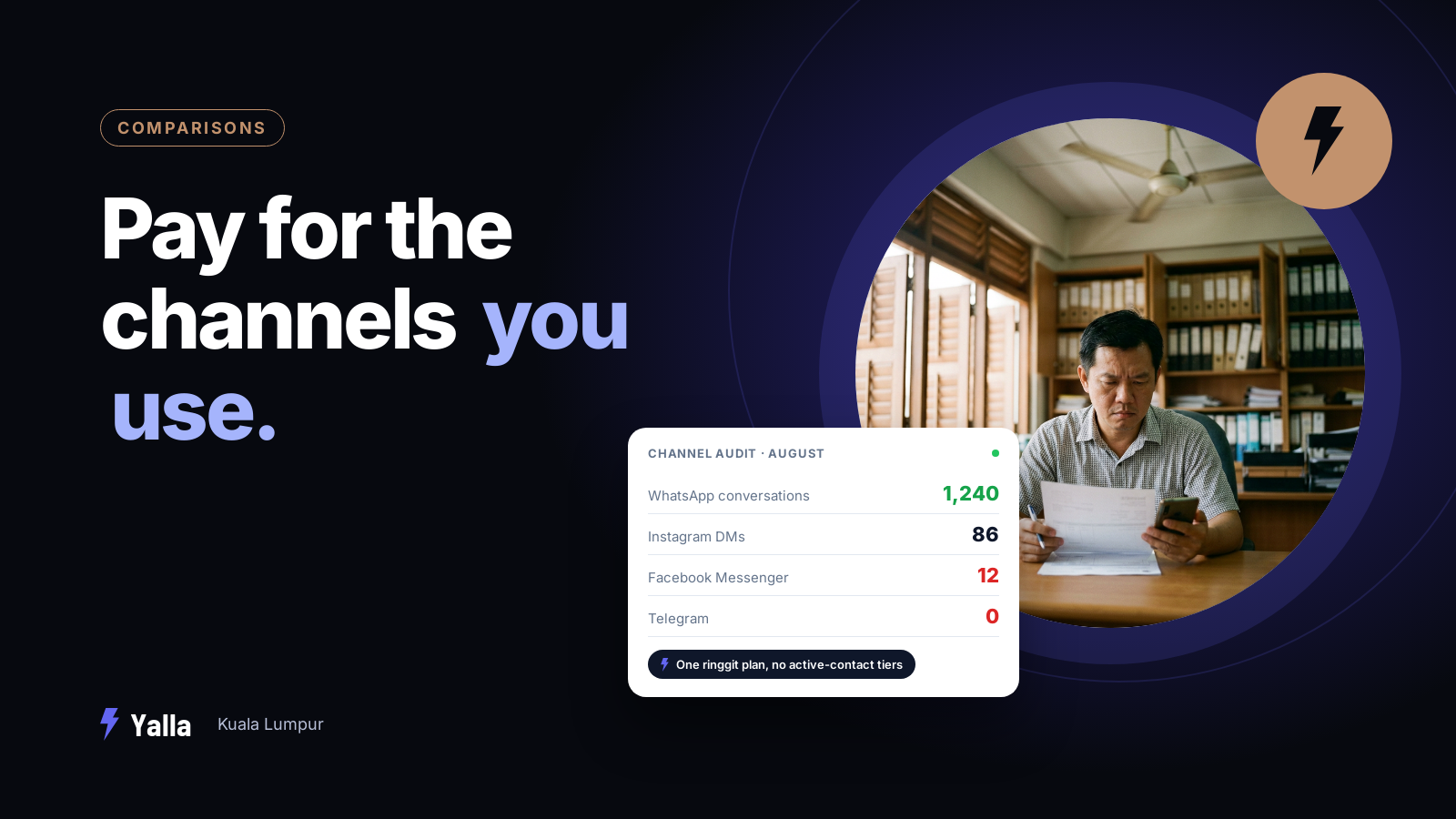
The second reason is quieter. respond.io is a strong multi-channel platform, and multi-channel is a cost as well as a benefit. Plenty of teams sign up picturing WhatsApp, Instagram, Facebook, TikTok, email and web chat running as one orchestrated machine. A year later they look at the data and most of the conversations that turn into revenue are happening on one or two channels. They're paying for breadth they don't use and maintaining complexity they didn't need.
An admissions team at an international school in the Klang Valley put the general version of this well, talking about a different platform they'd cancelled:
"One of the biggest issues we have with Open Apply is we're only using one third of the functions and we're paying a lot of money for it."
Different software, same feeling. If you recognise it, the audit further down is worth an afternoon.
Free download
The Channel Audit Worksheet: See Which Channels Earn Their Place Before You Renew
A practical companion to this article. Free for your email address.
Get it free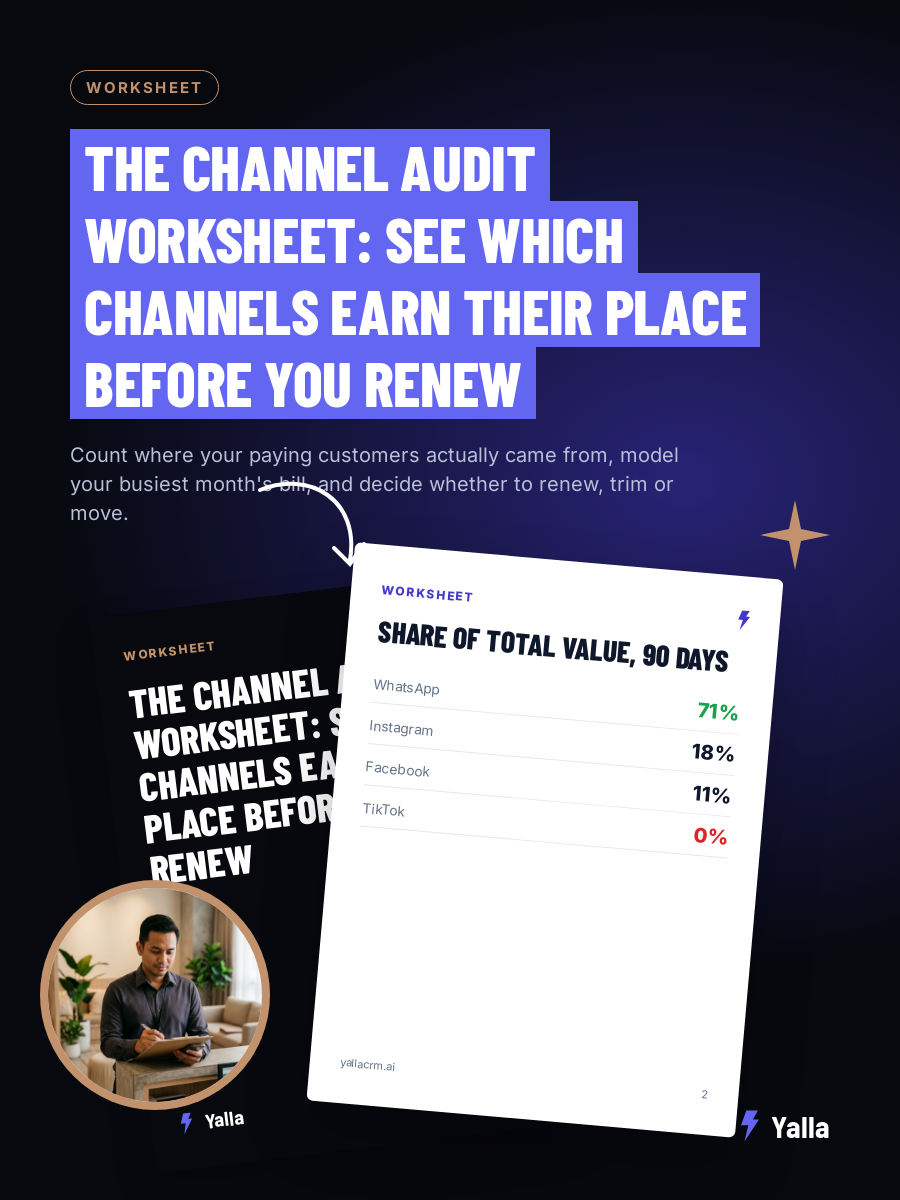
What respond.io does well, and where it stops
Give respond.io its due. As of August 2026 it's one of the most capable multi-channel messaging platforms in the category, well funded after a Series B earlier in 2026, and genuinely strong at pulling lots of channels into one inbox. Its TikTok-to-WhatsApp conversion tooling is ahead of most rivals. For a team that really does sell across a wide spread of channels, that breadth is real value.
Where it stops is where most inbox-first platforms stop. respond.io is built around the conversation and the contact, and it's excellent at routing, replying and broadcasting. It's less naturally a system that runs the rest of the business off the back of that conversation: the pipeline stages, the follow-ups on each deal, the report that tells you which channel produced paying customers rather than just replies. You can bolt a lot of that on through automations and integrations. The question is how much of your week goes on maintaining the bolts.
The question to ask before you renew or move
Forget how many channels a tool can open. What matters is how much it can finish once a channel is open, without somebody stitching the outcome back together across screens.
If nine in ten of your conversations start on WhatsApp, you're renting a ten-channel cockpit to fly a single route.
So put one blunt question to any respond.io alternative: once a customer sends a message, how much can the software do next on its own? Can it move the deal forward, update the pipeline, trigger the follow-up and show up correctly in the report, all from that one conversation? Every CRM ships an AI now. How much of your business that AI can reach is what separates them.
Where respond.io is still the better choice
Here's where you should stay, or where respond.io beats Yalla outright:
- You genuinely sell across many channels. If TikTok, Instagram, Facebook, web chat, email and WhatsApp are all live, revenue-producing channels for you, respond.io's multi-channel depth is worth paying for.
- You have a larger support or sales team living in the inbox. Its routing, roles and workload tools are built for bigger seat counts working the queue all day.
- You need custom integrations into an existing stack. If you depend on bespoke API connections and have the technical people to build and maintain them, respond.io's flexibility rewards that.
- The MAC model suits you. If your active-contact volume is stable and predictable, tiered contact pricing can be perfectly fair.
If two or more of those describe you, renewing may well be right. Not every switch is an upgrade.
Where Yalla isn't the answer either
The same honesty applies to us.
- Email-led pipelines. If most of your selling happens over email with long document trails, a record-first CRM like HubSpot or Salesforce fits better than a chat-native tool.
- Custom data models. If you want to design bespoke objects and relationships and treat your CRM like a flexible database, Attio is built for that and we aren't.
- Enterprise compliance and procurement. If you need deep audit trails, SSO governance and the full compliance apparatus of a large organisation, Salesforce is the safer choice.
If that's you, Yalla won't be the upgrade you want, and it's better to know before you spend a week migrating.
How Yalla approaches it
Yalla is a chat-native CRM where the AI does the work as well as the talking. The difference from an inbox-first platform is where the centre of gravity sits. In Yalla the conversation is the trigger: when a message lands, the system is built to carry it through to the next real business action instead of leaving it as a reply in a queue.
That's what Yalla Brain is for. It acts across pipelines, WhatsApp, Instagram, Facebook, email campaigns and reporting from one instruction. You aren't stitching a reply tool to a pipeline tool to a reporting tool and hoping the automations hold. With fewer moving parts there are fewer gaps for a lead to fall through at 11pm on a Friday.
For most small and mid-sized KL teams whose revenue lives on WhatsApp and a couple of social channels, that focused coverage beats a wide spread they only half use. For a team genuinely running six live channels with a big inbox crew, it may not, which is exactly why the section above exists.
The audit to run before you switch
Do this before you touch anything. It's useful whether you stay or move.
- Pull your channel usage. Take the last ninety days and count the conversations per channel that led to a sale, a booking or an enrolment. If one or two channels carry almost everything, you're paying for breadth you don't use.
- Model your MAC bill for your busiest month, not your average one. Think year-end sales, school intake season, a Chinese New Year promotion, whatever your peak is. Overage is where the surprise lives. Confirm your current tier ceilings and per-contact overage with respond.io directly.
- List what your automations actually maintain. Every bolt-on integration can break. Count them and be honest about the hours they cost.
- Test the coverage question on any alternative. Send a real enquiry through a trial, in the language your customers really use, and see how far the software carries it before a person has to step in.
- Plan the migration around your renewal date. Confirm number porting and conversation-history export with both providers, and time the switch so you're not paying twice.
FAQ
Is respond.io or Yalla cheaper?
It depends on your active-contact volume and how many channels you use. respond.io prices on monthly active contacts, so a business with spiky campaign traffic can see the bill jump in a busy month, while one with steady volume may find its tier perfectly fair. Confirm both providers' current pricing directly, because tiers and overage terms change.
Can I move my WhatsApp number and chat history off respond.io?
Your WhatsApp Business number belongs to you, so it can move between providers, though porting takes coordination and a short planned window. Conversation-history export varies by platform and plan, so confirm exactly what you can take before you cancel anything.
Is respond.io better than Yalla for multi-channel messaging?
If you genuinely run many live channels, including TikTok, web chat and email alongside WhatsApp and Instagram, respond.io's multi-channel depth is a real strength. Yalla is built for teams whose revenue concentrates on WhatsApp and a couple of social channels, and it focuses on carrying those conversations through to pipeline actions. The right answer depends on whether you use the breadth you'd be paying for.
What's the biggest difference between an inbox-first tool and a chat-native CRM?
An inbox-first tool is organised around the conversation and treats everything else as something you bolt on. A chat-native CRM treats the conversation as the trigger for the rest of the business, moving deals, follow-ups and reporting forward from the place the message arrived. The practical test is how much the software does on its own after a message lands.
Free download
The Channel Audit Worksheet: See Which Channels Earn Their Place Before You Renew
A practical companion to this article. Free for your email address.
Get it freeYalla is the chat-native CRM where the AI does the work, not just the talking.
See how much of your business it can reach.