
Who Owns This Lead? Routing Enquiries to the Right Salesperson
When enquiries land on one shared number, whose job is it to reply? How KL sales teams assign every lead to one owner and stop double replies and dropped chats.
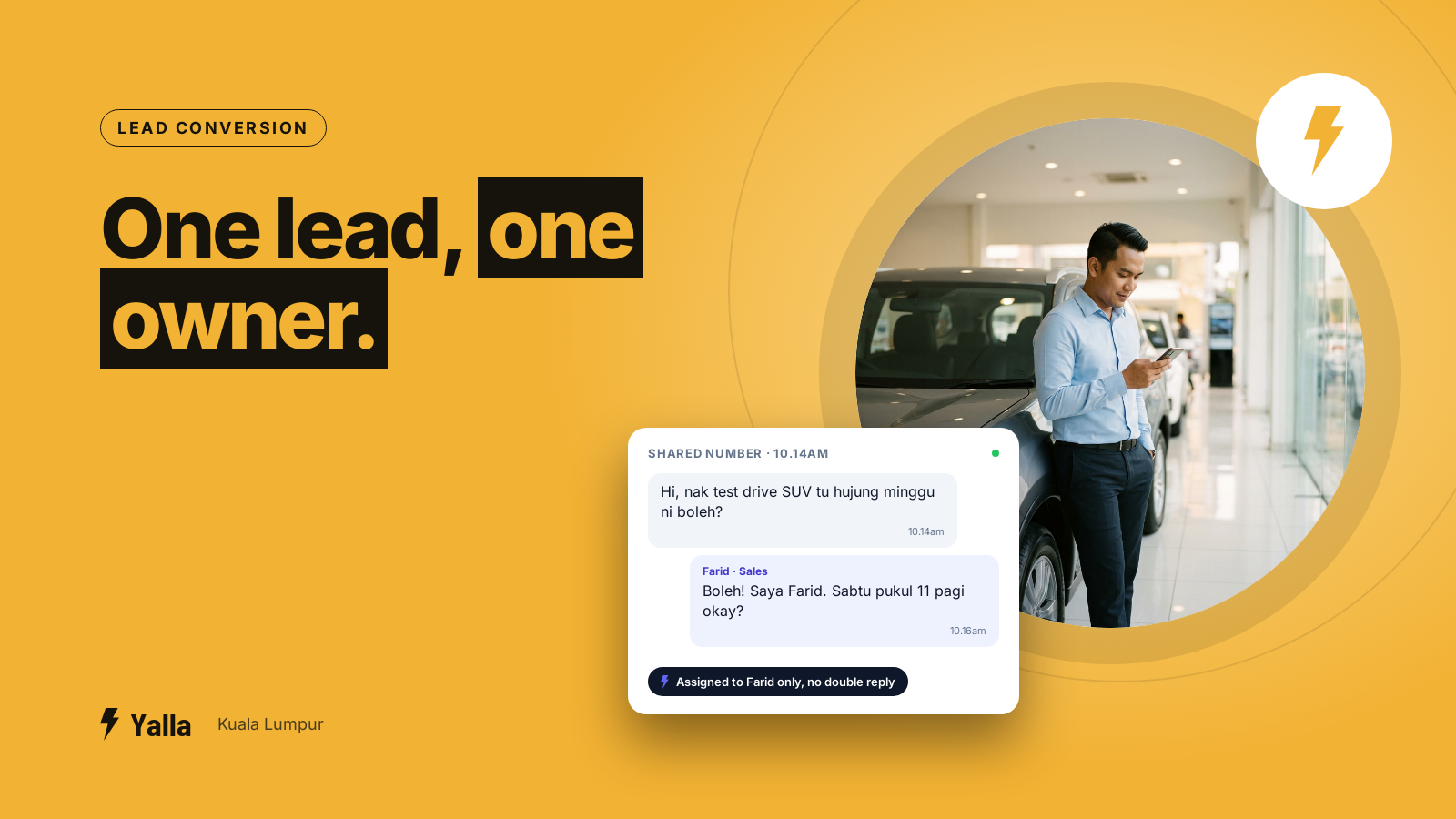
An enquiry lands on your company WhatsApp. Three salespeople at your Petaling Jaya office see the notification. Two of them reply, so the customer gets greeted twice, by two different names, with the same opening question. Another enquiry further down gets seen by everyone and answered by nobody, because each person assumed a colleague had it. By the time anyone notices, that lead has booked with a competitor in Subang who replied in four minutes.
This is the shared-number problem, and it's usually the moment a KL sales team starts looking at CRMs. What they want first is rarely a dashboard. It's something much simpler: when an enquiry arrives, one person owns it, that person knows it's theirs, and nothing sits unanswered because nobody was sure whose job it was.
Why one shared number drops leads and doubles others
When a team works from one WhatsApp number with no assignment layer, every enquiry is technically everyone's job, which in practice makes it nobody's. There's no record of who's handling what, so two things keep happening.
The first is collision. Several people answer the same customer because none of them can see a colleague already replied. It looks disorganised, and in a market where people compare three providers in the same evening, looking disorganised costs you.
The second is diffusion. The enquiry is visible to the whole team and picked up by no one, because responsibility is spread so thin it disappears.
The admissions team at a Malaysian international school described the physical version of this. They didn't share a number on several phones. They shared one handset:
"They have the physical phone and we just take it in turns."
Whoever holds the phone owns every enquiry that day, and whatever they didn't finish becomes the next person's mystery. The same school also routed parent enquiries by the family's language by hand, every morning. That's assignment, done manually, by someone who'd rather be talking to parents.
Free download
Setting Up WhatsApp Lead Routing: A Configuration Worksheet for KL Sales Teams
A practical companion to this article. Free for your email address.
Get it free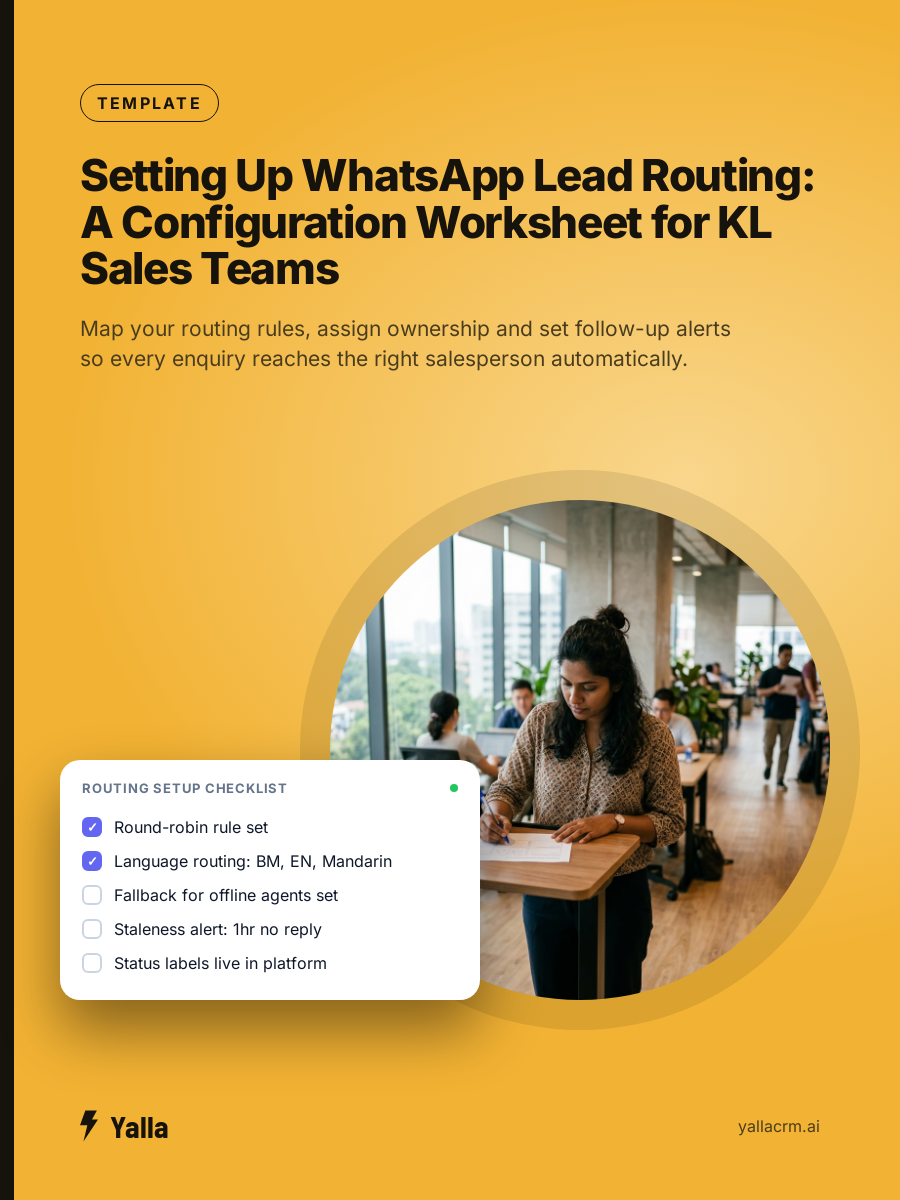
What assignment actually means
Lead assignment is the rule that decides which salesperson becomes the single owner of an incoming conversation, and makes that ownership visible to everyone. A properly assigned lead has one name on it, sits in that person's queue, and drops out of the general pile so nobody else picks it up by mistake.
Assignment and a shared inbox are different things. A shared inbox lets everyone see every conversation. Assignment decides whose responsibility each one is. You want both: shared visibility so a manager can step in, and clear ownership so accountability doesn't vanish. A shared inbox without assignment just gives more people the chance to trip over each other.
The main ways to route an enquiry
There's no single right method. It depends on how your team is set up and what your customers need. Most WhatsApp CRMs support some mix of these:
| Routing method | How it works | Best for |
|---|---|---|
| Round-robin | Each new lead goes to the next person in a fixed rotation | Teams where anyone can handle any enquiry and you want an even workload |
| Area or branch | Assign by the customer's location, say Cheras to one branch and Shah Alam to another | Multi-branch businesses and agents covering set areas |
| Language | Route by the language the enquiry arrives in | Teams getting Malay, English and Chinese enquiries on the same number |
| Product or skill | Match the topic to a specialist | Businesses with distinct product lines or service tiers |
| Priority or value | Send high-intent or high-value leads to your closers | Teams that separate qualifying from closing |
| Manual pick-up | People claim conversations from a queue | Very small teams where rules add more friction than they remove |
Round-robin is the usual starting point because it's fair and needs almost no setup. Most tools in this space handle it in similar ways. respond.io says it can assign conversations by availability, language, region, priority or department as well as round-robin, and SleekFlow documents rule-based routing. The mechanics are much the same everywhere. Where tools differ is what happens after the assignment, and that's where most teams actually leak leads.
Language routing deserves a special mention for Klang Valley businesses. If your Mandarin-speaking salesperson spends half her day passing Malay enquiries to a colleague, that's two handovers per lead and a customer who notices the delay. A rule that reads the first message and routes it takes that job off everyone.
Making sure the assigned person follows up
Assignment only covers the first thirty seconds. The bigger leak is silent stalling. A lead is assigned, the salesperson gets busy, the chat goes cold, and nobody notices until it's too late. Assignment without follow-up just moves the failure from "nobody replied" to "the assigned person forgot."
A routing setup worth paying for needs three more things:
- A staleness alert that fires when an assigned chat has had no reply within your target window, so a manager can reassign before the lead cools.
- Reassignment rules, so if someone is on leave or overloaded, the lead moves on instead of rotting in their queue.
- A status on every conversation, such as new, in progress, waiting on customer or closed, so anyone can see at a glance which leads are actually being worked.
For an owner or sales director, this is also the view you've been missing. On Monday morning you can see who has which lead, where each one stands, and which have been sitting untouched since Friday.
What should happen before a person is assigned
Here the routing question meets the AI question. The instant an enquiry arrives, something should acknowledge it, ask the one or two questions that decide where it belongs, and only then hand a warm, sorted conversation to the right person. If that first step waits for a person, your routing is only as fast as your slowest available salesperson, which at 9pm on a Sunday is nobody.
The more of your business the AI can see, the better it assigns. A routing engine that can read the enquiry, check whether this customer already exists, see which salesperson owns that account, and act on all of it will route more accurately than one looking only at the message text. That's the difference between "next person in the rotation" and "the person who already knows this customer."
In Yalla, the AI does the work rather than just chatting. Yalla Brain works across pipelines, WhatsApp, Instagram, Facebook, email campaigns and reporting from one instruction, so the same system that qualifies the enquiry also routes it, logs it against the right contact, and flags it if the assigned salesperson goes quiet.
Where auto-assignment goes wrong
Automation doesn't replace a sensible rule, and over-configured routing is a real failure. Three mistakes come up often.
Round-robin on a team with uneven skills. If your best closer and your newest hire get the same share of high-value leads, you're optimising for fairness at the cost of revenue. Once your leads differ in size, value-based routing matters more than equal shares.
Assigning to people who are offline. A rotation that hands a midnight enquiry to someone who's asleep, with no fallback, is slower than manual pick-up would have been. Availability has to be part of the rule.
Routing on too little information. Assigning purely on the first message, before anyone knows what the customer wants, sends enquiries to the wrong specialist and forces an internal handover the customer can feel. A short qualifying step first prevents most of this.
When a formal routing setup isn't worth it
If two people share the load and both can handle anything, a routing engine is overkill. Agree who covers which hours, pick up manually, and put your energy into speed of reply. Rules start paying off once the team is big enough for ambiguity to cause collisions, roughly three or more people handling inbound.
If your sales genuinely run on email, with long threads and formal proposals, a record-first CRM built around the email timeline will suit you better. If you need a very custom data model, something like Attio is built for that. And if your assignment logic has to satisfy enterprise audit trails and complicated permission hierarchies, Salesforce is designed for that weight. Yalla is built for teams whose leads arrive in chat and need to be owned, answered and followed up fast.
Frequently asked questions
What's the best way to assign leads to a sales team?
Start with round-robin if anyone can handle any enquiry, because it's fair and quick to set up. Move to area, language or product routing once your leads clearly differ and misrouting causes awkward handovers. Whichever you choose, add a staleness alert so an assigned lead that goes unanswered gets escalated before it cools.
Can WhatsApp assign leads automatically on its own?
No. The standard WhatsApp Business app has no assignment logic. Automatic routing needs the WhatsApp Business API connected to a CRM or inbox tool that adds the assignment layer. The app shows the messages. The CRM decides who owns each one.
How do I stop two salespeople replying to the same lead?
Give each conversation one visible owner the moment it arrives, and take it out of the general queue once assigned. When everyone can see a lead already belongs to a named colleague, the double replies stop.
Should AI qualify a lead before it's assigned?
Ideally, yes. A short qualifying step, asking what the customer wants and checking whether they're already a contact, means the lead reaches the right specialist already warmed up. Assigning on the raw first message is quicker to set up but sends more enquiries to the wrong person.
Free download
Setting Up WhatsApp Lead Routing: A Configuration Worksheet for KL Sales Teams
A practical companion to this article. Free for your email address.
Get it freeYalla is the chat-native CRM where the AI does the work, not just the talking.
See how much of your business it can reach.