
Your Team Shares One Enquiry Phone. Here's What It's Costing You
Plenty of Klang Valley teams still answer customers from one handset passed round the office. What that costs you, and when a shared inbox is worth it.
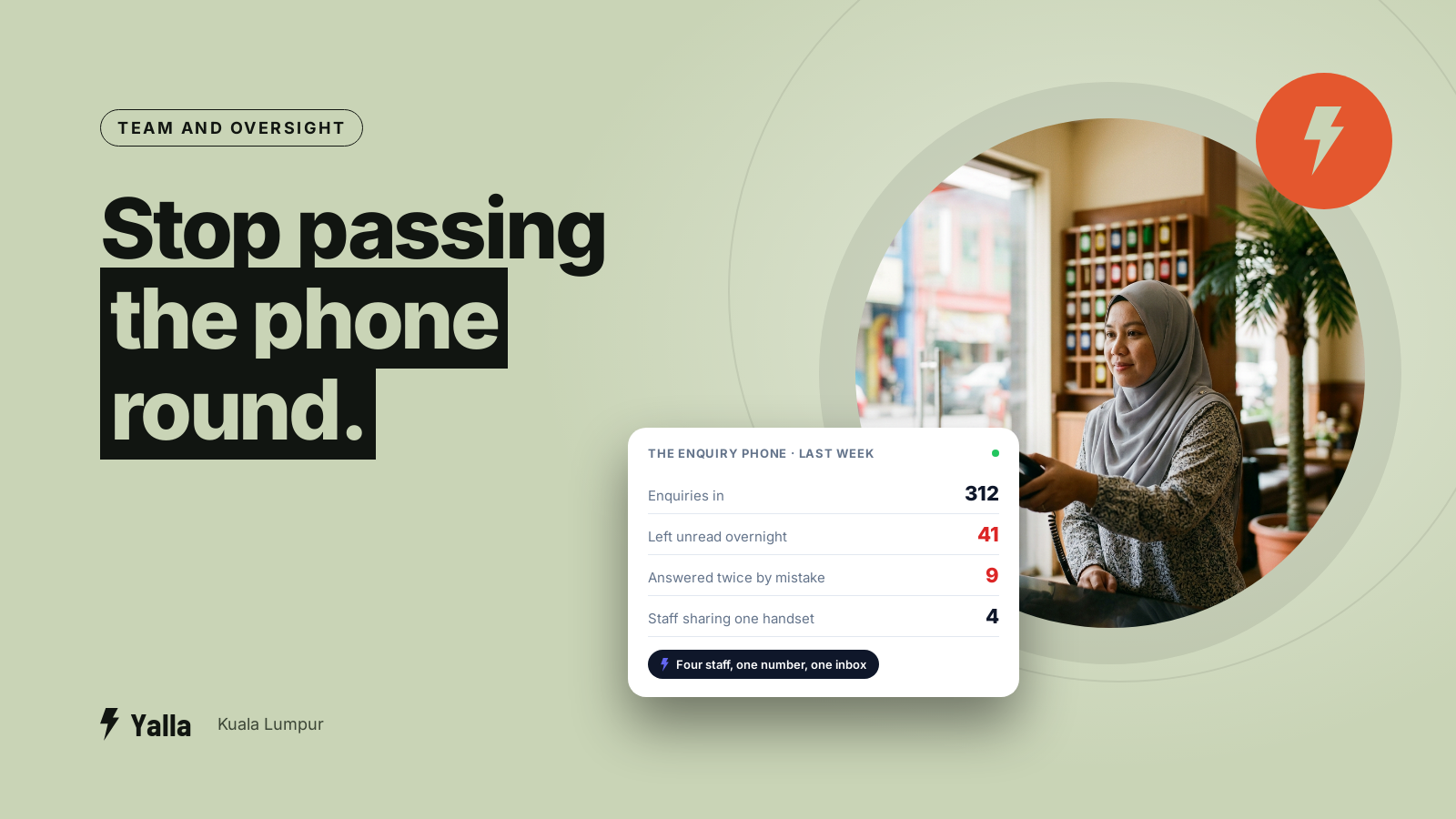
There's a phone in the admissions office of an international school in the Klang Valley that moves from desk to desk.
Whoever has it that day answers the parents' WhatsApp messages. The next day someone else takes it. When we asked how the team handles a shared business account, this is what they told us:
"It's handled by the team, but more like a single device that goes around. They have the physical phone and we just take it in turns, because otherwise it's quite a lot for one person."
And then, without being asked, the part that stayed with us:
"We do it manually instead of the normal way tech do it. You have multiple people logging into the business WhatsApp. We do it the other way around. So we rotate."
They know there's a normal way. They picked the handset on purpose, because the normal way hadn't worked for them.
If you run a sales or enquiry team anywhere between Petaling Jaya and Cheras, you've probably seen a version of this. One number on the website and on every Facebook ad, and one phone that has to be in the building for the business to answer anyone.
The same shape, different businesses
A budget hotel operator described his setup to us like this: "Currently, how it works in my hotel is my staff use WhatsApp Web to reply. I have the physical phone with me." One number, several staff, and a handset that ties the whole operation to whoever is holding it.
A private hospital group we met through a BNI chapter came at it from the other side. Their marketing lead wanted a single place that the departments dealing with the same patient could all see:
"And this platform should be able to be accessed by customer service department, billing department and marketing department. As for the three main touch points."
The school, the hotel and the hospital all have the same underlying problem. The conversations that matter most sit on one device, or inside one department, and the rest of the business can't see them.
Free download
The WhatsApp Team Inbox Playbook: How to Assign, Track, and Follow Up on Every Enquiry When Your Whole Team Shares One Number
A practical companion to this article. Free for your email address.
Get it free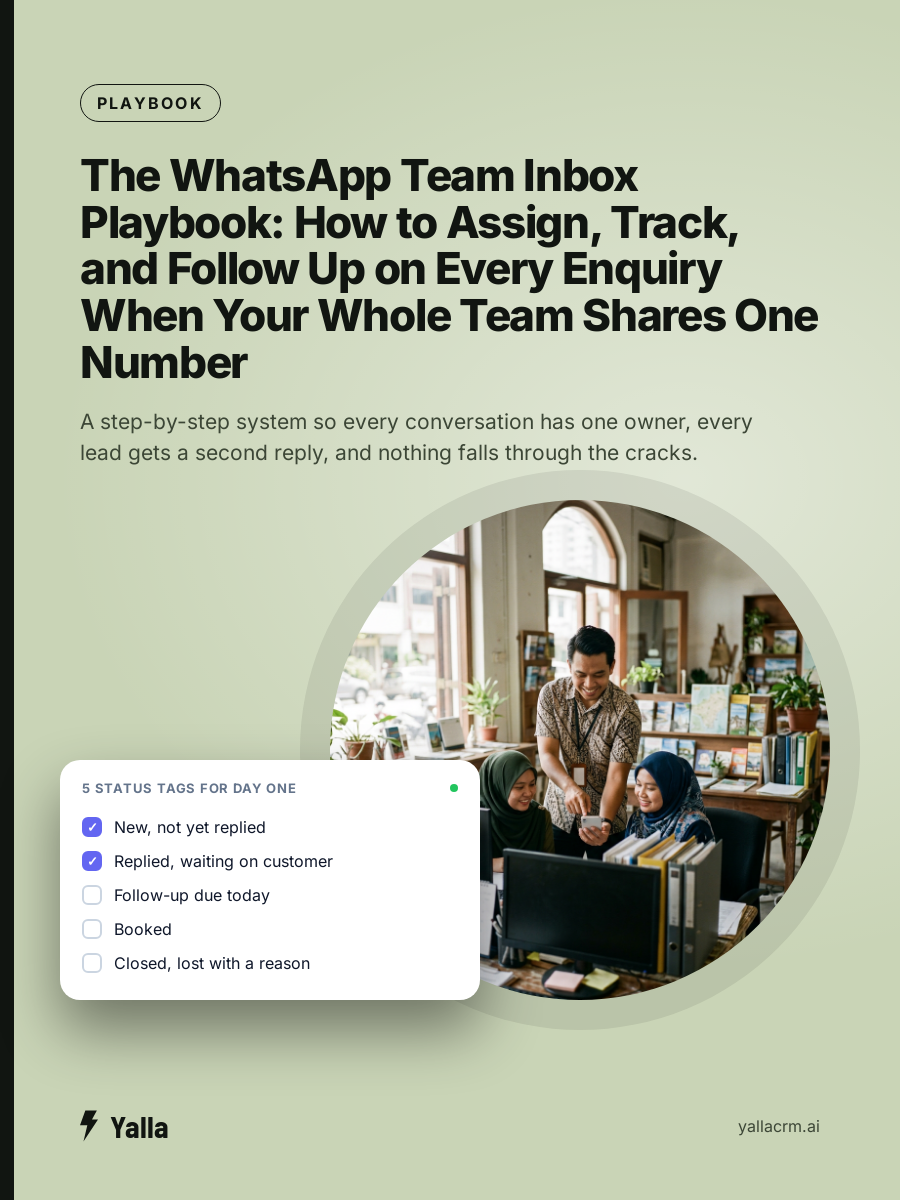
What it actually costs
Missed messages are the obvious cost. The expensive ones are quieter.
Nobody can check what was promised. When a parent says your colleague quoted a different fee last week, there's no record to open. The conversation lived on a phone, and whoever held it that day might be on leave today.
Nothing can be measured. The Head of Admissions at that school told us she can't produce a reliable enquiry-to-enrolment number: "It's incredibly manual, and if we did do it, it still wouldn't be particularly accurate because it would be sitting on lots of different data points." You can't improve a conversion rate you can't calculate.
Routing lives in one person's morning. At the same school, incoming enquiries are sorted by hand every morning. A visa question goes to one colleague. A family whose first language isn't English goes to whoever shares it. That's careful, thoughtful routing, and it exists entirely in one person's head. When she's off, it stops.
The history leaves with people. If your salespeople answer from their own numbers, the leads and the relationship go when they do. Picture a property agency in Mont Kiara where each negotiator works from a personal phone. The day the best negotiator resigns, two years of buyer conversations go with her, and the agency can't even list what it lost.
Why you can't just log everyone in
The WhatsApp Business app was built for one person with a few screens. You can link extra devices to the account, but they're companion screens for that same account. Everyone linked sees one shared list of chats. You can't hand a conversation to one person, there's no private view per agent, and nothing records who replied or how fast.
So a small team sharing the app ends up with two people answering the same customer a minute apart, a screenshot in the staff group asking "who's taking this one?", and a salesperson quietly replying from a personal phone because it's quicker. By Friday nobody can say which enquiry never got a second reply.
| Linked devices (Business app) | Shared team inbox (Business Platform) | |
|---|---|---|
| Built for | One person, several screens | A team, each with their own login |
| Assign a chat to one person | No | Yes |
| Private view per agent | No, everyone sees everything | Yes, by role |
| Report on who replied and how fast | No | Yes |
| History when someone leaves | Goes with the device | Stays with the business |
A shared team inbox runs on the WhatsApp Business Platform, which most people call the API. The number connects to a platform where every person has a login, conversations get assigned and tracked, and the number of agents depends on the tool you choose rather than on Meta's device limit. A team of four works the same way as a team of thirty.
The habit change nobody warns you about
Once the business number is on the Platform, your team stops answering it from the green app on their phones. They reply from the connected inbox, on a laptop or through that tool's own mobile app. Their personal WhatsApp stays exactly as it was.
For most managers that's the whole point, because it stops customer conversations living inside one salesperson's phone. It's still a change of habit, and habit is where rollouts stall. People drift back to whatever's quickest unless the new inbox is genuinely quicker for the thing they do all day.
The old fear was that moving to the Platform meant losing the number's chat history. Meta's coexistence option now lets an existing number run on the Business app and the Cloud API together, so you keep the number your customers already have saved and the chats already on it. Think of coexistence as a bridge for the move. On its own it won't turn the app into a team inbox. Check that your provider supports it before you switch, and back up anything you can't afford to lose.
How to tell if this is you
Answer these honestly. If two or more land, you have the problem.
- If your best person is off sick tomorrow, can anyone else see what they promised a customer last week?
- Can you say, without estimating, how many enquiries came in last month and how many became customers?
- Is there a physical phone that has to be in the office for your business to answer customers?
- When someone leaves, does anything of value leave with them?
What good looks like
The school's story is a warning against the easy advice to "just install a CRM". They'd bought software before, and it made things worse before it made anything better. That's part of why the handset exists.
Good is narrower than a transformation project:
- One number, many people, one history. Every conversation is visible to whoever needs it, and nobody has to hold a phone.
- Assignment that isn't someone's morning. Enquiries route by rule, whether that's topic, language, campus or product line, and a person can always override.
- A record that outlasts staff turnover. The conversation belongs to the business.
In practice it comes down to taking the handset out of the critical path.
Yalla does this by connecting your existing number to the Platform through coexistence, giving each person their own login to one shared inbox, and assigning new enquiries to the right owner automatically. An AI reply can greet and qualify an enquiry that lands at 11pm, so whoever picks it up in the morning starts with a sorted conversation. The manager sees response times and conversions by person instead of guessing.
Where this is overkill
We'd rather be straight about the boundaries.
- If your team is one or two people sitting in the same room, the rotating phone works. Fix it when it stops working.
- If your problem is too few enquiries, rather than mishandling the ones you get, this isn't your bottleneck. Sort demand out first.
- Moving salespeople off their personal numbers takes some persuading. Anyone who thinks of their contacts as theirs needs to hear what the shared inbox does for them, like fewer dropped chats and clear credit for the deals they close, before they'll use it.
The rough line is three or more people handling enquiries on one number. Below that, the free app is usually enough. Above it, the missing assignment and reporting start costing you deals you'll never hear about.
Free download
The WhatsApp Team Inbox Playbook: How to Assign, Track, and Follow Up on Every Enquiry When Your Whole Team Shares One Number
A practical companion to this article. Free for your email address.
Get it freeYalla is the chat-native CRM where the AI does the work, not just the talking.
See how much of your business it can reach.