
Should Your Business Automate Yet? Four Honest Reasons to Wait
Four objections to automation we hear on sales calls in KL, answered straight by a company that sells it, plus the signs it really is time to start.
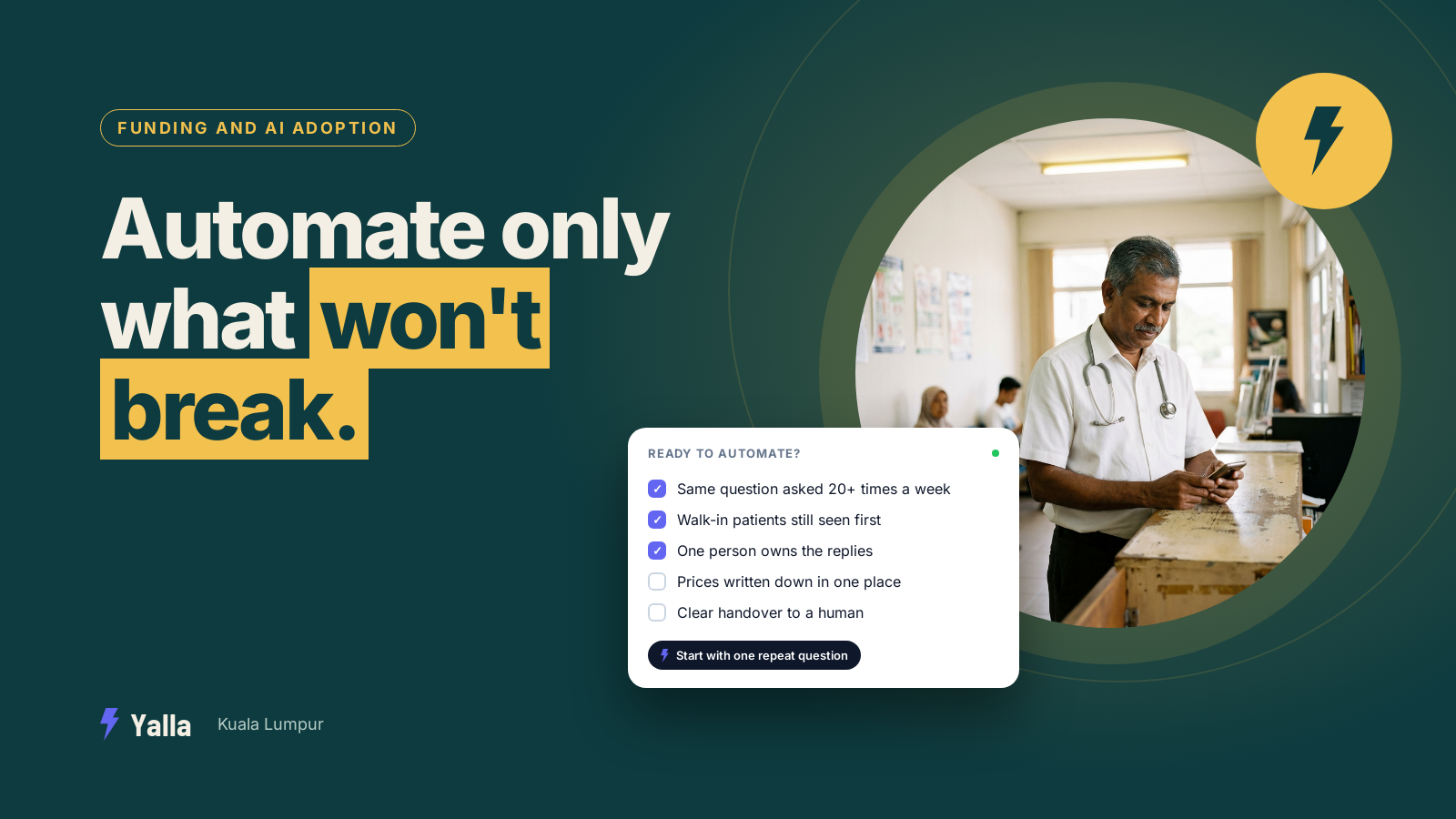
We sell automation software to businesses in KL and around the Klang Valley. This post argues against buying it in four specific situations, and we mean both of those things.
The reason is simple. The objections we hear on sales calls are usually better reasoned than the answers our industry gives them. So here are four, in the customers' own words, with our honest response to each.
1. "I'm scared it will break the thing that works"
A GP who had been thinking about automation for years:
"I thought about this automation a long time ago already, but I'm scared of implementing it. What if I miss? I know it's going to be good at generating online consultations, generating online appointments, but I'm scared if it impairs the walk-in treatments."
And then the exact mechanism of the fear:
"Walk-in patients are the ones requiring immediate or urgent treatment. They're sick, they need an MC. So I cannot tell them, okay, you come tomorrow, because I now have an appointment."
That's a correct analysis of his business, and it has nothing to do with being afraid of technology. His walk-in patients are urgent by definition. If online booking fills his day, he can't see the person who walks in ill at 11am, and that person is both his existing business and his duty as a doctor.
Our honest answer: he's right, and most booking automation would hurt him. The version that wouldn't leaves his calendar alone completely. It answers questions, gives accurate information about hours and fees, captures the enquiry, and leaves every capacity decision with him. If a vendor answers his objection with "our AI optimises your calendar", he should end the call. A well-reasoned fear deserves a narrower scope, and more reassurance won't fix it.
Free download
Should You Automate Yet? The 15-Minute Self-Assessment
A practical companion to this article. Free for your email address.
Get it free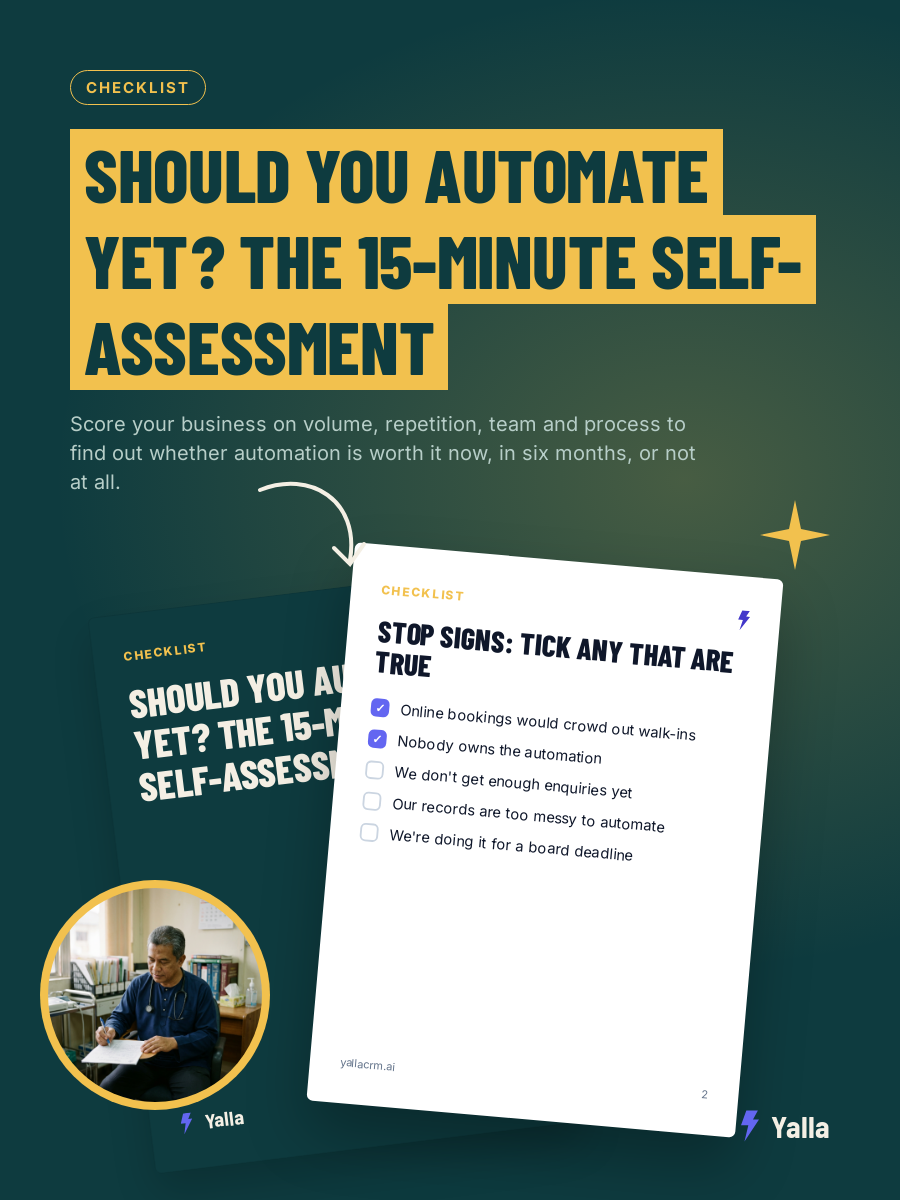
2. "What if it works and we can't cope?"
The same doctor, a moment later:
"I'm scared, I'm worried if we cannot meet up to the increased demand."
People rarely say this out loud, and it's completely legitimate. A business already at capacity gets nothing from more enquiries except a worse reputation. Automation that brings in demand you can't serve turns a growth problem into a service problem.
Our honest answer: if you're genuinely full, generating demand is the wrong project. What can still help is the efficiency side. The same tools that answer enquiries faster also strip out admin, and removing admin is how a small team creates capacity. Do that first, then open the tap.
3. "Everything is AI. Can I talk to a real human?"
The head of edtech at a five-campus international school group in Malaysia, in the middle of evaluating an AI product:
"I was hoping that it's a real human, because everything is AI. We will get frustrated. Like, can I get to talk to a real human?"
She then raised something sharper, that AI had made her own inbound worse:
"Many of the leads are not genuine... AI is too common already and it's too easily done, that the leads are not genuine."
Her team works to a one-hour response target and burns part of it on form submissions that were never people. For her, AI created a problem before it solved one.
Our honest answer: both points stand. A system that traps a parent in an AI loop with no route to a person is worse than a slow human, and for a school dealing with a family's visa or safeguarding question it's unacceptable. Whether AI is involved matters less than whether the handover to a person is fast, obvious and reliable. On fake leads, filtering helps, but she's right that it's an arms race, and we'd rather say so than pretend detection is solved.
4. "It looks overwhelming, and last time I gave up"
A property agent, after a short product walkthrough:
"As for me, I'm not quite familiar with all the systems, everything looks quite overwhelming."
An independent travel agent, on a previous tool:
"They will teach us how to do it and ask us to post on our own, which I do not know how to do, and that's a lot of restriction. That's why I just forget about it."
Picture a trading company in Puchong that paid a developer to build a custom quoting system, waited most of a year for it, and then watched the sales team quietly go back to their spreadsheets because the new screens took longer. Nobody announced the decision. The spreadsheet just won.
And an international school, on why it deliberately automates less than it could:
"With this automation tool that we use, it can be set up, but once it's broken then you have to manually come in and fix it. And that takes a lot of time. So we try to minimise the amount of automation that we do... I've experienced that way too much time."
That last one deserves attention. A well-run school made a considered decision to automate less, because its previous automation was fragile and fixing it cost more time than the automation saved. That's arithmetic, and they did it correctly.
Our honest answer: the failure rate in this category is high, and the cause is usually the handover rather than the product. That's why the questions in our piece on failed CRM rollouts matter more than any feature list: who builds the first version, what happens in month four, and whether there's a person to call. If you've been burned before, scepticism is the right posture, and the burden of proof sits with the vendor.
When you actually should
Having argued the other side properly, here's the positive case. Automate when:
- A specific, named task is eating hours. "We're inefficient" doesn't count. An international school worked it out with us on a call: about five minutes to key in each applicant and five more to check it, for 400 to 500 applicants a year. That's somewhere between 65 and 85 hours of admissions staff time, every year, on retyping. That's a target you can hit.
- You're losing customers to timing, not price. If enquiries from your Facebook ads go cold overnight and a competitor in the next mall replies first, that's a mechanical problem with a mechanical fix.
- Quality depends on who's on shift. When the same enquiry gets a different answer depending on which staff member picks it up, you have a process gap, and processes can be written down.
- You can't answer a basic question about your own funnel. A Head of Admissions who can't state her conversion rate is working hard with nothing that counts for her.
- Admin is the constraint, not demand. Automation multiplies what a team can handle. It's much worse at creating demand from nothing.
And when you shouldn't
- You don't get enough enquiries. Fix demand first.
- You're full and can't expand. Fix throughput first.
- Nobody owns it internally. A tool with no owner becomes shelfware, and we've seen a school paying full price while using a third of the features.
- You're doing it to meet a board deadline rather than to fix a problem you can name.
- Your data is so poor that automating on top of it would just make the mistakes faster.
- Your work is genuinely too custom. A bespoke furniture maker we met through BNI told us, near the end of our conversation: "I don't think your software can help much. That one is too custom, really, I don't know." He may well be right, and we'd rather hear that on the first call than in month four.
Honest assessment
We'd rather lose a sale than sell into the doctor's situation and break his walk-in practice. Partly because it's the right thing to do, and mostly because it's the durable choice. A customer who cancels in month four costs us more than the one we never signed, and costs them a subscription and a lot of goodwill inside their team.
If you're in one of the four situations above, the useful next step is a piece of paper. Write down the one task you'd want removed, and put a number on it: hours a week, enquiries lost, ringgit spent on ads that nobody followed up. If you can't fill in the number yet, it's too early, and that's a perfectly good answer.
Free download
Should You Automate Yet? The 15-Minute Self-Assessment
A practical companion to this article. Free for your email address.
Get it freeYalla is the chat-native CRM where the AI does the work, not just the talking.
See how much of your business it can reach.