
Leads That Don't Buy on the First Message: A SleekFlow Alternative for KL Sales Teams
For KL teams on SleekFlow whose sales no longer end in the chat: where SleekFlow stays the better commerce tool, and what to compare when you need a real pipeline.
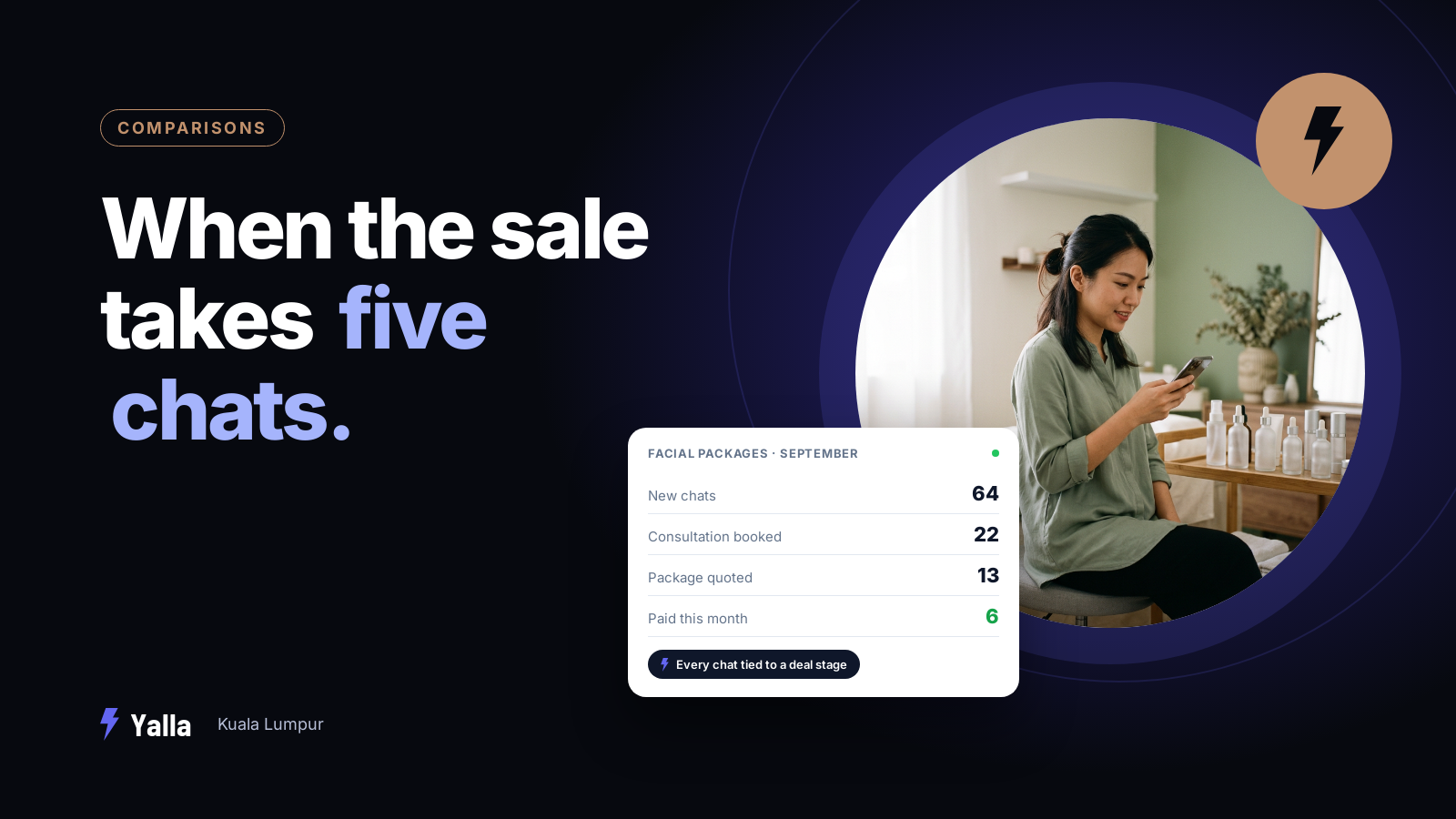
If your team already runs on SleekFlow, you know the category well. You have a WhatsApp Business API number, a shared inbox, broadcast campaigns, probably a product catalogue wired into the chat, and a few automation flows handling the repetitive replies. Plenty of Klang Valley businesses are set up exactly like this, from skincare brands in Puchong to furniture showrooms in Cheras.
So I'll skip the explainer and go straight to the question you're asking at renewal. Is a SleekFlow alternative worth the disruption, or is the tool you've got already the right shape for how you sell? The answer depends almost entirely on what happens after the first message. I'll say plainly where SleekFlow is the better choice, because otherwise the rest of this wouldn't be worth reading.
What SleekFlow is good at
SleekFlow is a WhatsApp-first omnichannel messaging and commerce platform. As of August 2026 its recognisable strengths are:
- a shared team inbox across WhatsApp, Instagram and Facebook
- broadcast and campaign messaging on approved templates
- a visual automation builder for routing and auto-replies
- commerce features that let a customer browse a catalogue and move towards a purchase inside the conversation
It was founded in Asia and is heavily used across the region, with real depth in Southeast Asia, and it leans into the social-commerce buyer who spots a product on Instagram or TikTok and finishes the transaction in chat.
That commerce flavour is the point. If most of your revenue is a person seeing a product, asking a quick question and paying without ever entering a formal sales process, SleekFlow is built squarely for that. Check the current tiers, message limits and commerce fees with SleekFlow directly before you decide anything. Pricing and packaging change, and I'm not going to quote a ringgit figure I can't stand behind this month.
Free download
Has Your Business Outgrown Your WhatsApp Tool? A Switcher's Self-Assessment for KL Sales Teams
A practical companion to this article. Free for your email address.
Get it free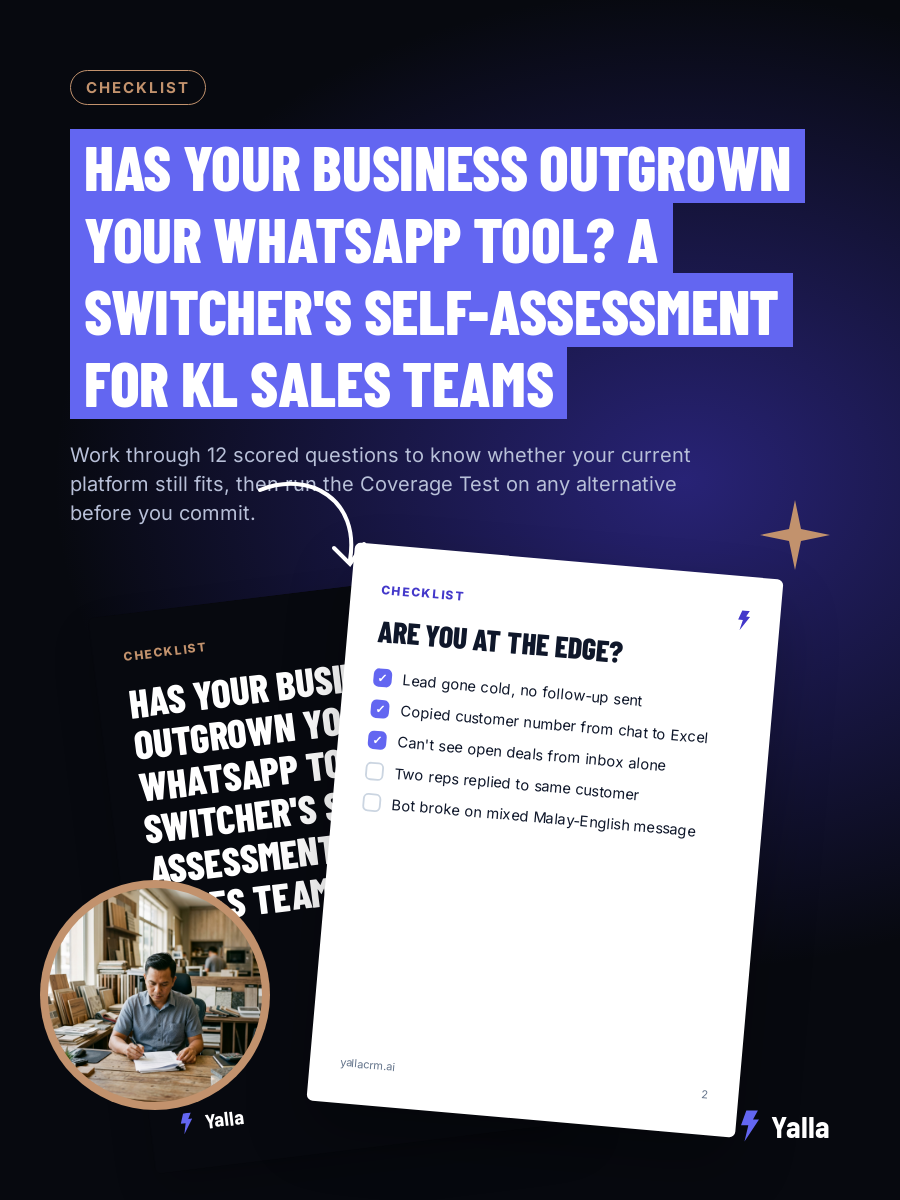
Where SleekFlow stays the better choice
Switching isn't automatically the right move. SleekFlow is still the better tool if one of these describes you:
- Your business is chat commerce from end to end. Discovery on social, a question in chat, payment in chat, done. If a sales pipeline would just be empty columns nobody uses, don't pay for one.
- You sell through catalogue-in-conversation. SleekFlow's commerce and social-selling features are a genuine strength for the browse-and-buy motion.
- Broadcasts are your growth engine. If your week is mostly segmented sends and promotions on WhatsApp and Instagram, with light follow-up, you're using the part SleekFlow does well.
- Your team is happy and the all-in cost is fair. A tool your staff already know, at a price you can live with, beats a slightly better feature set they have to relearn during your busiest season.
If two or more of those fit, renew and stop reading. A switch only pays off when the shape of your work has outgrown the tool.
When chat sales outgrow a messaging tool
The switch becomes worth thinking about when the sale no longer finishes in the chat. That tends to happen sooner than teams expect.
Picture a renovation contractor in Shah Alam. A homeowner messages about a kitchen. They don't book today. They need a site visit, then a quote, then a follow-up in three days because they're comparing two other contractors. Halfway through they ask about the bathroom too, which a colleague handles. Then they go quiet, and somebody is supposed to chase them.
Once a meaningful share of your revenue depends on what happens after the first conversation, you're running a sales process that happens to start in chat. That's when a messaging tool starts to leak, and the signs are specific:
- leads going cold because nobody owned the follow-up
- a rep copying customer details from the inbox into a Google Sheet
- a manager who can't answer "how many open deals are worth chasing this week" from the inbox alone
- an AI that writes a lovely reply but can't move the deal, book the visit or update the record afterwards
That manual hand-off between the chat and everything else is where the work piles up. Go back to the Shah Alam contractor. The homeowner's details sit in a WhatsApp thread, the site-visit date goes into someone's phone calendar, the quote lives in a PDF on a laptop, and the reminder to chase exists only in the rep's head. The messaging tool did its job. The conversation just had nowhere to go once the reply was sent.
What to compare when you're leaving SleekFlow
SleekFlow is built to turn a message into a checkout. When you outgrow it, the question is what turns that conversation into a customer record, a pipeline stage and a follow-up sequence that runs without somebody sitting in the thread.
Ask any alternative one blunt thing: once a customer sends a message, how much can the software do next on its own, without a person copying information between screens? Can it qualify the lead, move it to the right stage, book a slot on the calendar, schedule the follow-up for three days' time and update the record? Or does it stop at drafting the message and hand everything else back to your team?
| What to check at renewal | Messaging-tool answer | What you want if sales outgrew chat |
|---|---|---|
| After the reply is sent | A person takes it from here | The AI updates the record and moves the deal |
| Where deals live | In the inbox and in someone's head | In a pipeline with stages and owners |
| Follow-up when a lead goes quiet | Someone remembers, or nobody does | Triggered automatically, then chased |
| Booking a visit or call | Paste a link and hope | Booked inside the conversation |
| Reporting | Message and campaign stats | Deals, sources, conversion and response time |
Run that table against a real enquiry during any trial, in whatever mix of Malay, English and Chinese your customers actually use. Demos are always in tidy English.
How Yalla is different
Yalla is a chat-native CRM where the AI does the work as well as the talking. What separates it from a messaging-first tool is that the pipeline, the channels, the campaigns and the reporting sit in one place, so the AI can act across all of them from one instruction instead of stopping at the message.
Concretely, Yalla Brain acts across pipelines, WhatsApp, Instagram, Facebook, email campaigns and reporting from one instruction. So when a customer asks about a product and doesn't buy today, the same system can qualify them, put them in a pipeline stage, book the call, schedule the follow-up and tell you on Monday morning which open conversations are worth real money. In a chat-native tool the conversation and the sales process are the same object. Your reps stop reconciling two systems by hand.
Where Yalla isn't the answer
Here's where you shouldn't switch to Yalla:
- Your pipeline is email-led and document-heavy. A record-first CRM like HubSpot or Salesforce fits that motion better.
- You need a highly custom data model with bespoke objects and relationships. Attio is built for that flexibility.
- Enterprise compliance and procurement are the deciding factors. Salesforce is the safer institutional choice.
- You're pure chat commerce with no real follow-up. As above, SleekFlow's commerce features may simply suit you better than any CRM.
A CRM earns its fee when the money is in the follow-through. If the money is in the first message, keep the messaging tool.
Frequently asked questions
Is Yalla a direct replacement for SleekFlow?
For the shared inbox, WhatsApp and social messaging, and campaign sends, yes, those all live in Yalla. The difference is underneath: a real sales pipeline and an AI that acts on it. If you only ever needed the inbox and broadcasts, that's more CRM than your business needs, and SleekFlow may be the leaner fit.
Will I lose my WhatsApp number or chat history if I switch?
A WhatsApp Business API number can generally be migrated between providers, and what history you can export depends on your current plan. As of August 2026, confirm the exact porting steps and exportable history with both SleekFlow and the new provider before you start, and time the move to your renewal date so you're not paying twice.
We mostly sell through social commerce. Should we move at all?
Probably not, if the transaction really does complete in chat and there's little follow-up. SleekFlow's catalogue and social-selling features are a real strength for that. Reconsider only when a meaningful share of revenue depends on chasing customers after the first conversation.
How do I compare the AI in each tool fairly?
Ignore the demo. The underlying models are largely the same and every reply looks polished. Ask what the AI is allowed to act on after it writes the message: can it move a deal, book a call and trigger a follow-up, or does it hand the work back to a person? That one question separates a reply assistant from something that actually takes work off your team.
Free download
Has Your Business Outgrown Your WhatsApp Tool? A Switcher's Self-Assessment for KL Sales Teams
A practical companion to this article. Free for your email address.
Get it freeYalla is the chat-native CRM where the AI does the work, not just the talking.
See how much of your business it can reach.