
Your Sales Team Closes Deals in Chat: What a WhatsApp CRM Is, and When a KL Business Needs One
For most KL businesses the sale happens in a chat, not an email. What a WhatsApp CRM actually is, how it differs from a plugin, and how to judge one.
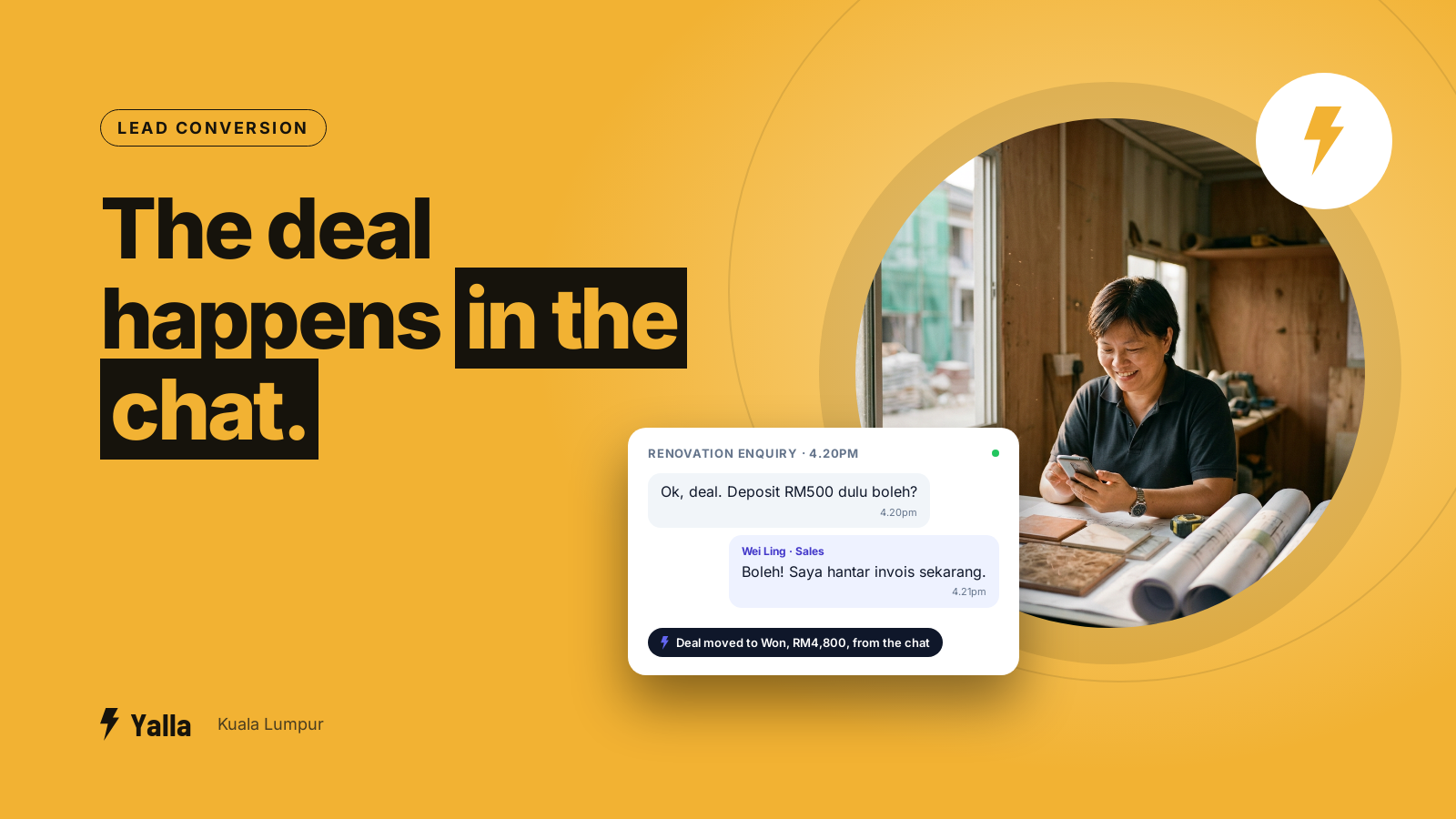
Ask a Kuala Lumpur business owner where their sales actually happen and the honest answer is usually "in WhatsApp". The Facebook ad sends people there. The walk-in customer asks for the number. The BNI referral gets passed on as a contact card. Then the deal is negotiated, confirmed and chased in a chat thread, often on one person's phone.
Most CRMs were designed around a different habit. They assume the email is where the conversation happens, and the record is where someone types up what was said afterwards. This article explains what a WhatsApp CRM is, how it differs from a CRM with a WhatsApp plugin, and how to judge one without getting lost in a feature list.
What a WhatsApp CRM is
A WhatsApp CRM is a customer relationship management system where the main place a deal is captured, tracked and moved forward is the chat thread. Contacts arrive from WhatsApp (and usually Instagram and Facebook messages as well), the conversation is stored against the customer's record, and the pipeline moves as the chat moves.
The difference that matters is the centre of gravity. A traditional CRM treats the record as the source of truth and the message as an attachment. A WhatsApp CRM treats the conversation as the source of truth and builds the record around it. That sounds like a small reshuffle. In practice it decides whether your team logs activity after the fact, badly and late, or whether the system captures it as it happens.
Here's what the "after the fact" version looks like in practice. Picture a dental clinic in Subang running a promotion for school-holiday check-ups. Past patients sit in the clinic system, the new enquiries from the Facebook ad sit in the front desk's WhatsApp, and someone copies names into a spreadsheet at the end of the day so the dentist can see who's coming. By Friday nobody's sure which of the forty people who asked about the RM99 check-up actually got a reply with a date.
Old patients in one place, new ad leads in another, and the follow-up done by hand. That's the gap a WhatsApp CRM is built to close.
Free download
The One-Week Sales Chat Audit: Count the Enquiries Your Team Is Losing
A practical companion to this article. Free for your email address.
Get it free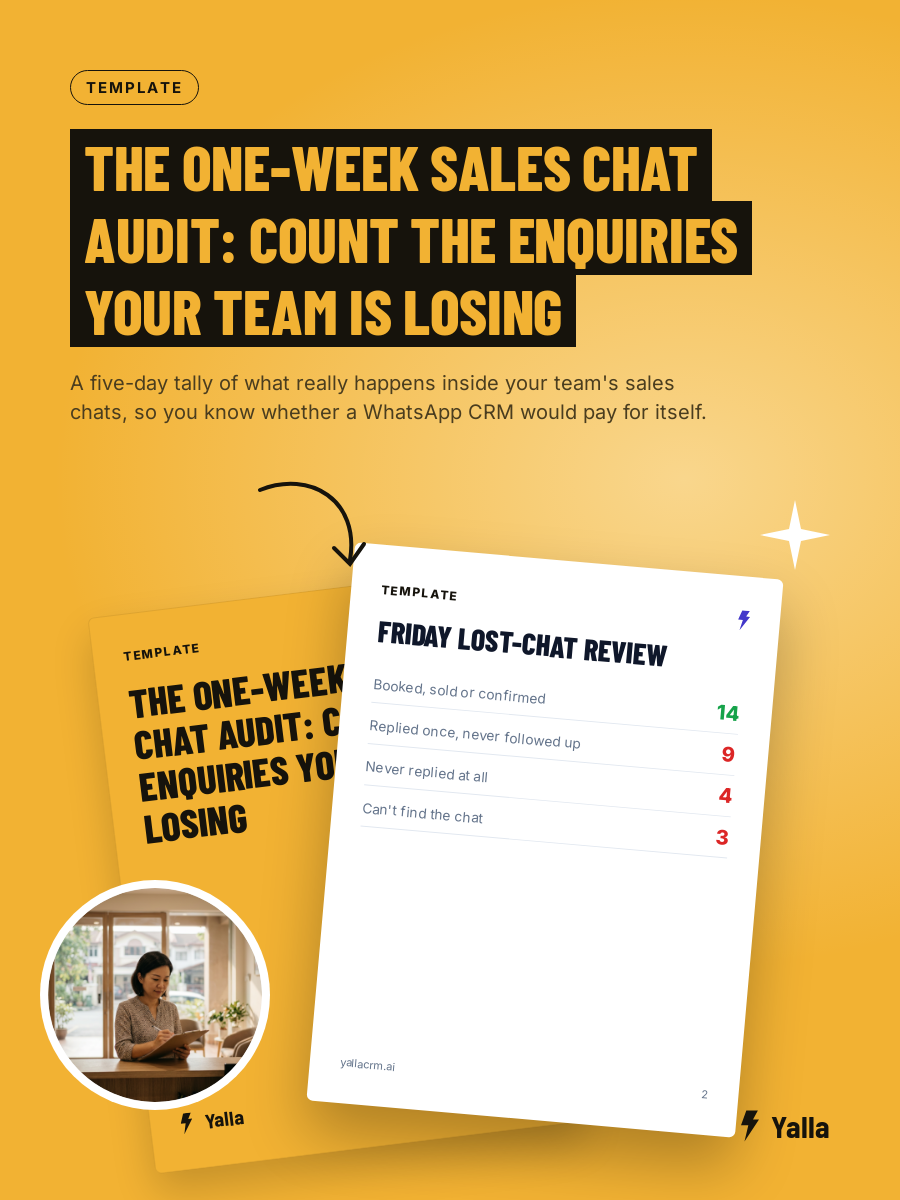
Why chat changes the CRM
Email is slow and formal. People expect a reply in hours or a day. WhatsApp is fast and personal. People expect a reply in minutes, and a silent thread reads as a no.
That gap breaks email-shaped CRMs in three concrete places.
Speed to lead. Someone who messages "still available?" at 9pm about a unit in Cheras wants an answer at 9pm. An email-shaped CRM puts it in a queue someone reads tomorrow, and by then they've messaged three other agents.
Who owns the thread. WhatsApp conversations run for weeks and feel personal. When a salesperson leaves, the thread often lives on their own phone and goes with them. A WhatsApp CRM keeps the number and the history with the business.
Who replies first. With real message volume, a person can't answer every thread the moment it lands. Either the system answers, or the enquiries that arrive after hours go cold.
The workaround most small teams land on is to share one phone, or to have everyone reply from their own. The first means only one person can work the inbox at a time. The second means the business can't see its own conversations. Either way you're a team doing its best with a tool built for one person.
A WhatsApp CRM versus a WhatsApp integration
Most CRMs now offer a WhatsApp integration. Usually that means messages can be sent and received inside the CRM, and maybe logged against a contact. It's useful, and it's a smaller thing than a WhatsApp CRM.
The test is reach, meaning the set of your systems the software can read from and act on. When a WhatsApp message lands, can it read the pipeline, the past campaign history and the Instagram thread, and then act across all of them? Or can it only show the text and wait for someone to do the rest?
| WhatsApp integration | WhatsApp CRM | |
|---|---|---|
| Where the message lives | A tab or a separate inbox | On the customer record |
| What the AI can reach | The current thread | Pipelines, chat channels, campaigns, reporting |
| Who moves the deal | A person, by hand, later | The system, as the chat happens |
| What happens after hours | Nothing until someone reads it | The first reply goes out |
An integration widens what you can see. A WhatsApp CRM widens what gets done without you.
Where the AI fits
Every CRM has an AI now, and arguing about whose model is smartest is a claim nobody can check. The more useful question is how many of your systems the AI can touch from a single instruction.
An AI that can only draft a reply is helpful. An AI that can read the pipeline, update the stage, send the message, tag the contact for next month's campaign and record the outcome is doing a salesperson's admin for them. That difference is most of the value.
It's how Yalla is built. One AI works across pipelines, WhatsApp, Instagram, Facebook, email campaigns and reporting, so "reply to this enquiry, tag her for the open day and move her to qualified" is one instruction. None of those pieces has to be the best of its kind on its own. The benefit comes from them being connected.
How to judge a WhatsApp CRM
Ignore the feature grid for a moment and score four things.
- Capture. Do leads from WhatsApp, Instagram and Facebook lead ads land on a record automatically, or does someone copy a phone number into a spreadsheet? Manual capture is where most pipelines leak before anyone has tried to sell.
- Response. Can the system answer the first message the moment it arrives, in Malay, English or Chinese, when nobody's at their desk?
- Reach. From one instruction, how many systems can the AI act on? A reply plus a pipeline update plus a campaign tag is reach. A reply on its own is a chatbot.
- Continuity. Does the business own the number, the threads and the history? If they live on a salesperson's personal phone, you have a liability with a good memory.
Then add a fifth that owners often forget: can you get a number out of it? The Head of Admissions at that school told us why she can't give a reliable conversion rate today: "It's incredibly manual, and if we did do it, it still wouldn't be particularly accurate because it would be sitting on lots of different data points." A WhatsApp CRM should make that number something you read off a screen on Monday morning.
To put a price on the gap, picture a furniture showroom in Shah Alam spending RM6,000 a month on ads that send people to WhatsApp. If a quarter of those enquiries never get a proper second reply, that's RM1,500 a month buying conversations nobody finishes.
When a WhatsApp CRM is the wrong choice
It isn't right for every business, and pretending otherwise would make the rest of this less believable.
- Your pipeline is email-led. If your deals genuinely live in long email threads with procurement and legal, a record-first CRM built around email will serve you better.
- You need a very custom data model. If your business runs on bespoke objects and relationships that don't look like a normal pipeline, a flexible CRM such as Attio is built for that.
- You need heavy enterprise compliance. If buying is governed by strict procurement, audit and certification requirements, an incumbent like Salesforce carries the controls that kind of buyer demands.
- You're one person with a handful of chats. The free WhatsApp Business app is enough until the threads outgrow you.
A WhatsApp CRM earns its place when your customers message you, expect a quick and personal reply, and your team is losing deals in the gap between "they messaged" and "someone answered properly".
WhatsApp Business and a WhatsApp CRM
People mix the two up, so it's worth separating them. WhatsApp Business is the messaging app, and the underlying Business Platform, for sending and receiving messages under a business profile. A WhatsApp CRM sits on top of that channel and adds the pipeline, the contact records, the automation and the reporting, so a conversation becomes a tracked deal rather than a message in an app.
You typically use the Business Platform as the channel and the CRM as the system that manages what happens on it. If a single person handles a small number of chats, the app on its own may be all you need. Once the threads outgrow one person, or leads start slipping through unanswered, or the history needs to belong to the business rather than to somebody's phone, that's the point to look at a CRM.
Free download
The One-Week Sales Chat Audit: Count the Enquiries Your Team Is Losing
A practical companion to this article. Free for your email address.
Get it freeYalla is the chat-native CRM where the AI does the work, not just the talking.
See how much of your business it can reach.