
Losing Leads Between Ads and Follow-Up? What an AI CRM Actually Is
What an AI CRM does for a Kuala Lumpur team selling on chat: how it differs from a chatbot, what it costs in ringgit, and when you should skip it.
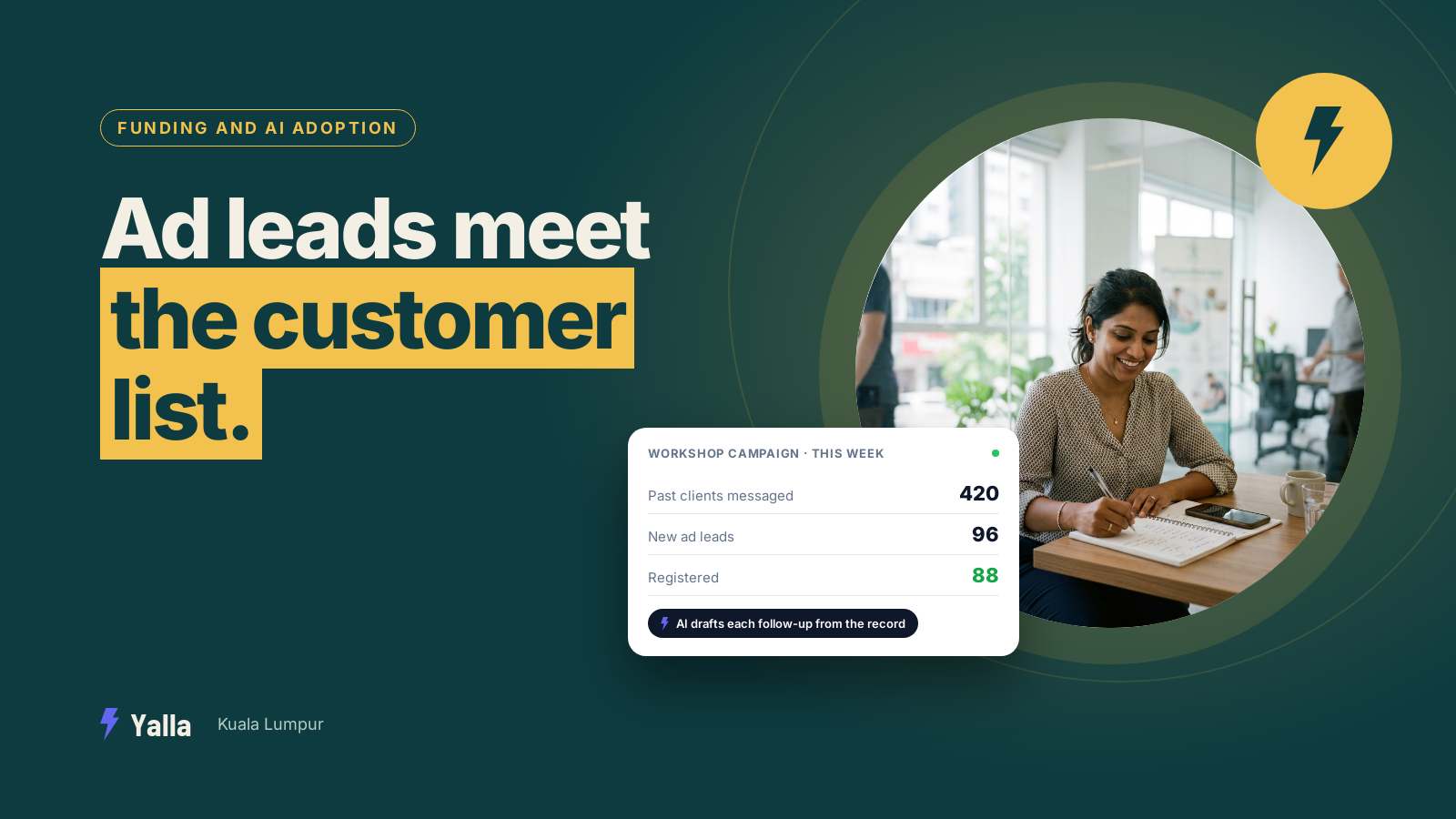
A private hospital group we met through a BNI chapter was planning a parent craft class for 150 couples. Their marketing lead described the plan on a call with us like this:
"So moving towards that event our strategy is to contact to reach our existing patient data through email and WhatsApp which have been done manually, and prospect from social media advertising and social media boosting. So if we can have that in one platform to manage from existing data and from the potential leads that comes in from the ads, it's more effective I think."
She didn't ask for an AI CRM. She asked for one place where the old patient list and the new ad leads could both be worked, by marketing, customer service and billing, without somebody doing it by hand. That's the problem an AI CRM is supposed to solve, and it's a better starting point than any vendor's definition. Most businesses in KL that go looking for one are in the same spot: leads arriving on WhatsApp, Instagram and Facebook, a team of three to fifteen people answering them, and no clear view of who replied to whom.
The short definition
An AI CRM is a customer relationship management system where the AI can read the same records and conversations your team can read, and take the same actions your team can take. It can answer an enquiry, ask the qualifying questions, assign the lead to the right salesperson, move the deal to the next stage, schedule the follow-up and log what happened.
A normal CRM is a filing cabinet with reminders. It stores the contact and waits for someone to act. An AI CRM does a share of the acting.
Every CRM on the market now claims an AI, from Salesforce and HubSpot to Zoho, Attio and the WhatsApp tools. So the label on its own tells you almost nothing. What separates them is how much of your business the AI is allowed to see and touch.
Free download
The AI CRM Demo Scorecard: 10 Tests With Your Own Chats
A practical companion to this article. Free for your email address.
Get it free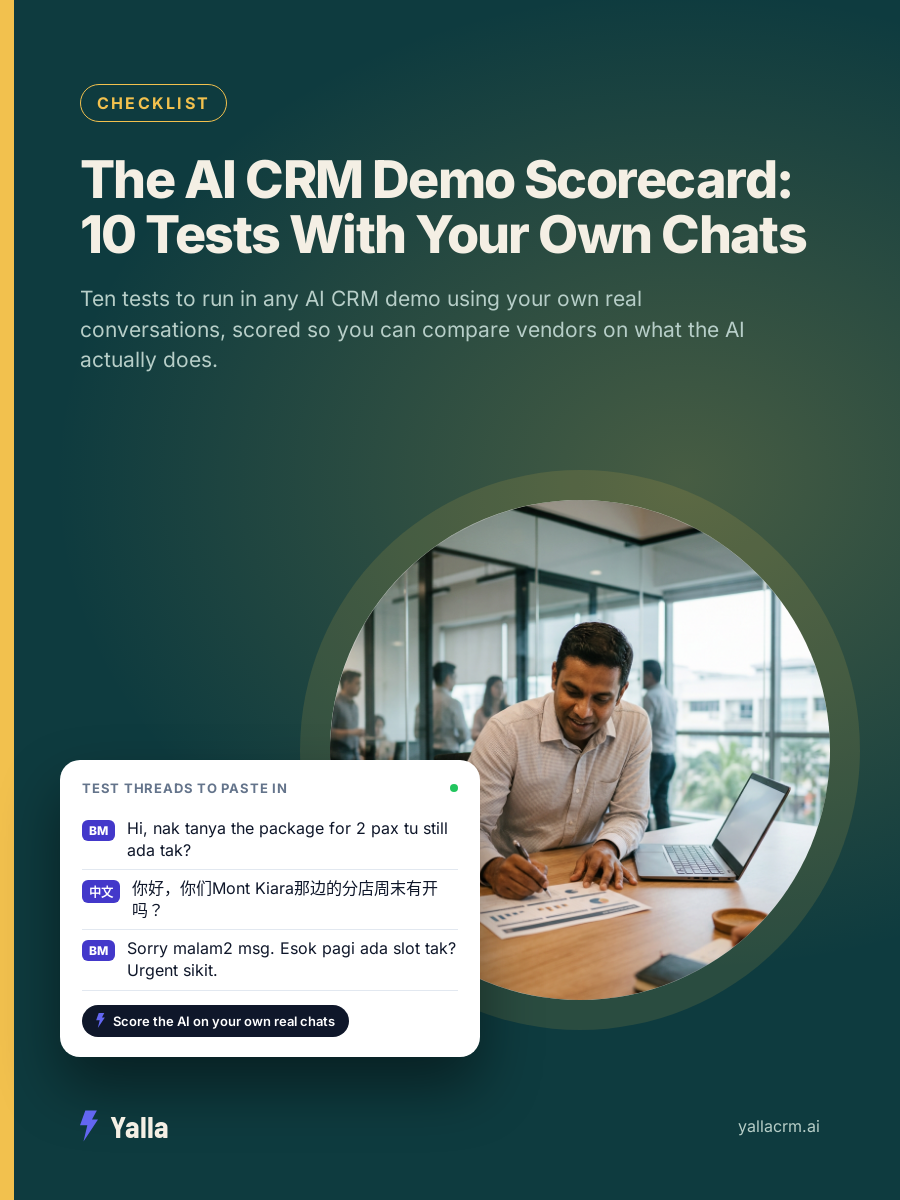
What an AI CRM actually does day to day
Strip out the marketing and the real work falls into five groups. Most products do some of these. Few do all of them well.
- First reply and qualification. The enquiry that lands at 10.40pm on a Friday gets an answer straight away. The AI asks what the customer needs, their budget or timing, and which branch suits them, then books a call or a visit if they're ready.
- Routing and assignment. The lead goes to the right person without anyone forwarding screenshots. A Mont Kiara enquiry goes to the Mont Kiara branch. A Mandarin speaker goes to the salesperson who speaks Mandarin.
- Follow-up. When a prospect goes quiet after a quote, the AI notices and sends the nudge, instead of relying on someone remembering on Monday.
- Keeping the record honest. Duplicate contacts merged, missing fields filled, the deal moved to "quoted" because a quote was actually sent. The pipeline shows what happened, not what someone remembered to update.
- Summaries and reports. A 60-message thread becomes a two-line status. A question like "how many Facebook leads did we lose last week" gets an answer without building a dashboard first.
The difference shows up on a Monday morning. A traditional CRM gives your team a list of 40 leads to work through. A decent AI CRM gives them the six that need a human, with the other 34 already replied to, sorted and followed up.
How is an AI CRM different from a chatbot?
This is the question we get asked most, and the confusion is fair, because a lot of chatbots now call themselves AI CRMs.
A chatbot is a conversation layer. It answers a message from a script or a knowledge base, and when it hits the edge of what it knows, it hands over or stops. Its job ends at the reply. It usually doesn't own your pipeline, your contact history or your reporting.
An AI CRM treats the conversation as one input. After it replies, it matches the message to an existing contact, decides whether the lead is worth chasing, assigns an owner, moves the deal and sets the next task.
| Chatbot | AI CRM | |
|---|---|---|
| Main job | Reply to a message | Reply, then update the record and the pipeline |
| What it can see | Its own script or knowledge base | Contacts, deals, past conversations, campaigns |
| After the reply | Handover or dead end | Lead qualified, owner assigned, follow-up set |
| Channels | Usually one | Every channel it's connected to |
| How you judge it | Questions deflected | Enquiries converted and hours saved |
A chatbot that can't change a deal stage is a support tool with a sales badge on it. You judge an AI CRM by what happens to the pipeline after the chat.
Assistant or agent
You'll hear vendors use both words. They mean different things.
An AI assistant waits for you. You ask it to draft a reply or summarise a deal, it hands the result back, and you still send it, save it and chase it. It makes the person faster.
An AI agent finishes the task. Tell it "follow up everyone who went quiet after a quote this month" and it finds those contacts, writes the messages on the right channel, sends them, logs the activity and moves the deals. It removes the task. "Agentic CRM" is simply the newer name for a CRM whose AI works this way.
Both are useful. But an assistant doesn't help with the enquiry that arrives when nobody is at their desk.
The one thing to check before you buy
Before you judge how clever the AI is, map where your customers actually talk to you. Then check whether the AI can read and act in each of those places from inside the CRM, without paying for a middleware connector on top.
Run this on any product you're considering:
- List your inbound channels in order of volume. For most KL businesses the list starts with WhatsApp, then Instagram and Facebook, then a website form or email somewhere further down.
- For each channel, ask: can the AI read the full conversation here, and can it reply and update the record here?
- Ask it to handle a real, messy thread from your busiest channel. In the Klang Valley that usually means a customer switching between Malay and English mid-sentence, or writing in Chinese. See whether the summary is right and whether you'd actually send the reply.
- Ask what happens to a message that arrives at 11pm. "It drafts a reply for your team to approve in the morning" and "it answers, qualifies and books now" are two very different products.
If the AI only covers the third and fourth channels on your list while your customers live on the first, no amount of model quality fixes that. The models underneath most of these products are now broadly similar. The coverage is where they differ.
Why this matters more from 1 October 2026
Meta starts charging for WhatsApp service messages on 1 October 2026. Those are the free-form replies your team or your bot sends inside the 24-hour customer service window, which used to be free. They'll be billed at the utility rate on Meta's rate card for Malaysia. Conversations that start from a Click-to-WhatsApp ad or a Facebook Page button still get their free window. The change applies to the WhatsApp Business Platform (the API), not the WhatsApp Business app on your phone.
The practical effect is that every unnecessary back-and-forth now has a cost. A bot that asks three clarifying questions to do one job pays three times. An AI that can read the customer's history and resolve the enquiry in one accurate reply sends fewer messages and costs less. Check the current Malaysian rate on Meta's pricing page, because it's set per country and revised from time to time.
What an AI CRM costs
The sticker price and the working price are rarely the same, because the AI is increasingly metered separately from the seats. A snapshot of list prices, which are set in US dollars:
| Product | Entry pricing (as of August 2026) | Where the AI cost hides |
|---|---|---|
| respond.io | Plans priced in US dollars, roughly RM330, RM670 and RM1,170 a month at current rates | Tiered on monthly active contacts, so cost climbs with volume |
| Attio | Free for small teams, then priced in US dollars per seat, roughly RM120 to RM290 a seat a month | AI and enrichment run on credit pools. Extra workspace credits cost about RM630 a month |
| HubSpot | Free tier, paid tiers that scale steeply with seats | AI agents spend credits per task completed |
On top of whichever tool you pick, you pay Meta's WhatsApp charges separately. Read past the seat price to how the AI itself is billed: credit pools, active-contact tiers and add-on modules are where a cheap-looking tool becomes an expensive one at your real volume. Confirm current figures on each vendor's own pricing page, because they move every quarter.
Which kind of CRM fits which business
There's no single best AI CRM. There's the one whose coverage matches where your conversations happen.
| Your setup | Best-fit shape | Why |
|---|---|---|
| Leads arrive on WhatsApp, Instagram and Facebook | Chat-native CRM, such as Yalla | The AI can read and reply where customers already are |
| The team lives in email and proposals | Record-first CRM | Conversation and record are already one surface |
| You need bespoke objects and a flexible data model | Data-model CRM, such as Attio | The structure bends to how you work |
| Regulated enterprise with heavy process | Salesforce-class | Compliance and deep customisation are the point |
Where an AI CRM is the wrong choice
Honest scoring, because it's what makes the rest believable.
- Email-led, document-heavy sales. If your pipeline lives in long email threads, tenders and formal proposals, a record-first CRM built around email will serve you better than a chat-native one.
- Custom data models. If your business needs objects and relationships that don't map to contacts and deals, a configurable tool like Attio will bend to you in ways an opinionated AI CRM won't.
- Enterprise compliance. Deep audit trails, granular permissions and procurement-grade security reviews are what Salesforce and the large incumbents are built for.
- You only want broadcasts. If all you need is to send promotions to a list for Hari Raya or the year-end sale, a messaging tool is cheaper. An AI CRM is overkill for one-way blasts.
An AI CRM earns its keep when a team has conversations arriving faster than people can answer them, and those conversations need to become qualified, assigned, followed-up pipeline.
Where Yalla fits
Yalla is built for teams whose enquiries land on WhatsApp, Instagram and Facebook and need to be answered, assigned and followed up before they go cold. Yalla Brain acts across pipelines, WhatsApp, Instagram, Facebook, email campaigns and reporting from one instruction. That's the coverage test above, in practice: one instruction that works across the channels and the pipeline, instead of a draft you then have to route and log yourself.
We don't claim the smartest model in the category. Model quality has converged and pretending otherwise would be dishonest. What we'd point to is the connection between the parts, which is exactly what that hospital marketing lead was asking for: the old list and the new leads in one place, visible to every department that touches the patient.
Frequently asked questions
Will an AI CRM replace my sales team?
No, and be wary of anyone who says it will. It takes over the mechanical layer: the first reply, sorting, routing, chasing and logging. Your people spend their time on the conversations that need judgement and a relationship, which in this market is most of the ones that close.
Do I need an AI CRM if I already use the WhatsApp Business app?
The app works for one phone. It doesn't assign enquiries across a team, track them through a pipeline or follow up on its own, and it gets messy once three or four people are sharing one number. If enquiries are slipping through, a CRM with WhatsApp built in gives you the routing and follow-up the app can't.
What's the difference between an AI CRM and a WhatsApp CRM?
A WhatsApp CRM organises your WhatsApp conversations into a shared inbox with contact records. An AI CRM adds an AI that can act on those records. Plenty of products are both. Look past the label at what the AI is allowed to read and change once a message comes in.
Is an AI CRM worth it for a small team?
Often more than for a large one. Small teams feel dropped enquiries hardest, because there's nobody covering the gap at 9pm or during lunch. If your business runs on long email-led sales cycles, the return is smaller and a traditional CRM may be enough.
Free download
The AI CRM Demo Scorecard: 10 Tests With Your Own Chats
A practical companion to this article. Free for your email address.
Get it freeYalla is the chat-native CRM where the AI does the work, not just the talking.
See how much of your business it can reach.