
What Your Sales Team's Customer Replies Will Cost From 1 October 2026
Meta's October 2026 change puts a price on replies your KL team sends inside the 24-hour window. What changes, who pays, and how to keep the bill down.
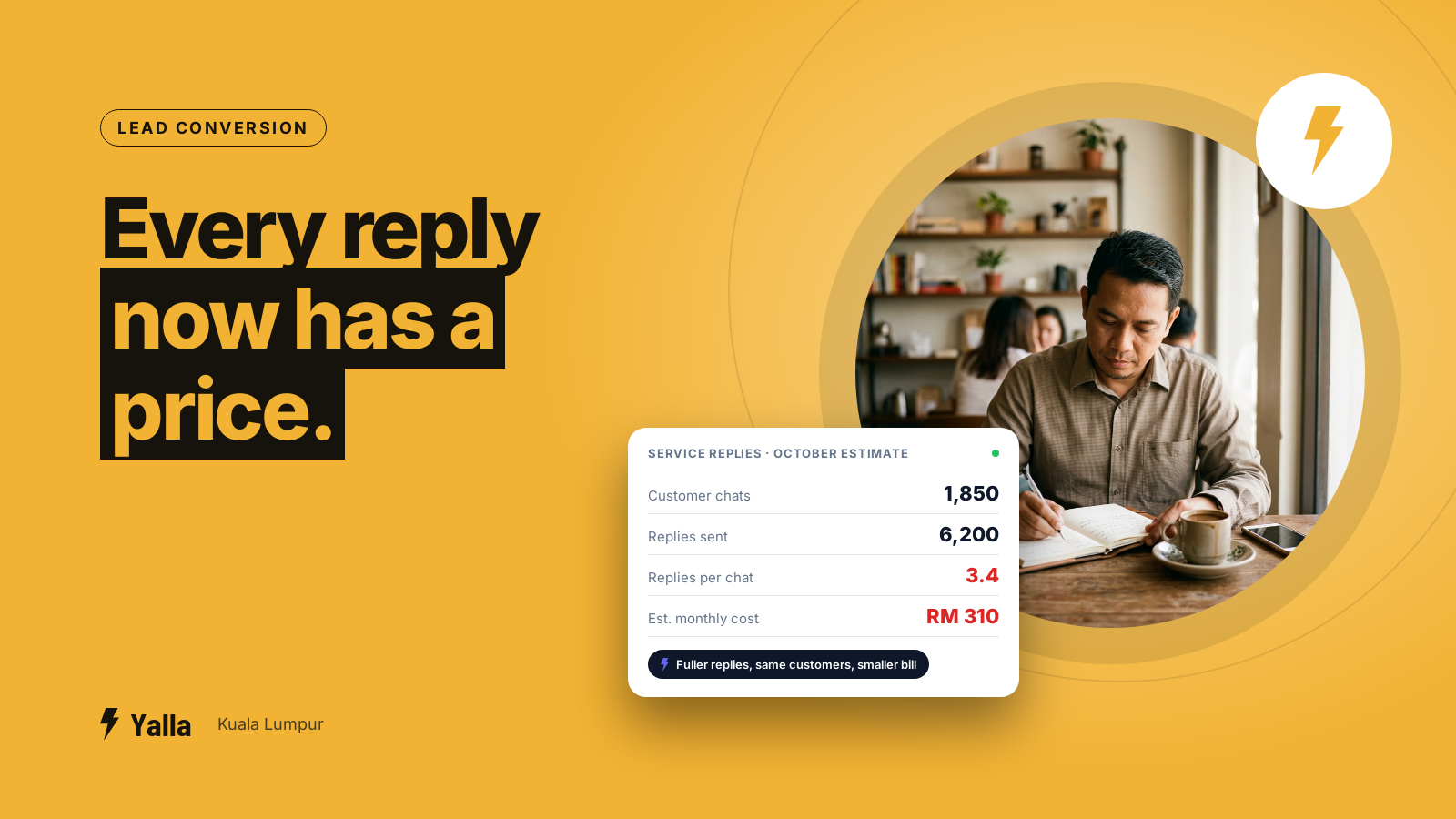
If your team in Petaling Jaya or Bangsar answers customer enquiries on WhatsApp all day, Meta is putting a price on something you have never paid for. From 1 October 2026, the replies your staff send inside the 24-hour customer service window become billable, one message at a time.
It is an easy change to miss. The wording is small and the effect is large, because it lands on the part of the channel a busy Klang Valley sales team uses most: the ordinary back-and-forth with a customer who has just messaged you.
This piece covers what changes, who pays, and the practical ways to keep the bill down without answering fewer people.
What changes on 1 October 2026
Until now, once a customer messaged you, a 24-hour service window opened and your team could reply freely inside it at no charge. Meta's published guidance, as summarised across provider briefings in August 2026, ends that on 1 October:
- Service messages become billable per message. Free-form replies your team sends inside the 24-hour window are charged individually.
- Utility templates lose their in-window free status. Order updates, appointment confirmations and similar utility templates sent inside an open window had been free since July 2025. That carve-out goes.
- Service messages get no volume discount. They are priced at the same per-message rate as utility and authentication templates in each country, but unlike templates they don't get cheaper as your volume grows.
- Rates are set per country. Meta said it would publish per-country rates by 1 September 2026. Take the Malaysia figure from your provider's current rate card. Rates have moved more than once, and a number copied from a blog post goes stale fast.
This follows the July 2025 change, when Meta dropped conversation-based pricing and started charging per delivered template message. Put the two together and nearly every message a business sends on the WhatsApp Business Platform carries a price.
Free download
What Meta's New WhatsApp Charges Will Cost You
A practical companion to this article. Free for your email address.
Get it free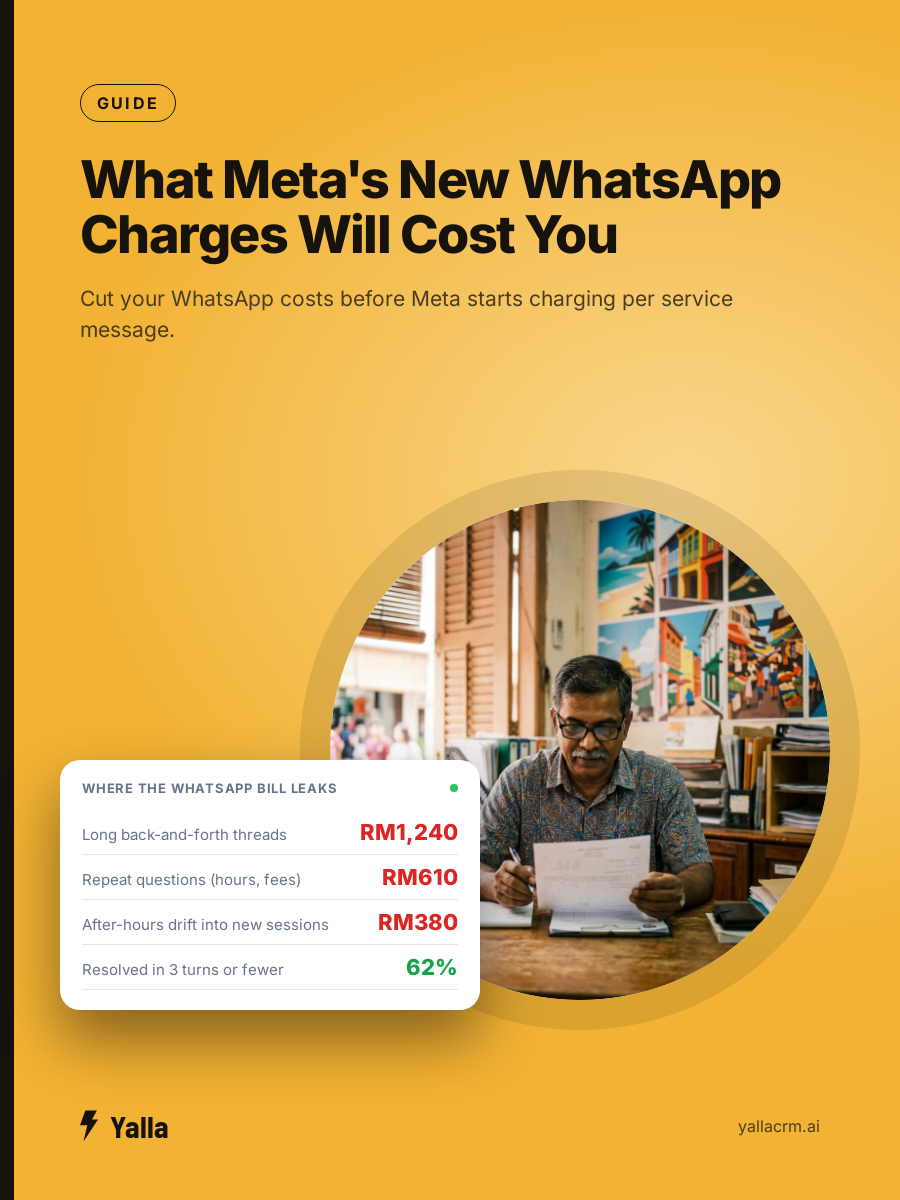
Who pays, and who doesn't
The change applies to the WhatsApp Business Platform, the official API. If your business connects WhatsApp through a CRM, a shared inbox, a chatbot vendor or any provider on the official API, you are in scope.
The free WhatsApp app and the standalone WhatsApp Business app on a phone are not affected. A sole trader in Subang replying from her own handset pays nothing new. The businesses that pay are the ones with a team working one number through the API, which happens to be the set of businesses sending the most replies.
A separate change is worth keeping apart in your head. Since 1 August 2026, replies written by Meta's own AI, the Meta Business Agent, have been billed by token. That is priced in US dollars, roughly RM8 per million tokens at current rates, which provider briefings put at around 20 sen a reply. It is Meta's AI, metered by use. The AI inside your CRM doesn't carry that Meta token charge, so don't add the two together when you work out your exposure.
Why teams feel it and solo sellers don't
Think about how a normal enquiry runs at a furniture showroom in Puchong. A customer asks in Malay whether a sofa is in stock. The salesperson replies "let me check." Then asks which colour. Then confirms it is available at the Shah Alam warehouse. Then asks if there is anything else. Four replies for one question. Until October all four were free inside the window. From October that is four billable messages for a low-value exchange, repeated across every chat, every day, by every person on the team.
The more human back-and-forth it takes your team to finish a thread, the more the new pricing costs you. A handover from the Chinese-speaking salesperson to the Malay-speaking one, with "let me pass you to my colleague" and a fresh greeting, adds messages without adding anything the customer needed.
Message count matters more than the rate
It's tempting to wait for the rate and then do the maths. The rate is half the equation, though, and it's the half you can't touch. The half you control is how many messages it takes to finish a conversation.
Here is the arithmetic without guessing at Meta's number. Say five salespeople each close out 60 conversations a day, and the average conversation takes five replies from your side. That is 1,500 billable messages a day, or around 33,000 in a 22-working-day month. Whatever the Malaysia rate is, 33,000 is the figure it multiplies. Bring the average down to three replies and it drops to about 20,000. That saving holds at any rate, and it still holds if Meta changes the rate again next year.
So efficient WhatsApp support now has a third measure alongside response speed and headcount: how much of the customer's need you settle in the fewest turns.
Push new enquiries through the free entry points
According to Meta's guidance as of August 2026, conversations that start from a click-to-WhatsApp ad or a Facebook Page call-to-action button still qualify for free message delivery. Confirm the current terms before you plan spend around it. If it holds, your channel mix now has a direct cost effect.
- Send paid social traffic to click-to-WhatsApp ads rather than a landing form, so the conversation starts in the free entry point.
- Put WhatsApp buttons on your Facebook Page and Instagram profile, so inbound interest opens the same way.
- Keep templates for genuine re-engagement of people who have gone quiet.
Where an AI CRM lowers the bill
Most "WhatsApp AI" can hold a conversation. It greets, it understands the question, it replies politely. If it can't look up the order, check the booking calendar, read the pipeline or update a record, it ends up doing what a stretched human does: asking follow-up questions and stalling until someone takes over. More messages.
What cuts the count is how many of your systems the AI can read and act on. An assistant that can pull the order status, confirm the delivery slot and answer in one message costs you one message. An assistant that only sees the last line of the chat has to ask for the order number, then the name, then the date. Under per-message pricing that difference turns up on the invoice.
Yalla is a chat-native CRM built around that idea, with an AI that does the work inside the conversation as well as the talking. Yalla Brain acts across pipelines, WhatsApp, Instagram, Facebook, email campaigns and reporting from one instruction, so it can close a WhatsApp thread by fetching and updating the record itself instead of handing the customer back to a person for the part it can't touch. It also keeps WhatsApp, Instagram and Facebook in one inbox, which matters more from October. When the same customer messages on two channels and two people answer, you pay twice for one answer.
What an AI CRM can't fix
An AI CRM doesn't make WhatsApp free. Marketing template broadcasts are still billed, and they are still the right tool for outbound campaigns such as a Deepavali promotion to your existing customers. If your business depends on large promotional sends, your costs rise in October however clever your assistant is. Model that line separately.
Automation also shouldn't squeeze the conversations that need a person. A complaint, a bespoke quote, a negotiation over a renovation package: these take as many messages as they take. What you want to stop is paying human message counts for questions a machine can answer in one go, like "where's my order" or "buka hari Ahad?"
And if your business barely uses WhatsApp, or sells mainly through email and proposals, this change is a footnote. A record-first CRM built around email will suit you better than a chat-native one.
A checklist for your team
- Measure messages per resolution. Pull a week of threads and count the average number of messages your side sends to close a conversation. That is your baseline and your biggest cost driver.
- List your five most repeated questions. Opening hours, price, stock, booking slots, parking. These are the ones eating billable replies.
- Check what your AI can actually look up. For each of those five, can your current tool fetch the answer itself, or does it hand off to a person? Every handoff is extra messages.
- Merge utility messages. Where you send three utility messages in a row, combine them into one fuller message.
- Keep marketing spend and service spend apart. Model broadcast costs on their own, so the service change doesn't get blamed for campaign costs, or the other way round.
- Multiply by the real rate. Take the current Malaysia rate from your provider, multiply by your baseline, then by your target count. The gap is the saving on the table.
FAQ
Does the October 2026 change affect the free WhatsApp Business app?
No. It applies only to the WhatsApp Business Platform, the official API that CRMs and support tools connect through. Replies sent from the WhatsApp or WhatsApp Business app on a phone cost nothing new.
How much will a WhatsApp service message cost in Malaysia?
Meta sets the rate per country and said it would publish them by 1 September 2026. What was confirmed ahead of that is the mechanism: service messages are priced at the same per-message rate as utility and authentication templates, without the volume discounts templates get. Your provider's current rate card has the Malaysia figure.
Is this the same as the July 2025 change?
No, it's the next step. July 2025 ended conversation-based pricing and moved to charging per delivered template. October 2026 extends charging to free-form service replies inside the 24-hour window, which had stayed free.
Is a cheaper WhatsApp tool the safest way to cut costs?
Not necessarily. A low base price can hide a weak AI that needs more messages per conversation, and from October those extra messages are billed. Compare total cost: the plan, the AI tier, and the Meta messages it takes to get the job done.
Free download
What Meta's New WhatsApp Charges Will Cost You
A practical companion to this article. Free for your email address.
Get it freeYalla is the chat-native CRM where the AI does the work, not just the talking.
See how much of your business it can reach.