
What a Five-Person KL Sales Team Pays: Yalla vs HubSpot on Cost, Chat and AI
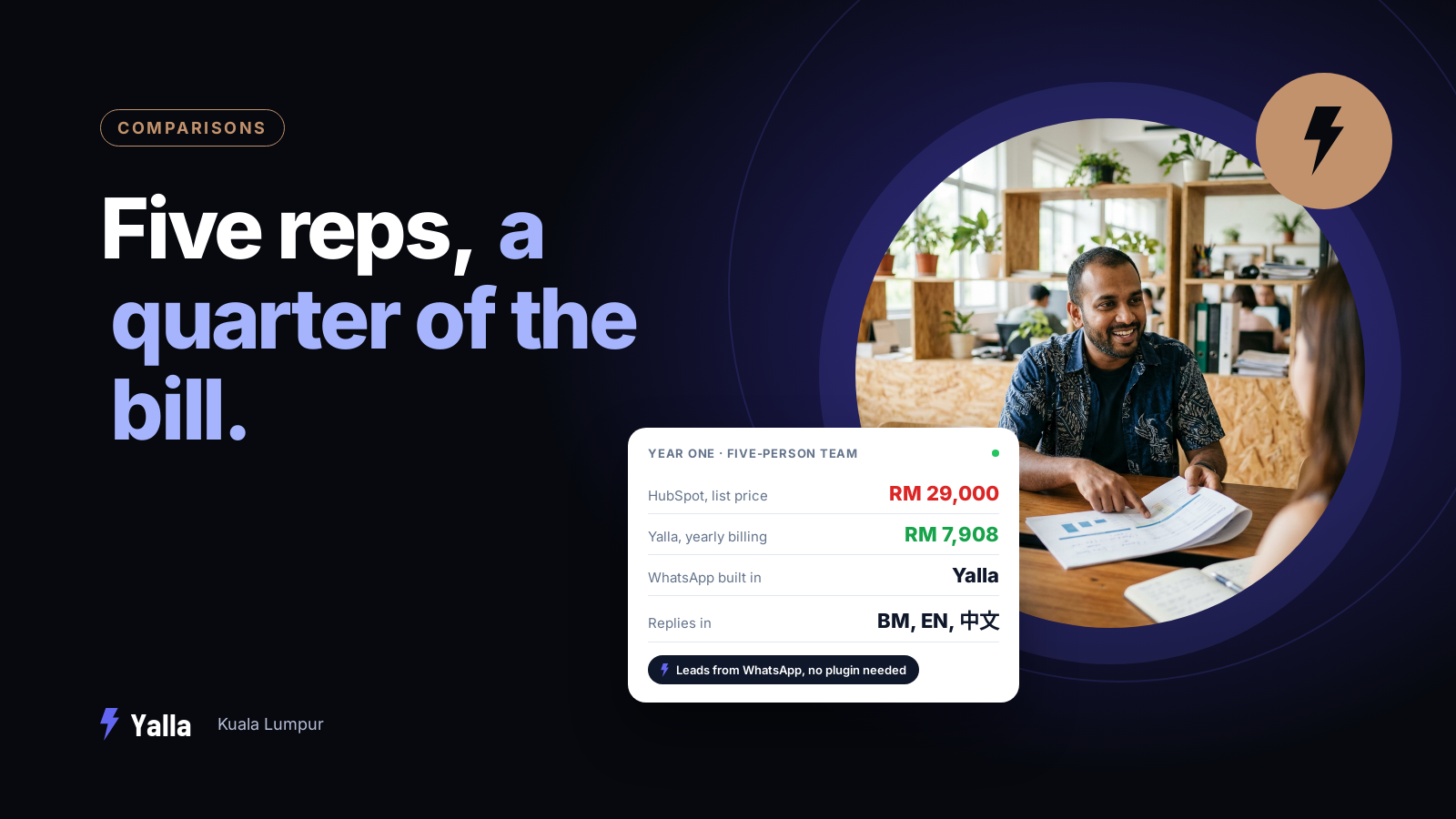
A five-person KL sales team pays HubSpot roughly RM29,000 in year one and Yalla RM7,908. Pricing, chat depth, what each AI reaches, and when HubSpot wins.
HubSpot is a serious platform. It has had twenty years to build its marketing and reporting layer, its Academy is genuinely excellent, and for a large B2B organisation with a RevOps function it earns its price. No honest comparison says otherwise.
Most of the KL teams weighing it against Yalla aren't that organisation, though. They're sales teams of two to twenty people, in Petaling Jaya, Bangsar South or Cyberjaya, whose leads arrive on WhatsApp and Instagram rather than through web forms, and who answer in Malay, English and Chinese depending on who's asking. For them the comparison comes down to three things: what it costs in ringgit, whether chat is native or bolted on, and what the AI can actually do. This page takes each in turn, using HubSpot's published list prices.
The price gap, in one calculation
HubSpot's list prices are set in US dollars, so its figures below are converted at roughly RM4.20 to the dollar and rounded. Treat them as close estimates rather than an invoice. Yalla's figures are its published ringgit prices. HubSpot Professional is billed annually, so the Yalla column uses yearly billing too, to compare like with like.
A five-person sales team, year one:
| HubSpot (Sales Hub Professional) | Yalla (Growth) | |
|---|---|---|
| Seats | About RM380 per seat per month, billed annually: roughly RM22,700 a year | RM659 a month billed yearly, 5 users included: RM7,908 a year |
| Mandatory onboarding fee | About RM6,300, one-time | None |
| Marketing and campaigns | Marketing Hub Professional: about RM3,740 a month for 3 seats and 2,000 marketing contacts, plus about RM12,600 onboarding | Included, unlimited contacts |
| Year one, sales only | Roughly RM29,000 | RM7,908 |
| Year one, sales and marketing | Roughly RM86,400 or more | RM7,908 |
Three pricing axes drive the gap. HubSpot charges per seat, per marketing contact, and a one-time onboarding fee. Yalla charges one flat price with users bundled, unlimited contacts on every plan, and free onboarding. If you'd rather pay Yalla month to month, Growth is RM849 a month, or RM10,188 for the year, which is still roughly a third of HubSpot's sales-only figure. A sixth salesperson adds RM139 a month on Growth.
Free download
The HubSpot Exit Plan: Move Your Sales Team to a Chat-First CRM Without Losing a Deal
A practical companion to this article. Free for your email address.
Get it free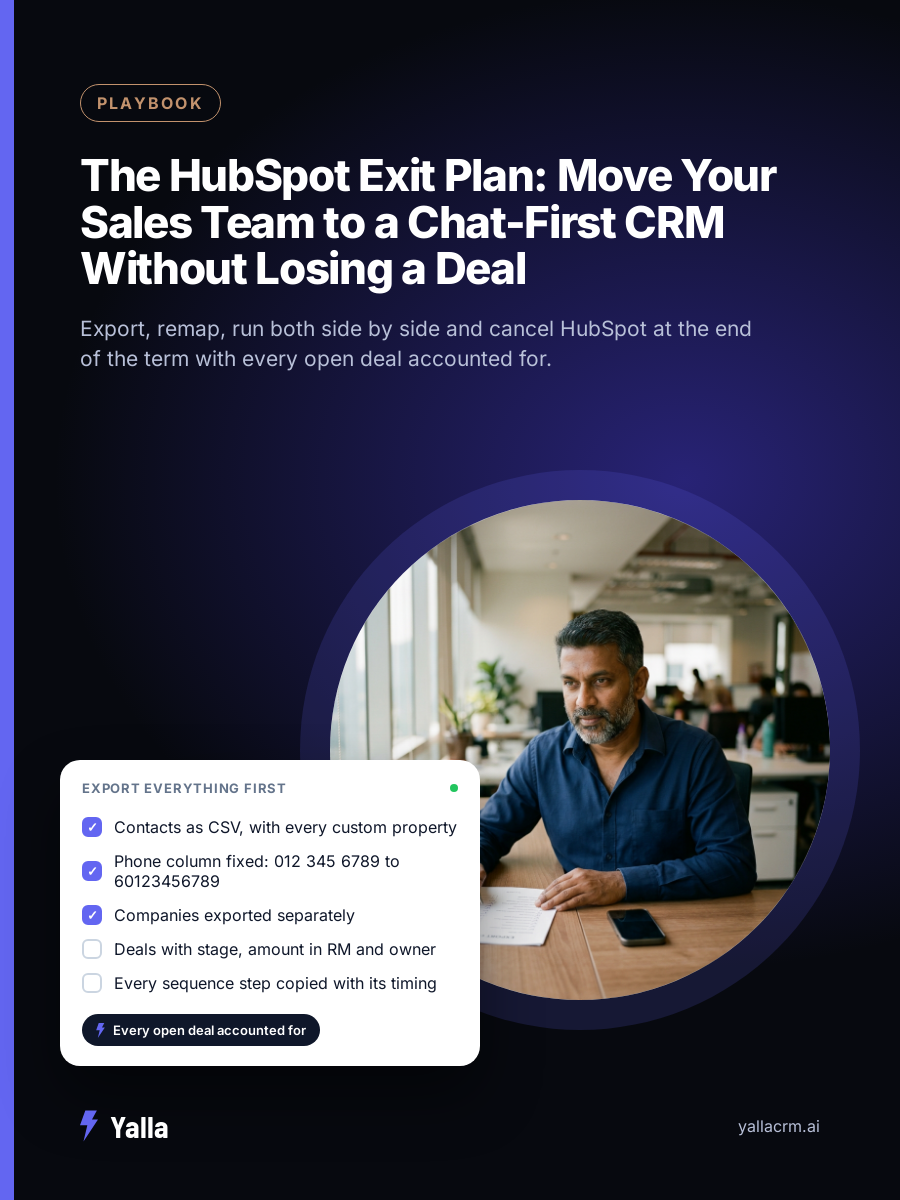
Built for typing, or built for chat
HubSpot was designed for a world where a person types information into records and the software remembers it. Chat channels came later, and it shows in the details. The native WhatsApp integration needs a Professional plan, supports one WhatsApp number per portal, and treats WhatsApp strictly as a one-to-one channel, so there are no native broadcasts to a segment.
That matters in the Klang Valley, where a lot of businesses run more than one number. A clinic group with branches in Subang and Cheras, or a property agency with a separate line for rentals, hits the one-number limit quickly.
Yalla was built the other way round. WhatsApp Business API, Instagram DMs, Facebook Messenger, TikTok DMs and email land in one inbox from the Starter plan. Multiple WhatsApp numbers run side by side, broadcasts are unlimited, and template approval happens inside the platform. There's no per-message markup on WhatsApp either: you pay Meta, and Yalla adds nothing on top.
It also changes who can see the conversation. The marketing lead at a private hospital group we met through a BNI chapter described what she needed from any platform like this:
"And this platform should be able to be accessed by customer service department, billing department and marketing department. As for the three main touch points."
Three departments looking at the same patient's conversation, rather than three copies of it. That's much easier when the chat is the record, instead of a channel feeding into one.
What each AI can reach
Both platforms ship an AI, so the useful question is what it can act on.
HubSpot's Breeze sits on top of the record system. It summarises, drafts and scores, with availability and credits depending on your tier. It's an assistant for the people doing the work.
Yalla Brain acts across pipelines, WhatsApp, Instagram, Facebook, email campaigns and reporting from one instruction. Ask it where your sales are coming from this month and it builds the report. Yalla Agents qualify leads, answer in 90+ languages and book appointments on their own from the Starter plan up, drawing on bundled credits rather than a separate AI licence. One credit covers five agent replies, and top-ups cost about RM0.50 a credit if you run out. For a business whose customers flip between Malay and English mid-sentence, that language coverage gets used every day.
One instruction. Four systems. No integrations.
Where HubSpot is the better choice
Honest scoring, because a comparison where one column always wins reads as marketing:
- Reporting and attribution. HubSpot's custom report builder and predictive scoring are best in class.
- Custom objects and data models. On Enterprise, HubSpot can model almost anything. Yalla has custom fields, not custom objects.
- Integrations. 1,700+ apps in the marketplace, against Yalla's native Meta stack plus API and webhooks.
- Email sequencing. HubSpot's deliverability and sequencing tools go deeper.
If you're a larger B2B organisation with email-led pipelines, heavy attribution needs and a RevOps function, HubSpot's price is buying something real. If your revenue happens in chat, you're paying for depth you won't use while missing the channel depth you need every day.
Switching: what it actually takes
Export contacts, companies and deals from HubSpot as CSV. They map into Yalla contacts, custom fields and pipeline stages during free onboarding. Most teams are live inside a week, and the 14-day trial is deliberately long enough to run both platforms side by side before you cancel anything.
Two things worth doing before you export. First, check when your HubSpot annual term ends, because paying for the rest of a year you've stopped using is the most common way switching costs more than it should. Second, decide which pipeline stages you actually use. Most teams find half of them are empty, and the move is a good excuse to start with fewer.
FAQ
Is Yalla cheaper than HubSpot?
For most small and mid-sized sales teams, by a wide margin. A five-person team on HubSpot Sales Hub Professional pays roughly RM29,000 in year one: about RM380 per seat per month billed annually, plus an onboarding fee of about RM6,300. The same team on Yalla Growth pays RM7,908 on yearly billing, at RM659 a month with five users included and no onboarding fee, or RM10,188 billed monthly at RM849 a month. HubSpot's list prices are in US dollars, so its ringgit figures move with the exchange rate. Yalla's are set in ringgit. The gap widens once marketing contacts or a second hub come in, because Yalla charges for neither.
What does HubSpot cost in 2026?
HubSpot's published list prices are in US dollars. Converted at current rates, roughly: a free CRM tier for up to 2 users; Sales Hub Starter at about RM38 per seat per month annually; Sales Hub Professional at about RM380 per seat per month annually plus a one-time onboarding fee of about RM6,300; Sales Hub Enterprise at about RM630 per seat plus about RM14,700 onboarding. Marketing Hub Professional is about RM3,740 a month for 3 seats and 2,000 marketing contacts plus about RM12,600 onboarding, with extra contacts around RM1,050 a month per 5,000. Marketing Hub Enterprise is about RM15,100 a month plus about RM29,400 onboarding.
Does HubSpot work with WhatsApp?
Yes, with real limits. The native integration needs a Professional plan or above, supports one WhatsApp Business number per portal, and doesn't support bulk broadcasts to a segment, because HubSpot treats WhatsApp as a one-to-one channel. Multiple numbers or broadcasts need a third-party tool in between. Yalla handles multiple numbers, unlimited broadcasts and template approval natively.
Does Yalla charge per contact like HubSpot does?
No. Contacts are unlimited on every Yalla plan. HubSpot's Marketing Hub prices in marketing-contact blocks, which is where most surprise invoices come from.
When is HubSpot the better choice?
When you're a larger B2B organisation with a dedicated RevOps function, a complex custom data model, heavy attribution reporting or a long list of enterprise integrations. HubSpot's reporting, custom objects and app marketplace are genuinely best in class.
Does Yalla have AI agents like HubSpot Breeze?
Yes. Yalla Agents are autonomous sales and booking agents included from the Starter plan up. They qualify leads, answer in 90+ languages and book appointments on their own, drawing on the plan's bundled credits rather than a separate AI licence.
HubSpot prices verified 25 July 2026 against HubSpot's published pricing pages and converted to ringgit at roughly RM4.20 to the US dollar. Pricing changes often, so check HubSpot's pricing page for current figures before you decide.
Free download
The HubSpot Exit Plan: Move Your Sales Team to a Chat-First CRM Without Losing a Deal
A practical companion to this article. Free for your email address.
Get it freeYalla is the chat-native CRM where the AI does the work, not just the talking.
See how much of your business it can reach.