
Why Parent Enquiries Go Cold Before Your Admissions Team Replies
For school admissions offices: where parent enquiries stall between the first message and the campus tour, and how to close the gap before families go elsewhere.
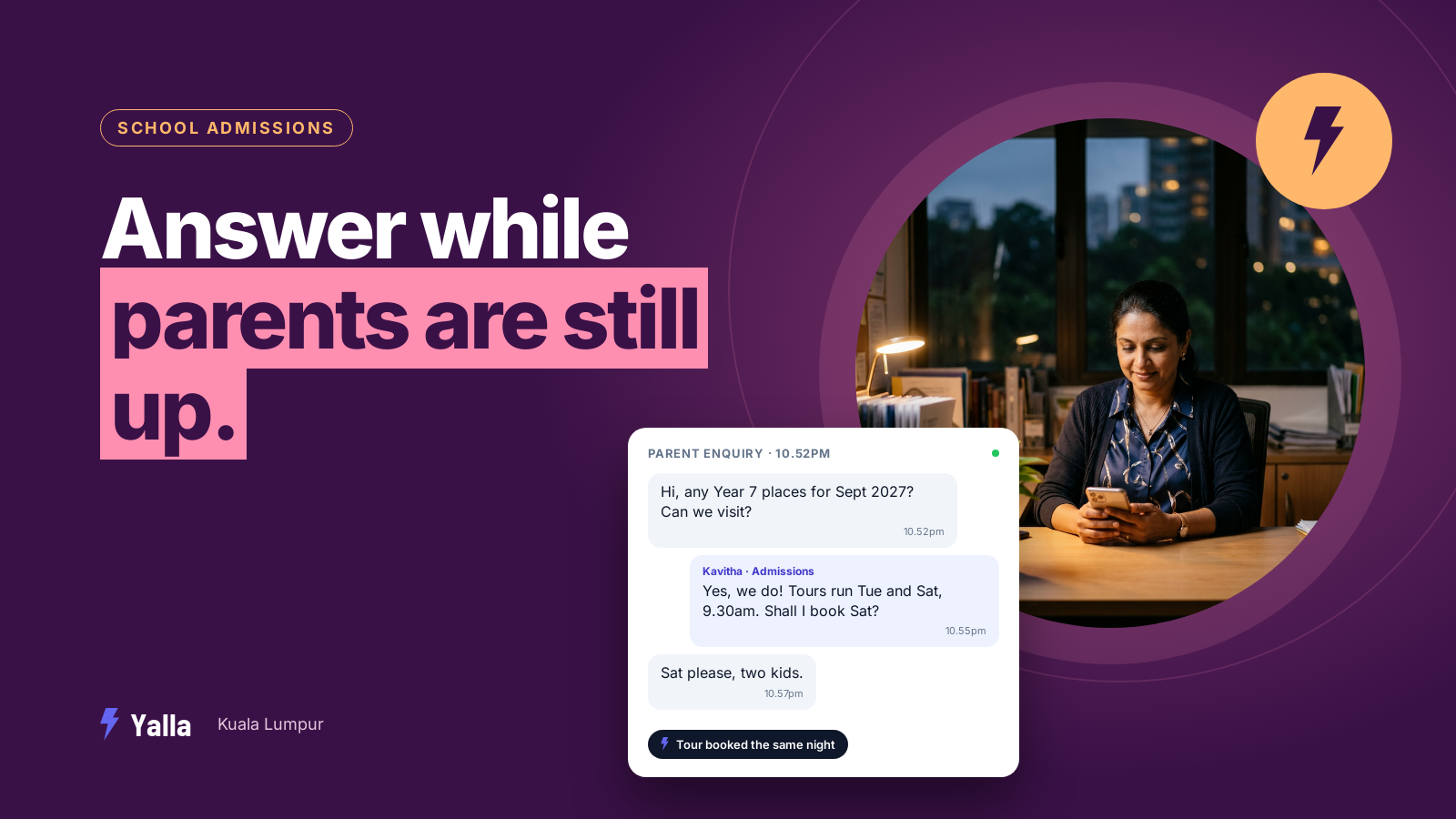
A parent shortlisting international schools rarely enquires at just one. They message three or four on the same evening, usually on WhatsApp, often after the children are in bed. The school that replies while the parent is still on their phone gets the conversation. The one that replies the next morning is writing to someone who has already booked a tour at a school across town.
This is written for the people who run admissions at private and international schools: the head of admissions, the admissions officers, and the registrar who ends up doing the data entry. Most articles about enrolment are written for parents choosing a school. Very little is written for the office that has to answer them.
We've spent time with admissions teams at two international schools, one of them a five-campus group. What follows leans on what they told us.
How much you lose at the first step
A senior admissions lead at the five-campus group gave us the number most admissions offices suspect but rarely say out loud:
"It drops off about 50%, 40%... after initial inquiry."
He described that as normal for the sector. It may well be. But it means that out of every ten families who reach out, four or five are gone before a proper conversation starts. Each of them came from somewhere, whether an open day, a Facebook ad, a relocation agent or a word from another parent, and most of that cost has already been paid.
Some of that drop-off is families who were never a fit. A good part of it happens in the hours between the parent asking and the school answering.
Free download
How to Turn a Parent WhatsApp Enquiry into a Booked School Tour
A practical companion to this article. Free for your email address.
Get it free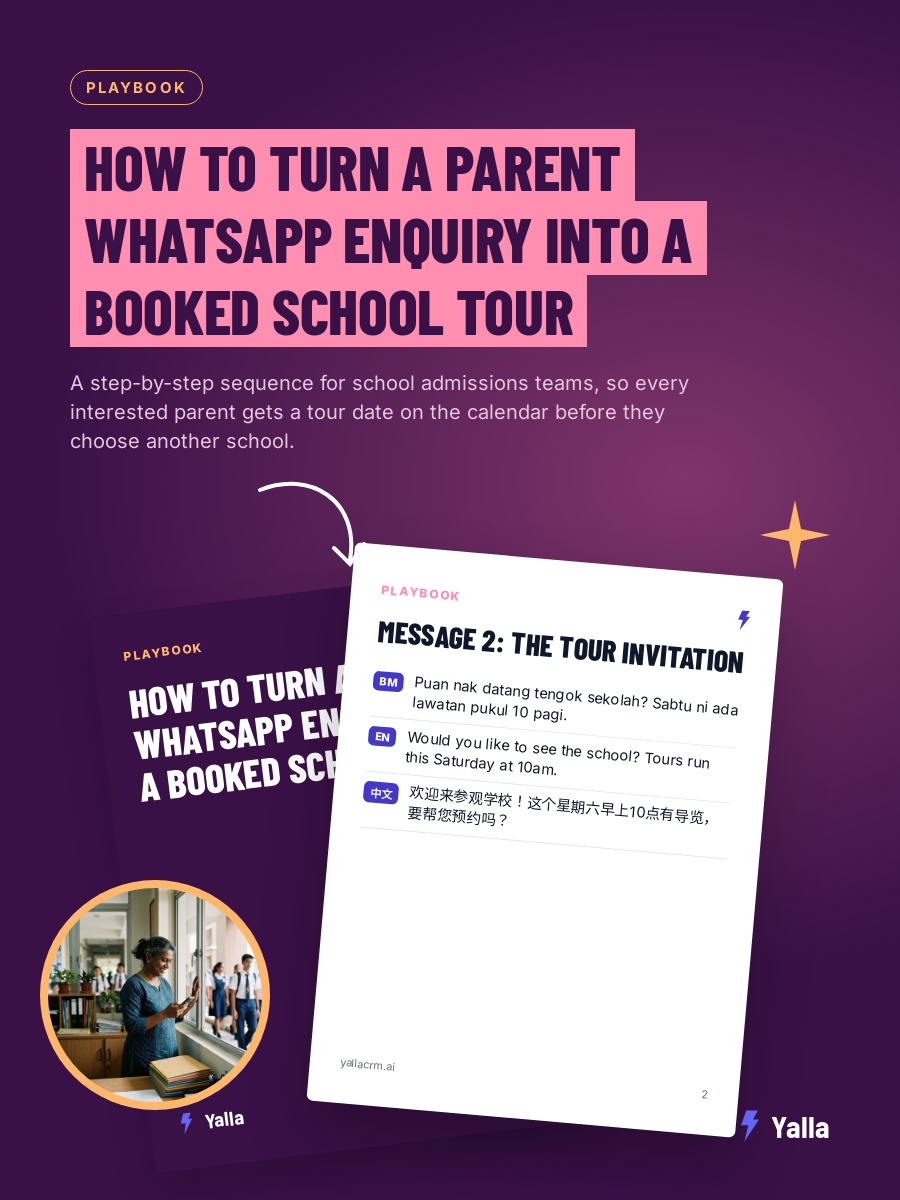
Why admissions replies take hours
Usually nobody is slacking. The way the office is set up does it.
One phone, passed around. At one school, WhatsApp enquiries arrive on a single handset:
"They have the physical phone and we just take it in turns."
Whoever has the phone that day is also running a campus tour, meeting a family, or chasing documents. When they're busy, the phone waits. On Friday afternoon, nobody wants it.
Language routing by hand. Families write in English, Spanish, Mandarin, Korean, Japanese, depending on your catchment. At one school, enquiries were sorted by language every morning, manually, before anyone replied.
Data entry before the reply. Somebody has to copy the parent's name, the child's age, the year group and the start date into a spreadsheet or the school's information system. The five-campus group estimated about five minutes to enter each applicant and five more to check it, across 400 to 500 students a year. That works out at roughly 70 to 80 hours a year of retyping, and it tends to happen in batches, not the moment the enquiry arrives.
Admin crowding out the families. One team described the time lost to manual system work while families with visa or safeguarding questions, the ones who really need a person, were left waiting. Their officers should be with those families "instead of sitting down at the system and trying to make things work manually."
Put those together and a reply that should take minutes takes hours, with nobody doing anything wrong.
Why the first hour matters for a school
A parent who has just sent an enquiry is in research mode. They're comparing, reading fee pages and asking friends. An hour later they've moved on to the next school's website. A day later they've spoken to two other admissions offices and put a tour in the diary.
At that point you're not competing on curriculum or facilities. You're competing on who was in the conversation while the decision was still open. For a school, one lost enquiry can mean years of fees, and often a younger sibling a couple of years later.
The follow-up nobody owns
Speed on the first reply is half the problem. The other half is what happens after it. One admissions team told us exactly what they wished their system would say to them:
"It has been three days, do you want to follow up?"
In most offices, nobody's job is remembering the applicant. A family asks about Year 7 in March, gets a helpful reply, goes quiet, and the next contact is when they've enrolled elsewhere.
And ask most heads of admissions for their enquiry-to-enrolment rate and you get something like the answer we heard:
"Conversion rates... it's incredibly manual, and it still wouldn't be particularly accurate."
If you can't see where families drop out, you can't fix it, and you can't tell the board what the marketing budget produced.
What a school admissions CRM should do
A school admissions CRM earns its keep by acting while the enquiry is still fresh. For an admissions office anywhere, it should:
- Pull every enquiry into one shared inbox: the school WhatsApp number, website form, Facebook and Instagram messages. No more single phone.
- Send an instant first reply at any hour, in the language the parent wrote in, answering the predictable questions: fees, availability by year group, curriculum, term dates, how to book a tour.
- Ask two or three qualifying questions: the child's age or current year, the intended start date, and whether the family is local or relocating.
- Assign the enquiry to the right officer automatically, by campus, year group or language, with the whole conversation attached.
- Prompt the follow-up. "No reply from this family in three days" should be a task on someone's list, not something they have to remember.
- Show the funnel: enquiries, tours booked, applications and offers, without anyone building a spreadsheet.
On bots and fake leads, one school raised a fair concern: "AI is too common already and it's too easily done, that the leads are not genuine." A couple of simple qualifying questions in the first reply sorts real families from junk before an officer spends time on them.
Where a CRM isn't the answer
It won't fix the offer. If fees and facilities don't line up, faster replies just get you to the no sooner.
It won't replace the tour. Families decide on the campus walk and the conversation with a teacher. A CRM gets more of the right families to that point and stops officers spending their day on triage.
It needs accurate inputs. Fees, availability and term dates have to be kept current. An AI answering confidently from last year's fee schedule is worse than a slow human.
Don't buy more than you'll use. A school that cancelled its previous admissions platform told us: "One of the biggest issues we have with [the platform] is we're only using one third of the functions and we're paying a lot of money for it." The same team warned that they were "non-technical... it will definitely take some time." Whatever you choose, budget for the setup and training, not just the licence.
How Yalla fits admissions teams
Yalla gives the admissions office one shared inbox on the school's existing WhatsApp number, with Instagram, Facebook and web enquiries in the same place. AI replies handle the first response and the routine questions in the parent's language, then hand over to a named officer with the full thread. Enquiries are assigned automatically, silent families get flagged for follow-up, and the head of admissions gets a live view of enquiries, tours and offers during intake season. We help set it up with your team rather than handing you a video library, because an admissions office in January doesn't have time to configure software.
Frequently asked questions
How fast should a school reply to an admissions enquiry?
Within minutes during the day, and with an instant automated first reply out of hours so the parent isn't left waiting until Monday. Track your own median reply time. Most schools are surprised by it.
Can we keep our school's WhatsApp number?
Yes. The number printed on your banners and website can be connected to a shared team inbox through the WhatsApp Business API, so parents carry on messaging the number they already know.
Can it handle enquiries in several languages?
Yes. The first reply goes out in the language the parent used, and the enquiry can be routed to an officer who speaks it, which replaces the morning sort by hand.
Is it worth it for a small admissions team?
Small teams feel the gap most. Two or three people can't be at a desk every time a parent messages, and intake season makes it worse. A shared inbox with instant first replies lets a small team cover evenings and weekends without extra headcount.
Free download
How to Turn a Parent WhatsApp Enquiry into a Booked School Tour
A practical companion to this article. Free for your email address.
Get it freeYalla is the chat-native CRM where the AI does the work, not just the talking.
See how much of your business it can reach.