
How Many Times Should You Follow Up a Lead Before You Stop?
A KL sales guide to how many times you should follow up a lead, the cadence that converts in ringgit terms, and how to do it without annoying buyers.
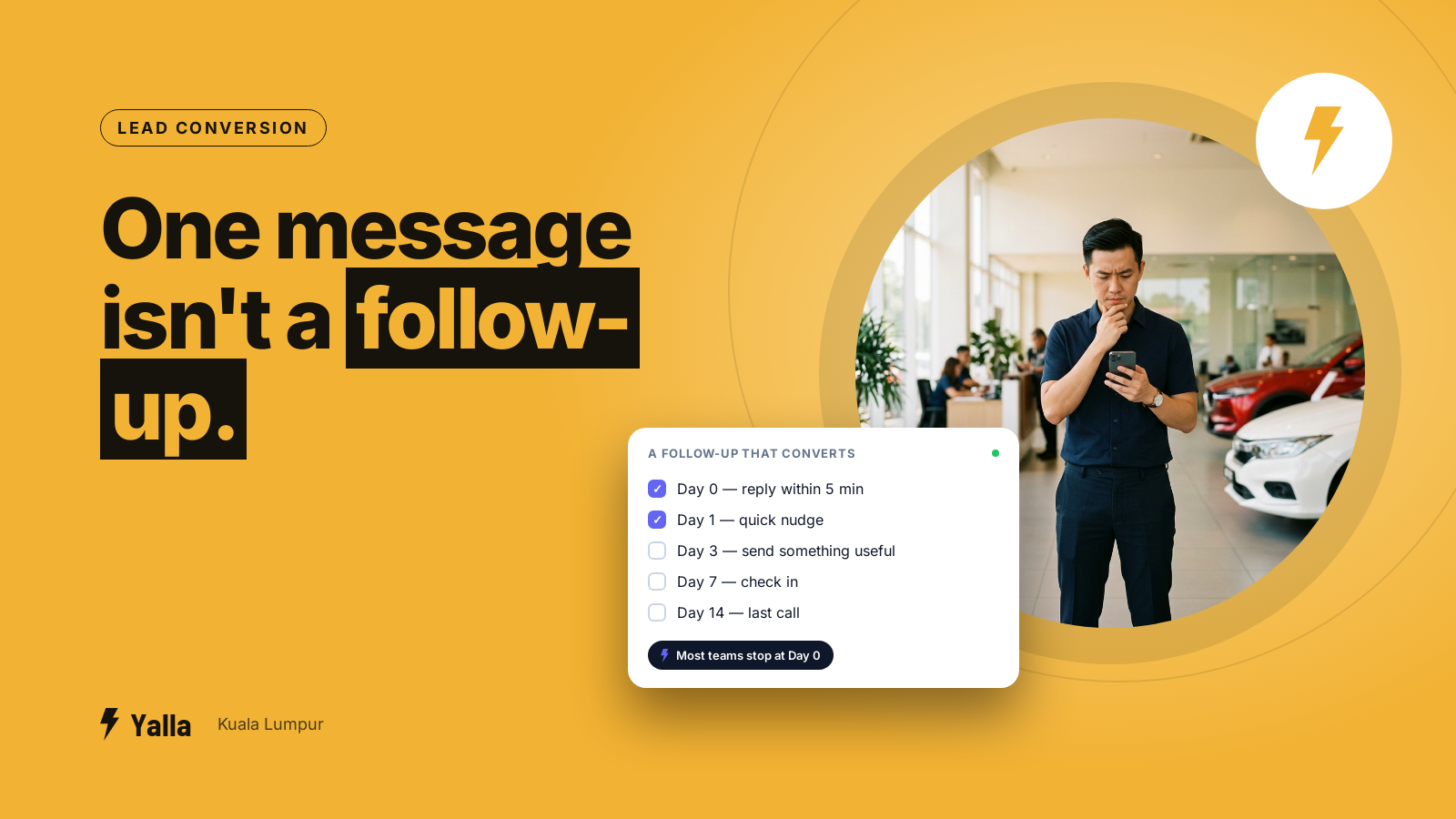
A Klang Valley sales manager told us on a demo that some of his leads sat for up to six months before anyone followed up a second time. Not because the leads were bad. Because once the first WhatsApp reply got no answer, nobody circled back. In Kuala Lumpur, where a single Facebook or Instagram lead can cost RM15 to RM40 before anyone even says hello, that is paid money going quietly cold in a spreadsheet.
So how many follow-ups is the right number, and when does persistence turn into pestering? Here is the honest answer, the cadence that actually works, and how to run it without your team becoming the business everyone mutes.
How many times should you follow up a lead?
At least five times, spread over two to three weeks, before you treat a lead as lost. That is the short answer, and it is backed by numbers that are uncomfortable for most sales teams. Across widely reported 2026 sales benchmarks, roughly 80% of deals that eventually close need five or more follow-ups, yet about 44% of salespeople give up after a single attempt. The gap between those two figures is where most of your lost revenue lives.
For a KL business whose enquiries arrive on WhatsApp, the maths is even kinder to persistence. A reply inside WhatsApp's 24-hour service window costs you nothing. A template message sent after that window costs a few sen. So the real cost of a fifth follow-up is not money. It is remembering to send it, and knowing it will not annoy the person on the other end. Both of those are fixable.
Free download
The Lead Follow-Up Script Pack: Five WhatsApp Messages for KL Sales Teams
A practical companion to this article. Free for your email address.
Get it free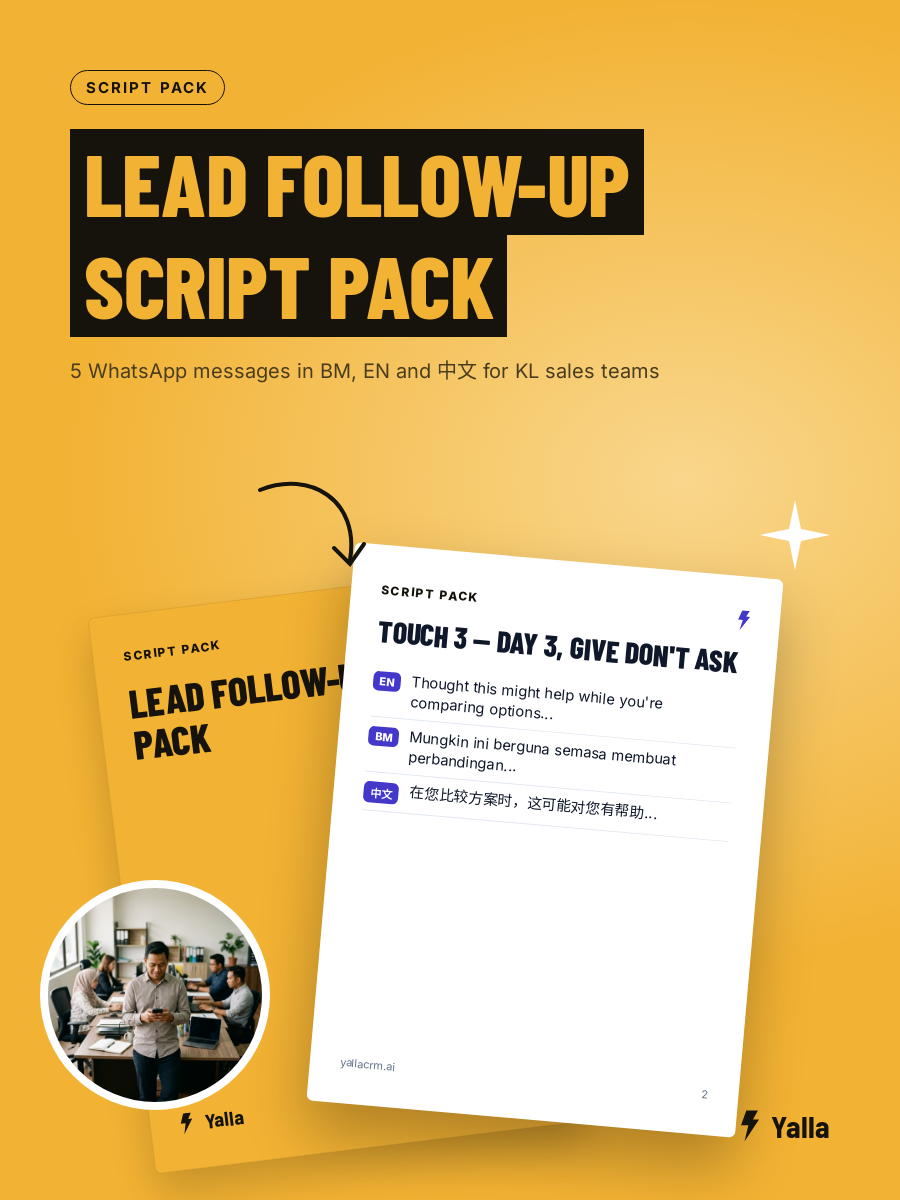
Why most KL sales teams stop after one message
When a salesperson sends one WhatsApp, gets no reply and moves on, it is rarely laziness. It is usually one of four things:
- They read silence as a no. It almost never is. People are in meetings, driving on the Federal Highway, or comparing three suppliers at once. No reply on Tuesday is not a decision.
- Nobody owns the second touch. The first reply happens because the notification is loud. The third and fourth never happen because no system reminds anyone, and "follow up with that lead" is nobody's actual job.
- They are afraid of being annoying. This is the real one. A good salesperson would rather send nothing than be the pushy vendor. So they send nothing.
- The lead gets buried. By Thursday there are forty newer chats on top. The lead from Monday is three scrolls down and out of mind.
None of these are character flaws. They are what happens when follow-up depends on human memory instead of a process.
What a follow-up sequence that converts looks like
A sequence is not sending the same "Hi, any update?" message five times. Each touch should earn its place by adding something, changing channel, or lowering the effort for the buyer to reply. Here is a simple five-to-six touch cadence that works for most KL sales teams selling to businesses or higher-value consumers.
| Touch | Timing | What to send |
|---|---|---|
| 1 | Within 5 minutes of the enquiry | Answer the actual question, and ask one qualifying question back |
| 2 | Next day | A short, friendly nudge if they went quiet: "Still happy to help whenever you're ready" |
| 3 | Day 3 | Something useful without asking for anything: a price list, a photo, a relevant case |
| 4 | Day 7 | A check-in tied to their situation: "You mentioned you needed this before Raya, shall we lock it in?" |
| 5 | Day 14 | An honest last call: "I'll stop here so I'm not crowding your inbox, just reply when the timing's right" |
The speed of touch one matters more than any other step. KL buyers message several suppliers at once, and the first business to respond usually sets the agenda. We have written separately on why lead response time quietly decides who wins the deal.
How to follow up a lead without annoying them
This is the fear that stops most people, so it deserves a straight answer. You annoy people by repeating yourself, not by following up. The rules that keep you on the right side of the line:
- Add something every time. If the message is just "any update?", you are asking the buyer to do the work. If it carries a price, a photo, an answer or a useful reminder, you are doing the work for them.
- Space it out. Daily is pestering. Every few days, widening as you go, reads as attentive.
- Vary the channel. A WhatsApp, then a voice note, then an email feels like a person. Five identical WhatsApps feel like a bot.
- Always give an easy exit. "Let me know if now's not the right time" makes you easier to reply to, not harder. People answer honest messages.
- Stop the moment they ask. One "not interested" ends the sequence. That is what separates follow-up from harassment.
Do this and five touches feel like good service. Skip it and even two feel like too many.
When should you stop following up a lead?
If you have made five to seven genuine, spaced-out touches over two to three weeks and had zero engagement, stop the active chase. But stopping does not mean deleting. It means moving that contact to long-term nurture: a quarterly check-in, a seasonal offer, a message when something genuinely changes. The database of people who did not buy this month is one of the most valuable and most ignored assets a KL business owns, and there is real money in working your old leads properly instead of starting from scratch every time.
The one exception worth naming: not every enquiry deserves five touches in the first place. Some are clearly tyre-kickers, out of budget or out of area. Spending your sequence on the wrong leads is its own waste, which is why it helps to qualify enquiries early so your best effort goes to the people most likely to buy.
Why the sequence breaks down, and how to fix it
Here is the quiet truth about follow-up cadences: almost everyone agrees with the plan above, and almost nobody runs it by hand for long. By week two the discipline slips, the newer chats win attention, and the five-touch sequence becomes a one-touch habit again. The fix is not more willpower. It is taking the remembering off your team and giving it to software.
This is where the kind of system you use matters. Every CRM has an AI now. The only question is how much of your business it can reach. An assistant that can only read the chat window can, at best, nudge you to reply. One that can also see the pipeline stage, the quote you sent, the ad the lead came from and the last five messages can schedule the right follow-up, draft it in the customer's language, and tell you who has gone quiet before you have to go looking. Yalla is the chat-native CRM where the AI does the work, not just the talking: leads assigned the moment they land, follow-ups queued automatically, and a view the owner can check on a Monday morning to see which touches were actually sent.
To be fair about where this does not fit: if your sales are mostly long email threads and formal proposals rather than chat, a record-first CRM built around the inbox and the deal record will serve you better than a WhatsApp-native one. Follow-up discipline still matters. The tool that enforces it just looks different.
Frequently asked questions
How long should you wait between follow-ups?
Start close and widen the gap. A next-day nudge, then every few days, stretching to a week by the final touch. Daily messaging reads as desperate; leaving two weeks of silence reads as giving up. For most KL sales cycles, five to six touches across two to three weeks is the sweet spot.
Is it rude to follow up five times?
Not if each message adds something and you always offer an easy way out. People find repetition rude, not persistence. The business that politely checks in five times with useful information looks more reliable than the one that messaged once and vanished.
Should follow-ups be automated or personal?
Both. The timing, the reminders and the admin should be automated so nothing gets forgotten. The words should still sound like a person, and the moment a lead replies with something real, a human should take over. Automation decides when to follow up; judgement decides what to say.
How many follow-ups before a lead is dead?
Treat a lead as inactive after five to seven spaced touches with no engagement at all, then move it to long-term nurture rather than deleting it. A contact who ignored you in October may buy in March when their situation changes. Dead is rarely permanent; it just means "not now".
Free download
The Lead Follow-Up Script Pack: Five WhatsApp Messages for KL Sales Teams
A practical companion to this article. Free for your email address.
Get it freeYalla is the chat-native CRM where the AI does the work, not just the talking.
See how much of your business it can reach.