
Lead Response Time: Why KL Leads Go Cold Before You Reply
Lead response time decides who wins the sale in KL. See what good looks like in 2026, what slow replies cost in ringgit, and how to reply in minutes.
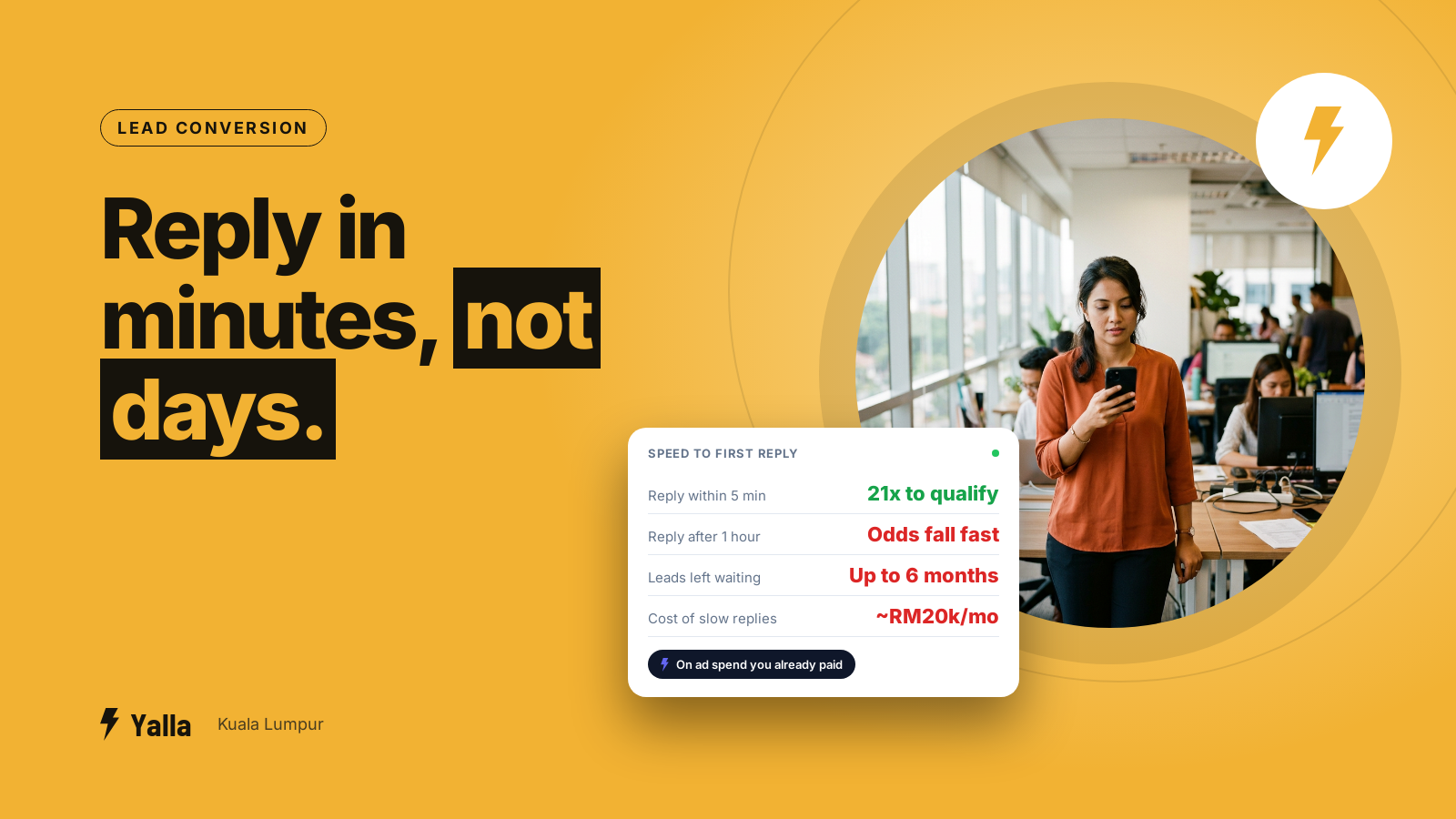
In Kuala Lumpur, most enquiries do not go cold because your price was wrong or your product was weak. They go cold because nobody replied fast enough. Lead response time is the gap between a prospect messaging your business and a real answer landing back, and in a Klang Valley market where the same buyer is messaging three of your competitors at once, that gap is usually the whole game.
On one of our demo calls this year, a business described enquiries sitting unanswered for as long as six months before anyone followed up. By then the customer had already bought elsewhere, and the ad budget that brought them in was spent for nothing.
What is lead response time, and why does it decide the sale?
Lead response time is how long it takes your team to send the first genuine reply after an enquiry arrives, whether it comes through WhatsApp, a Facebook or Instagram lead form, a DM, or your website. It is not how long until the deal closes. It is the very first answer a human or an automation gives.
It decides the sale because attention in chat is fleeting. A KL shopper who fills in a Facebook form at 9pm is not loyal to you yet. They filled in three forms in the same ten minutes. The business that answers first frames the conversation, sets the price anchor, and books the viewing, the call, or the site visit. Everyone who replies after that is negotiating from behind, often to a buyer who has already half-decided.
Free download
Lead Response Audit: Five-Day Tracker and SLA Template for KL Sales Teams
A practical companion to this article. Free for your email address.
Get it free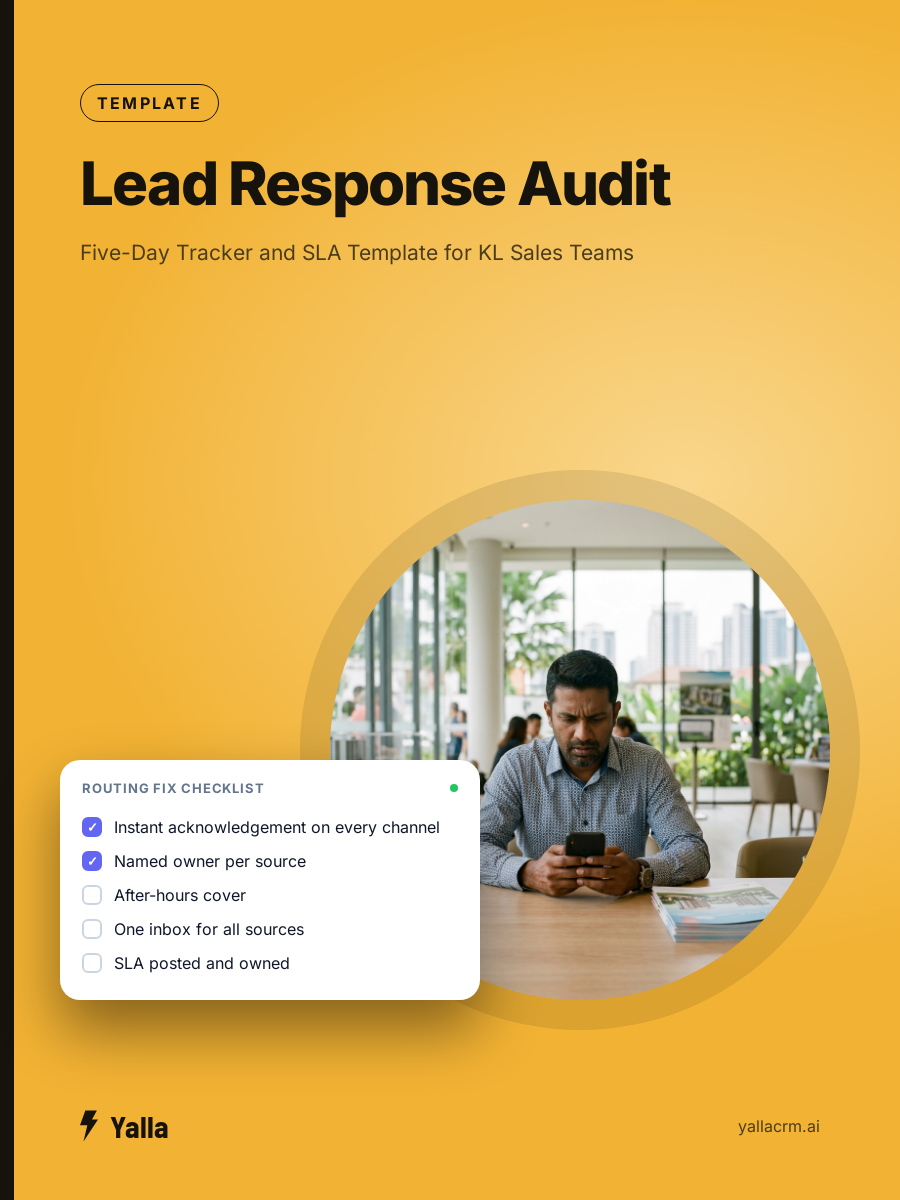
What is a good lead response time in 2026?
The honest benchmark is uncomfortable for most teams: under five minutes for a hot inbound lead, and under an hour is the floor rather than the target. Widely cited speed-to-lead research has found that replying within five minutes makes a lead far more likely to qualify than replying an hour later, and the odds keep falling with every extra hour that passes. As of 2026, buyers on WhatsApp expect that pace as normal, not exceptional.
For a Klang Valley business, a practical target looks like this:
| Enquiry type | Target first reply |
|---|---|
| Paid leads (Facebook, Instagram, Google ads) | Under 5 minutes, any hour |
| Organic WhatsApp and DM enquiries | Under 15 minutes in working hours |
| After-hours enquiries | Instant acknowledgement, real reply first thing |
If your average is measured in hours or days, you are not really competing on price. You are losing before price is ever discussed.
How is lead response time calculated?
The calculation is simple, which is why there is no excuse not to track it. For each lead, subtract the time the enquiry arrived from the time your first genuine reply was sent. Then take the median of those gaps across a period, per channel.
Use the median, not the average. If nine leads wait two hours and one is answered in one minute, the average flatters you at around 1 hour 48 minutes, while the median tells the truth at two hours. A worked example for a KL team over one day:
| Lead | Arrived | First reply | Response time |
|---|---|---|---|
| 1 | 9:05am | 9:12am | 7 min |
| 2 | 1:20pm | 3:45pm | 145 min |
| 3 | 8:40pm | 9:30am next day | 770 min |
The average here is about 307 minutes, but the median is 145. Either way, only the first lead was answered in time, and the 8:40pm enquiry, the one that arrived when your competitor's chatbot was still awake, waited more than twelve hours.
Lead response time, speed to lead and first response time: what is the difference?
These terms get used interchangeably, but they describe slightly different things, and it helps to be precise.
- Lead response time is the gap from an enquiry landing to your first reply. It is the metric this article is about.
- Speed to lead is the mindset and the practice of shrinking that gap, usually applied to fresh, high-intent inbound leads from ads.
- First response time is a customer-service term for the same idea, more often used for support tickets than for sales enquiries.
For a KL sales team, they point at one behaviour: get a useful reply back before the buyer's attention moves on.
Why do KL leads go cold before anyone replies?
The delay is rarely laziness. It is almost always structure. The most common reasons a Kuala Lumpur team is slow to the first reply:
- One shared phone, no owner. When every enquiry lands on a single WhatsApp number that three people glance at, each assumes someone else has it. The lead falls between them. We wrote about this exact trap in what a shared enquiry phone costs a team.
- After-hours arrivals. A large share of KL enquiries land in the evening and on weekends, when the sales team is off. By Monday morning the buyer has moved on. This is the whole problem behind leads that message after hours.
- No follow-up owner. Even when the first reply goes out, nobody is formally responsible for chasing. The thread quietly dies, which is the pattern in when nobody's job is the follow-up.
- Volume spikes after a campaign. Run one good Facebook ad or open day and fifty enquiries arrive in an afternoon. A team of three cannot answer all of them in five minutes by hand.
- Three languages at once. KL enquiries arrive in Malay, English and Chinese, and the person who can answer in the right language is not always the one holding the phone.
None of these is a motivation problem. They are all a routing problem, which is good news, because routing can be fixed.
What does slow lead response look like in a real KL business?
The pain wears a different face in each industry, but the shape is the same: an enquiry lands, no owner picks it up in time, and a competitor answers first.
- A private clinic or hospital group in Damansara. Marketing runs a health-screening campaign and 60 enquiries arrive on WhatsApp over a weekend. They pile up in one inbox while three departments each assume the front desk has it. Meanwhile there is an old patient list of thousands sitting in a separate system that nobody has messaged in a year. New ad leads and dormant patients never meet, and both go quiet.
- A property agency in Mont Kiara. A buyer messages at 10pm about a listing after seeing a Facebook ad. The agent who owns that project is asleep; by the time anyone replies at 9.30am the buyer has booked two other viewings. The RM3,000 spent on that ad set bought a lead that a faster agency closed.
- A school admissions office in Subang. Parents enquire the evening after an open day, while the school is enthusiastic to them. Replies go out three working days later, formal and cold, and the warmth is gone. We unpacked that specific gap in why parent enquiries go cold before admissions replies.
In all three, the business already paid to create the enquiry. The only thing missing is a first reply that arrives while the buyer still cares.
What does slow lead response actually cost?
Put ringgit on it and the number stops being abstract. Take a modest paid-media budget:
- You spend RM3,000 a month on Facebook and Instagram lead ads.
- That brings in roughly 150 leads at about RM20 each.
- Half of them, 75 leads, do not get a reply within the same hour because they arrived after 6pm or during a busy stretch.
Late leads convert at a fraction of the rate of fast ones. If your fast leads close at 20% and your slow ones close at 7%, those 75 delayed leads produce around 5 sales instead of the 15 they could have. That is 10 lost customers a month from response time alone, on money you already spent. If your average customer is worth RM2,000, slow first replies quietly cost you around RM20,000 in revenue every month while your ad spend stays exactly the same.
The cruel part is that the report never shows it. The ad manager shows cost per lead looking healthy. The loss hides in the gap between "lead received" and "someone replied," which almost nobody measures.
How do you reply in minutes without hiring a night shift?
You do not fix response time by asking the team to check their phones more often. You fix it by making sure the first reply does not depend on a human being awake. Three moves do most of the work:
- Instant acknowledgement on every channel. The moment an enquiry lands, from an ad, a DM, or the website, it gets an immediate, useful first message: confirming you received it, asking the one question that qualifies them, and setting an expectation for the real reply. This alone keeps the buyer from messaging your competitor next.
- Automatic assignment and routing. The enquiry is handed to a named salesperson by rule, not by luck. By region, by language, by product, or round-robin so nobody can say "I thought you had it." We covered the mechanics in routing enquiries to the right salesperson.
- AI that qualifies before a human is free. An AI agent can answer the common questions, capture budget and intent, and book the appointment at 11pm, then hand a warm, qualified thread to your rep in the morning instead of a cold "hi."
This is where the category has quietly changed. Every CRM has an AI now. The only question is how much of your business it can reach. A reply that arrives fast but cannot see your pipeline, your calendar, or your prices is just a faster way to say "let me check and get back to you." Yalla is the chat-native CRM where the AI does the work, not just the talking. Yalla Brain acts across pipelines, WhatsApp, Instagram, Facebook, email campaigns and reporting from one instruction, so the first reply is not only fast, it is one that can actually move the deal forward.
Should you set a lead response SLA?
A service level agreement here just means a written promise about how quickly enquiries get a first reply, and who owns it. For a KL SME it does not need to be a corporate document. One line is enough: "Every paid lead gets a reply within 5 minutes; every organic WhatsApp enquiry within 15 minutes in working hours; after-hours enquiries get an instant acknowledgement and a human reply by 9.30am."
The value of writing it down is that it turns a vague intention into something you can measure a person against. Without an SLA, "reply quickly" means whatever each rep decides on a busy day. With one, you can look at the median next week and see who is keeping it.
How do you start fixing it this week?
You cannot improve what you have never timed. A realistic first week, in order:
- Measure your baseline. For five working days, log when each enquiry arrives and when your first genuine reply goes out, per channel. Take the median so a few fast replies do not flatter the picture.
- Find where the damage clusters. It is almost always evenings, weekends and the day after a campaign. That tells you exactly where an automated first reply earns its keep.
- Give every source one owner and one inbox. Point your ad leads, your DMs and your old customer or patient list into the same place, with a named owner and an instant acknowledgement, so nothing waits in silence and no dormant list rots in a separate system.
- Set the one-line SLA and check it next Monday. Compare the new median against your baseline. If it dropped from hours to minutes, keep going; if not, look at which channel still has no owner.
Do only that, and most KL teams cut their first-reply time from hours to minutes without adding a single headcount. The next action is not to buy anything; it is to time yourself for one week and see where the leads are actually falling through.
When is a faster first reply not the answer?
Speed is not a cure for everything, and pretending it is will burn trust.
If your leads are low quality, replying in five minutes just gets you to "no" faster. Fix the targeting before you fix the timing. If your offer or price is genuinely uncompetitive, no response time saves it. And if you sell complex, high-value deals that close over months of email and procurement, minutes-to-first-reply matters far less than a clean, shared record of every touch; a record-first CRM built around email may serve you better than a chat-native one. Be honest about which business you are running before you spend on speed.
FAQ
What is the average lead response time for most businesses?
Most businesses are far slower than they think, often taking hours and sometimes days to send a first reply, especially to leads that arrive after working hours. Very few measure it at all, which is why the gap persists. If you have never timed yours, assume it is worse than your gut says and start by tracking it.
How fast should you reply to a Facebook or WhatsApp lead?
For paid leads from Facebook, Instagram or Google, aim for under five minutes at any hour, because those buyers are actively shopping and messaging competitors in the same session. For organic WhatsApp enquiries during working hours, under fifteen minutes is a reasonable target. After hours, send an instant acknowledgement and a real reply first thing.
Does replying faster really increase sales in KL?
Yes, and the effect is largest where buyers can switch instantly, which describes almost every WhatsApp-led purchase in Kuala Lumpur. The first business to reply frames the price and books the appointment, so faster first replies raise the share of leads you convert without spending a ringgit more on ads. It is one of the cheapest conversion gains available to a small team.
Can you reply in five minutes without staff online 24 hours a day?
Yes. An instant automated acknowledgement plus an AI agent that qualifies and books appointments covers the hours your team is asleep, then hands a warm thread to a real person in the morning. The buyer gets an immediate, useful response; your team gets a qualified lead instead of a cold one. That is how a five-person team competes with a call centre.
How do I measure my own lead response time?
Start counting from the moment an enquiry lands to the moment your first genuine reply is sent, per channel, and look at the median rather than the average so a few fast replies do not hide the slow ones. Break it out by hour of day and by source; you will usually find the damage is concentrated in evenings, weekends and post-campaign spikes.
Free download
Lead Response Audit: Five-Day Tracker and SLA Template for KL Sales Teams
A practical companion to this article. Free for your email address.
Get it freeYalla is the chat-native CRM where the AI does the work, not just the talking.
See how much of your business it can reach.