
How to Follow Up With Prospective Parents and Fill Seats
How to follow up with prospective parents from first enquiry to enrolment in KL: how fast, how often, what each message says, and a system that runs itself.
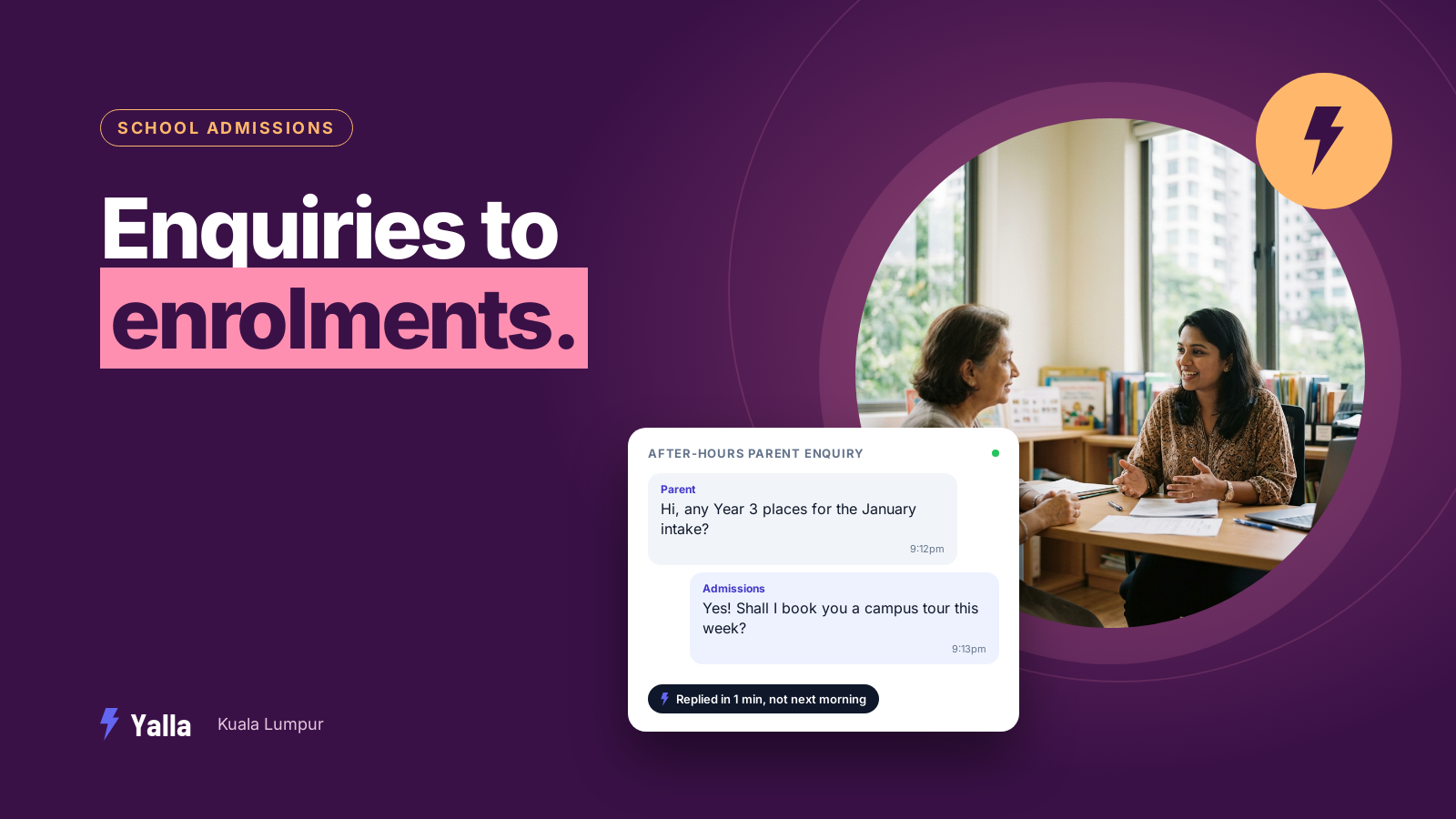
An international school in Mont Kiara can spend months and a healthy marketing budget filling an open day, then lose half of those families in the week that follows. In the Klang Valley, where a year of fees runs from RM30,000 to well past RM80,000, every prospective parent who goes quiet after the first enquiry is a five or six-figure place left unfilled. Knowing how to follow up with prospective parents is not admin. It is the difference between a full intake and a waitlist you never needed.
This is written for the admissions office, not for parents. It covers why enquiries stall, how fast and how often to follow up, what each message should say, and how to run the whole thing so it does not all rest on one person during peak intake.
Why do prospective parents go quiet after the first enquiry?
A parent rarely goes cold because they lost interest. They go cold because the moment passed. They messaged three schools on a Sunday night while the children were asleep, two replied the same evening and one replied on Tuesday. By then they had already booked tours with the first two.
In most admissions teams the drop-off between first enquiry and submitted application is close to half, and the leak is almost always in the gaps:
- Enquiries arrive on a shared phone or a general inbox and nobody owns a specific family, so the warm ones and the quiet ones blur together.
- The first reply is fast, the second never comes. After the tour or the prospectus, the family is left to decide alone, and silence from the school reads as indifference.
- Enquiries come in Malay, English and Chinese, and whoever picks up the phone is not always the person who can answer in that language, so the reply stalls.
- Peak intake buries the team. When 60 enquiries land in a fortnight, the counsellor physically cannot chase each one by memory.
None of this is a failing of care. It is a failing of system, and system is fixable.
Free download
The Admissions Follow-Up Script Pack: From First Enquiry to Enrolled Seat
A practical companion to this article. Free for your email address.
Get it free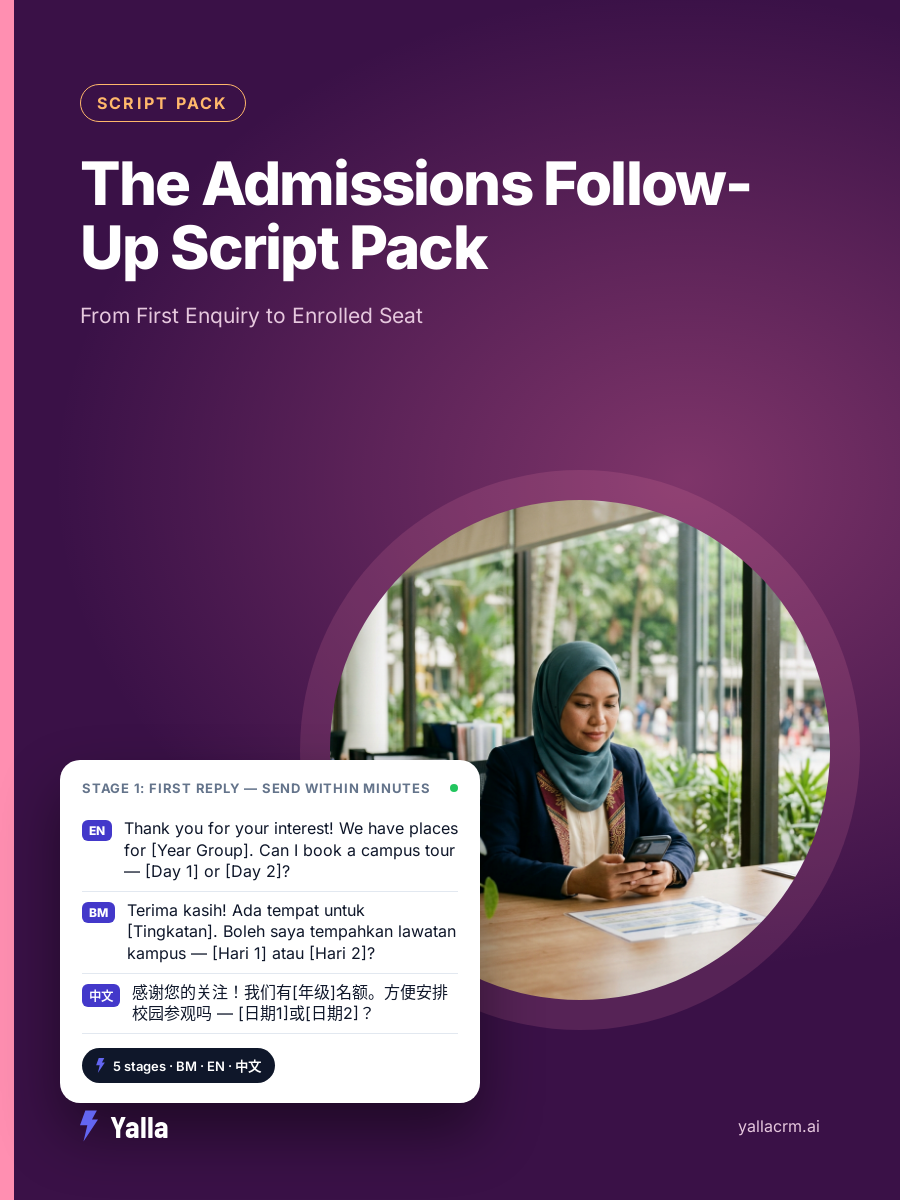
How soon should you reply to a parent enquiry?
Faster than feels necessary. A 2007 MIT and InsideSales study found you are around 21 times more likely to qualify a lead if you respond within five minutes rather than thirty. A 2011 Harvard Business Review review of 2,241 companies found the average first response took 42 hours. Admissions is no different from sales in this respect: the family that hears back in minutes feels chosen, and the school that replies the next morning feels like a backup.
The hard part is that parents enquire in the evening, after work and after dinner, which is exactly when the admissions office is closed. An enquiry at 9pm that waits until 9am has lost its best hour. We cover this timing gap in detail in why parent enquiries go cold before your admissions team replies.
How many times should you follow up with prospective parents?
More than once, and with a reason each time. The admissions journey has natural stages, and each one is a reason to make contact: enquiry, campus tour, application, offer, and the final decision. A family that has toured but not applied is not rejecting you. They are busy, comparing, and waiting to be reminded why they liked you.
A workable rhythm looks like this: reply within minutes, confirm the tour, send a warm recap the day after the visit, check in when the application has stalled for a few days, and reach out again as the intake deadline approaches. That is five or six deliberate touches across weeks, each tied to where the family actually is, not five copies of "just following up." The same discipline that fills an open day fills the weeks after it, which we unpack in school open day follow-up that fills your intake.
What should each follow-up actually say?
Each message should move the family one step, not simply remind them you exist. A sequence that works across a KL intake might read like this:
- Within minutes of the enquiry: a warm reply in the language the parent used, answering their actual question and offering two specific tour slots.
- The day after the tour: a short recap naming something personal from the visit, the fees and the application link, and a clear next step.
- Day three or four of silence: a gentle nudge offering to answer anything holding them back, and the application deadline.
- A week before the intake closes: a final, friendly reminder that places are filling, with the exact steps to secure one.
Written in Malay, English or Chinese to match the parent, these feel like a school that is paying attention, not a system sending blasts.
How do you follow up across the whole funnel without it falling on one person?
This is the real problem at peak intake, and it is solved the same way a good sales team solves it: by taking the remembering out of human hands.
- Every enquiry lands in one place. WhatsApp, the website form, Facebook and Instagram messages flow into a single shared admissions inbox instead of a personal phone, so nothing is lost when one counsellor is on leave.
- Each family is assigned to a named admissions officer automatically, so there is no enquiry that belongs to everyone and therefore no one.
- The stages drive the reminders. When a family tours but does not apply, the follow-up is queued without anyone having to notice. When an offer sits unaccepted, the team is prompted.
- The head of admissions can see the whole funnel at a glance: who enquired, who toured, who is waiting, and where families are dropping out, without chasing a weekly report.
In practice that means an evening enquiry gets an instant reply in the parent's own language, the officer is assigned before anyone opens a laptop, and the day-after-tour recap is already queued. That specific mechanism is the job a chat-native tool is built for. Yalla is the chat-native CRM where the AI does the work, not just the talking, so the admissions team spends its time on conversations rather than chasing its own to-do list. If you want the full picture of tightening the pipeline end to end, see how to optimise your admissions process.
Where does AI help an admissions team, and where must a human stay?
AI is genuinely useful for the parts that currently fall through the cracks. It can reply to an evening enquiry in seconds in the right language, answer the common questions about fees, intakes and bus routes, flag the families who have gone quiet, and remind the officer before a deadline. That alone recovers the enquiries a tired team loses.
What it must never do is replace the human relationship at the heart of admissions. A parent choosing where their child spends the next ten years wants to speak to a person who knows their child's name, and the tour, the interview and the reassurance must stay human. The honest line is that AI should carry the admin and the timing, so your counsellors have the hours to do the part only they can. Used the other way around, it does damage.
A follow-up timeline you can set up before the next intake
If you do nothing else before the next intake opens, put these in place:
- Route every enquiry source into one shared admissions inbox so no family sits unseen on a personal phone.
- Assign each new enquiry to a named officer automatically, with cover when someone is away.
- Set a first-reply target in minutes, including evenings, since that is when parents actually write.
- Build one stage-based sequence (enquiry, tour, application, offer, deadline) that triggers on its own.
- Review the funnel weekly so you can see exactly where families drop and act before the deadline, not after.
Do the first three and the half you were losing in the week after the open day starts to stay. Speed and consistency are what fill seats, and a late reply is the most expensive mistake in the funnel, as we explain in lead response time and why leads go cold before you reply.
Frequently asked questions
How fast should an admissions team reply to a parent enquiry?
As close to immediately as possible, and especially in the evenings when most parents enquire. Research on sales leads shows responses within five minutes are far more likely to convert than responses even half an hour later, and admissions behaves the same way. A reply the next morning often arrives after the family has already booked a tour elsewhere.
How many times should you follow up with prospective parents before stopping?
Five or six deliberate touches across the journey is normal and welcome, as long as each is tied to a real stage: enquiry, tour, application, offer and deadline. Parents rarely feel chased by a message that helps them take the next step. They feel neglected by silence after the first reply.
How do you manage parent enquiries that come in different languages?
Route them all into one shared inbox and make sure each family is assigned to someone, or something, that can reply in Malay, English or Chinese quickly. The delay caused by waiting for the right colleague to be free is a common reason multilingual enquiries stall. A system that drafts the reply in the parent's language removes that wait.
Can a small admissions team really keep this up at peak intake?
Only with a system. A two or three-person office cannot chase 60 families by memory during intake week. Automatic assignment, stage-based reminders and a shared inbox are what let a small team behave like a large one, so no family is lost simply because everyone was busy on the same day.
Free download
The Admissions Follow-Up Script Pack: From First Enquiry to Enrolled Seat
A practical companion to this article. Free for your email address.
Get it freeYalla is the chat-native CRM where the AI does the work, not just the talking.
See how much of your business it can reach.