
How to Optimise Your Admissions Process
A stage-by-stage guide to the KL admissions process: where enquiries leak, the metric to track at each stage, and what to look for in admissions software.
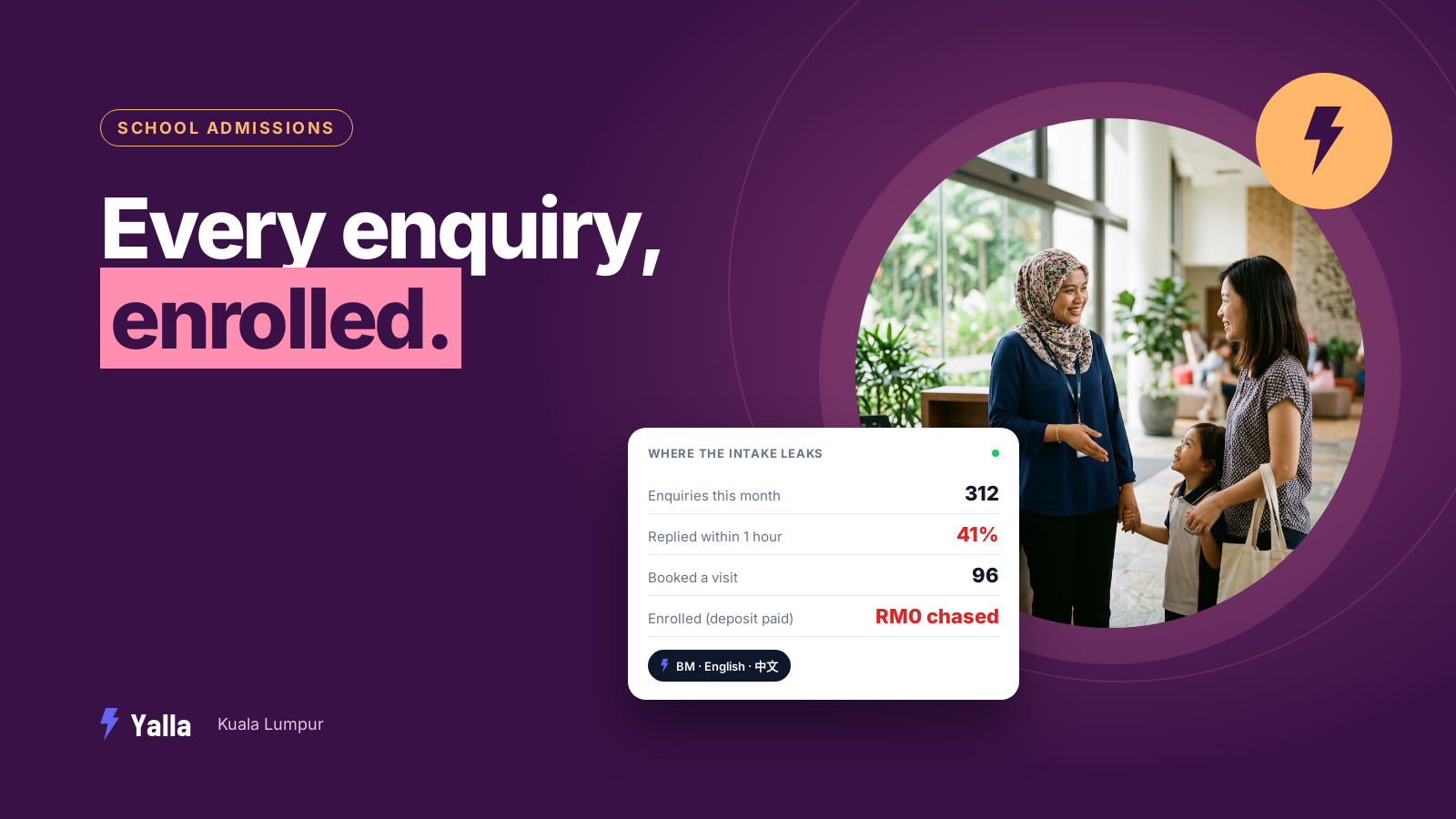
Every admissions team in the Klang Valley runs the same race. A parent in Cheras shortlisting preschools, a working adult in PJ comparing diploma intakes, a family relocating to Mont Kiara looking at Year 7: they all begin with an enquiry, and the institution that guides them smoothly from that first message to a signed place is the one that fills its intake. Optimising your admissions process is not about working harder during peak season. It is about knowing exactly which stage loses the most families and fixing that stage first.
This guide is written for admissions teams across Kuala Lumpur education, whatever you enrol into: nurseries and preschools (tadika), private and international schools, tuition and enrichment centres, colleges and universities, and training providers. The words differ by sector, so this guide uses cross-sector terms. An "enquiry" is any first contact. An "applicant" or "prospective student" is a family or adult who has shown real interest. A "visit" is an open day, a campus tour or a trial class. "Intake" is the cohort you are filling.
One thing that shapes everything below: intakes in KL do not run on one calendar. National-curriculum schools start their year in January. Many international schools open their main intake in August or September. Colleges, universities and training providers run several intakes a year, often January, May and September. So an admissions team is almost never "off season". While one intake is enrolling, the next is already enquiring, and the process has to hold up for both at once.
What does a good admissions process look like?
A good admissions process is a funnel you can see all the way through. A family enters as an enquiry and moves through first reply, qualification, visit, application, offer, acceptance and enrolment, and ideally comes back as a referral or a re-enrolment. At every step, some families drop out. That is normal. What is not acceptable is not knowing where they drop out or why.
The single most useful thing you can do this week is put a number on each stage: how many enquiries you received, how many got a reply within an hour, how many booked a visit, how many applied, how many were made an offer, how many accepted, how many enrolled. A five-campus international school group in the Klang Valley described the cost of not having that view:
"Conversion rates... it's incredibly manual, and it still wouldn't be particularly accurate."
If the numbers are guesses, every decision about marketing spend and staffing is a guess too. The goal of the rest of this guide is to make each stage measurable, then plug the leaks in order of size.
Here is a useful way to think about the whole thing. Every CRM has an AI now. The only question is how much of your business it can reach. In admissions, "reach" means the set of places your process actually touches: the WhatsApp number on your banner, the web form, the Facebook and Instagram messages, the spreadsheet, the offer letters, the reminder the day before an open day. A stage only improves if something can reach into it and act. Stages nobody and nothing can reach are exactly where families go cold.
Free download
The Admissions Team's Playbook: Scorecards, Templates and an Intake Calendar for KL Education Institutions
A practical companion to this article. Free for your email address.
Get it free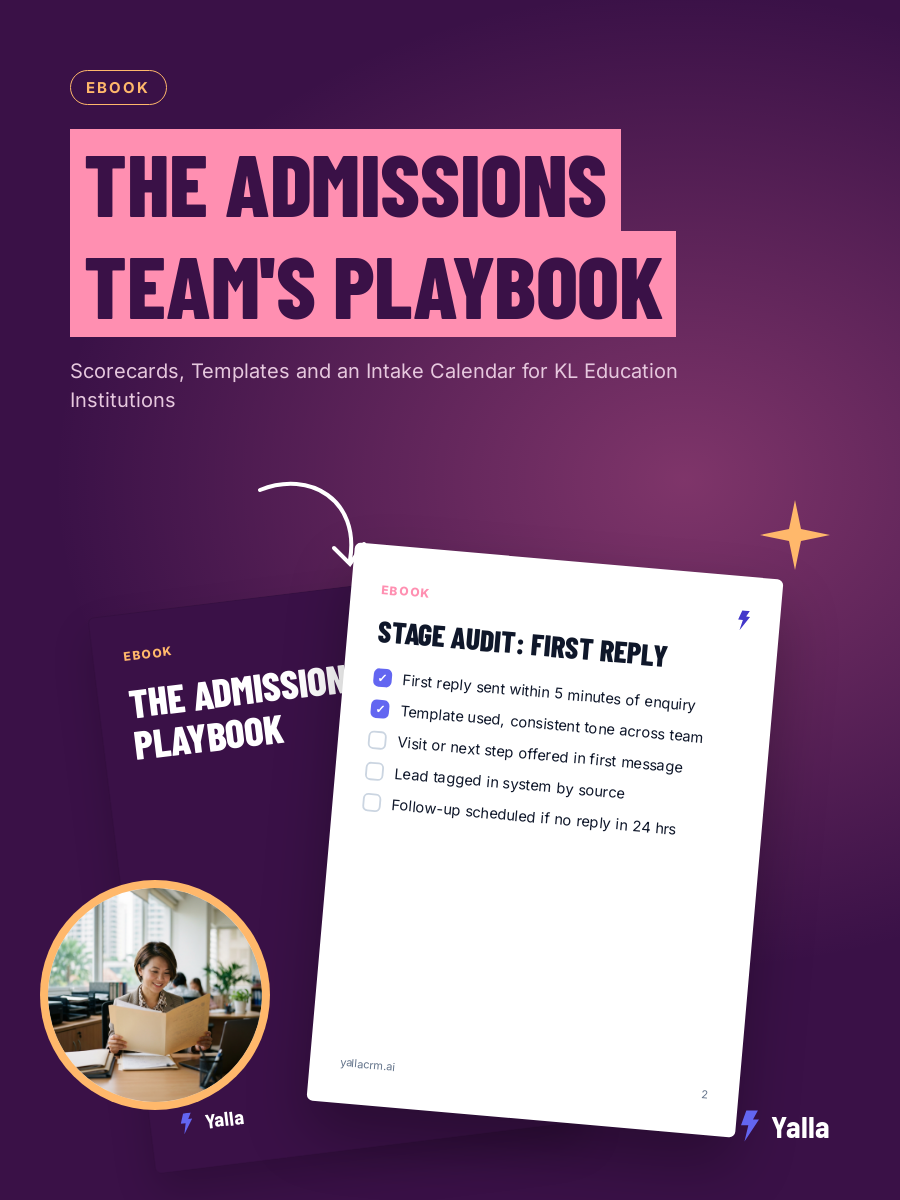
Where do admissions enquiries come from in KL?
The first stage is the enquiry, and in Kuala Lumpur it arrives through more doors than most teams admit. Get this wrong and you are losing families before the process even starts.
What good looks like: every channel a family might use lands in one place, tagged with where it came from. In the Klang Valley that means WhatsApp above all, plus Facebook and Instagram messages, TikTok comments and DMs, the enquiry form on your website, phone calls, walk-ins at reception, and the stack of contacts collected at education fairs and open days.
The metric to track: enquiries received per channel, and cost per enquiry per channel. If you spent RM4,000 on a fair booth and RM6,000 on Facebook lead ads in a month, you need to know which one produced enrolments, not just contacts.
Where it leaks: the education fair is the classic leak. Someone collects 120 names on a clipboard over a weekend, the sheet sits in a drawer, and by the time anyone types them in, the families have enrolled elsewhere. Facebook and TikTok enquiries leak the same way when they land in a personal inbox nobody checks on Monday. If an enquiry cannot be seen and answered the day it arrives, it is not really an enquiry. It is a receipt for money you already spent.
How fast should you send the first reply?
The first reply is where most admissions processes quietly lose the race. A parent comparing three institutions is usually messaging all three on the same evening, often after the children are in bed.
What good looks like: every enquiry gets an acknowledgement within minutes, at any hour, in the language the family wrote in, answering the predictable questions before a human even picks it up: fees in ringgit, availability by year group or intake, curriculum or programme, term or semester dates, and how to book a visit.
A first reply does not need to be clever. It needs to land fast, sound human, and ask one useful question. Something like this, sent the moment the enquiry arrives, keeps you in the race:
English: "Hi, thanks for reaching out to [Institution]. Happy to help. May I ask your child's age and which intake you're looking at (Jan or Aug)? I'll send fees and a tour slot once I know."
>
BM: "Hi, terima kasih hubungi [Institution]. Boleh saya tahu umur anak dan intake yang dicari (Jan atau Ogos)? Nanti saya kongsikan yuran dan slot lawatan."
The metric to track: median time to first reply. Measure your own honestly. Most teams are shocked when they see it, because the average is dragged out by every enquiry that arrived at 9pm or on a Friday afternoon.
Where it leaks: the shared handset. As one KL admissions team put it, "they have the physical phone and we just take it in turns." Whoever holds the phone is also running a tour or chasing documents, so replies wait hours. We covered this specific gap in detail in why parent enquiries go cold before your admissions team replies. An instant automated first reply does not close the family. It keeps you in the conversation while the decision is still open, which is the whole game at this stage.
How do you qualify a prospective student without scaring the family off?
Not every enquiry is a fit, and not every enquiry is even real. Qualification is how you spend your officers' time on the families most likely to enrol.
What good looks like: two or three light questions in the first exchange. For a school: the child's age or current year, the intended start date, whether the family is local or relocating. For a college or training provider: the programme of interest, the intended intake, and whether the fees will be self-funded, employer-sponsored or claimed through HRD Corp. The questions should feel like help, not an interrogation.
The metric to track: the share of enquiries that qualify as genuine prospects, and how quickly you can tell. One school raised a real worry about the flood of low-quality contacts: "AI is too common already and it's too easily done, that the leads are not genuine." A couple of qualifying questions sort real families from junk before an officer invests an hour.
Where it leaks: two opposite failures. Ask nothing, and officers waste days on families who were never going to enrol. Ask too much, too formally, too soon, and families who were serious go quiet because it felt like paperwork. The fix is to qualify inside a normal chat, not with a form that arrives before any human warmth does. If you want the mechanics, we wrote about how to qualify enquiries automatically without losing the human touch.
How do you turn an enquiry into a booked visit?
Families decide on the visit, not on the brochure. The campus walk, the trial class, the conversation with a teacher or programme lead: that is where the choice is really made. So the job of everything before it is to get the right families to book one.
What good looks like: a clear, low-friction way to book the visit offered inside the same conversation, with a confirmation and a reminder the day before. A parent should be able to pick an open-day slot or a private tour in three messages, not a phone-tag chain across a week.
The metric to track: enquiry-to-visit rate. Of the families who enquired, how many actually stood in your building or joined your trial class? This is often the biggest single leak in the whole funnel, and the one most worth improving.
Where it leaks: booked visits that never happen. No-shows are brutal in admissions because a slot with a teacher or a weekend open-day team costs real money whether the family turns up or not. A confirmation plus a reminder the day before lifts attendance sharply. We broke down the numbers on this in how to reduce no-shows to appointments and classes. And because an open day fills your pipeline for weeks after, the follow-up to everyone who attended matters as much as the day itself, which we cover in school open day follow-up that fills your KL intake.
How do you move a visit into an application?
The visit went well. Now the family has to actually apply, and this is where a warm lead can cool off in the gap between the handshake and the form.
What good looks like: the application link or pack goes out the same day as the visit, while the impression is fresh, with a clear list of what is needed and a named person to ask. For a school that might be the child's report cards and a copy of the passport or MyKad. For a college it might be SPM or diploma results and a personal statement. The fewer round trips to collect documents, the more applications you complete.
The metric to track: visit-to-application rate, and average days from visit to submitted application. If families who visited are not applying within a week or two, something in the handover is broken.
Where it leaks: the follow-up nobody owns. A family tours in March, gets a lovely reply, goes quiet, and the next contact is when they have enrolled somewhere else. In most offices, remembering that applicant is nobody's actual job. As one admissions team wished aloud, they wanted a system that would simply tell them, "it has been three days, do you want to follow up?" This is the same pattern we described in nobody's job is remembering the follow-up, and we wrote a dedicated playbook for the parent version in how to follow up with prospective parents and fill seats. Without a prompt, the follow-up depends on a busy person's memory, and memory loses.
How should you handle offers and acceptances?
Offer and acceptance are two separate stages, and treating them as one is how strong applicants slip away at the finish line.
What good looks like for the offer: the offer or placement letter goes out quickly and clearly, with the fee schedule in ringgit, the deadline to accept, and exactly what happens next. Speed matters here as much as at the first reply, because a family holding two offers will often go with the one that felt organised and certain.
What good looks like for acceptance: a light, human chase in the window between offer and deadline. Not pressure. A check-in that answers the last questions, usually about fees, payment plans, transport or start dates, and makes saying yes easy.
The metric to track: offer-to-enrolment rate (sometimes called the yield). Of the families you made an offer to, how many actually enrolled? This is the number your leadership cares about most, because it tells you whether your offer is competitive and whether your process closes.
Where it leaks: silence after the offer. An offer sent and then left alone assumes the family will drive the process. Many will not, not because they are not interested, but because they are also comparing your offer against another institution that is calling them every few days. The five-campus group put the scale of the whole leak plainly: "it drops off about 50%, 40%... after initial inquiry." Some of that drop is unavoidable. The part that happens because nobody chased is not.
How do you get an accepted applicant to enrol?
Acceptance is not enrolment. A family can say yes and still not complete the deposit, the forms or the medical paperwork, and until they do, the seat is not filled.
What good looks like: a short, guided run to the finish. A clear list of what completes enrolment, in ringgit and in plain language, with reminders as each deadline approaches. For many KL institutions this stage is a deposit plus a handful of forms and documents, and each missing item is a reason the enrolment stalls.
The metric to track: acceptance-to-enrolment completion rate, and how long it takes an accepted family to finish. Anything sitting unfinished for weeks is at risk.
Where it leaks: the paperwork gap and the data entry behind it. The five-campus group estimated roughly five minutes to enter each applicant and five more to check it, across 400 to 500 students a year, which is 70 to 80 hours of retyping annually. That work usually happens in batches, not the moment it is needed, so families wait on confirmations while an officer catches up on the backlog. Every hour spent retyping is an hour not spent walking an accepted family across the line.
How do you turn enrolments into referrals and re-enrolment?
The cheapest place in the entire process is the family you already enrolled. In KL education, word of mouth between parents, and the decision to re-enrol for the next year or the next programme, quietly decides whether next year's intake is easy or a scramble.
What good looks like: a real handover from admissions to the people who deliver, so a new family feels looked after from day one, plus a planned nudge at re-enrolment or renewal season and a simple way for happy families to refer a friend. For a preschool that is next year's places. For a college it is the next stage of study. For a training provider it is the next cohort or the next corporate booking.
The metric to track: re-enrolment or retention rate, and the share of new enquiries that came from referrals. A healthy referral share is the strongest sign your process and your product are both working.
Where it leaks: the database you already paid for and never message. Last year's enquiries, the families who visited but chose "not yet", the alumni: most institutions sit on a list like this and never touch it. We wrote about that exact waste in the customer database your team isn't using. Re-enrolment season is a reason to reach into that list, not let it gather dust.
How do you cope with peak season and three languages at once?
Two things break admissions processes in the Klang Valley specifically: the peak-season crunch and the fact that families do not all write in one language.
Peak season. Because national, international and college calendars overlap, enquiry volume spikes hard around each intake. A team that copes fine in a quiet month drowns when 300 enquiries land in three weeks, and that is exactly when the shared phone, the manual language sort and the batch data entry all fail together. The fix is to make the parts that do not need a human, like the first reply, the qualifying questions and the reminders, run on their own, so your officers spend the crunch on the families who genuinely need a person.
Three languages. A KL family might write in Malay, another in English, another in Mandarin, sometimes switching mid-conversation. Sorting enquiries by language by hand every morning is slow and it delays the first reply, which is the one thing you cannot afford to delay. Replying in the language the family used, and routing the enquiry to an officer who speaks it, removes a whole manual step. We covered this in handling enquiries across Malay, English and Chinese.
What should you look for in admissions software or a CRM?
Once you know which stages leak, the question becomes what tool plugs them. Most admissions software and school CRMs in Malaysia fall into two camps: student information systems built to manage already-enrolled students and records, and front-of-funnel tools built to win the enquiry. They solve different problems, and buying the wrong one is how a KL school ends up, in its own words, "only using one third of the functions and we're paying a lot of money for it."
For the enquiry-to-enrolment race this guide is about, look for:
- Every channel in one inbox. WhatsApp, Facebook, Instagram, web forms and walk-ins landing in one place, tagged by source, so nothing sits in a personal phone over the weekend.
- Fast, multilingual first replies. The ability to acknowledge an enquiry within minutes, in Malay, English or Chinese, at any hour, before an officer is free.
- An owned follow-up. Prompts that tell an officer "it has been three days, follow up on this family" so warm applicants do not quietly go cold.
- Visit and open-day management. Booking, confirmation and reminders inside the same conversation, plus a clean way to chase everyone who attended.
- A funnel you can actually see. Live counts at each stage, so the head of admissions is reading a dashboard instead of rebuilding a conversion report by hand each week.
- Local fit. Ringgit pricing, PDPA-aware data handling, and whether the training or subscription is claimable through grants or HRD Corp.
A student information system and a front-of-funnel CRM can sit side by side; many KL institutions run both. The expensive mistake is buying one and expecting it to do the other's job.
Where a CRM is not the answer
Honesty first, because software cannot fix everything and pretending otherwise wastes your budget.
It will not fix a weak offer. If fees, facilities or programme reputation do not line up against the school down the road, faster replies just get you to the "no" sooner. Fix the offer first.
It will not replace the visit or the teacher. Families still decide on the campus walk and the human conversation. A CRM gets more of the right families to that moment. It does not win the moment for you.
It needs accurate inputs. An AI answering confidently from last year's fee schedule is worse than a slow human. Fees, availability and intake dates have to be kept current or automation becomes a liability.
Do not buy more than you will use. One KL school on a previous platform told us, "we're only using one third of the functions and we're paying a lot of money for it." Match the tool to the stages that actually leak, and budget for setup and training, not just the licence.
If your admissions are email-led and document-heavy with almost no chat, a traditional record-first CRM may suit you better than a chat-native one. Choose for how your families actually reach you.
How Yalla fits an admissions team
For most KL admissions teams, though, families reach you in chat, which is where the reach argument matters. Yalla is the chat-native CRM where the AI does the work, not just the talking. Every enquiry, whether from your WhatsApp number, a web form, Facebook or Instagram, lands in one shared inbox. The first reply and the routine questions are handled instantly in the family's language, then handed to a named officer with the full thread attached. Silent applicants get flagged for follow-up so nobody has to remember them, and the head of admissions gets a live view of the funnel from enquiry to enrolment during intake season, instead of a spreadsheet built by hand.
Because the same system reaches across your channels and your pipeline, one instruction can act on the whole process. Yalla Brain acts across pipelines, WhatsApp, Instagram, Facebook, email campaigns and reporting from one instruction, so "message every family who visited last month but hasn't applied" is a sentence, not an afternoon. Every CRM has an AI. The difference in admissions is how many stages of your process it can actually reach and act on.
This article maps the whole funnel at a high level. Each stage, from the first reply to the re-enrolment chase, has its own playbook worth going deeper on, with the scripts, the timings and the ringgit benchmarks that turn a leaky process into a full intake.
Frequently asked questions
What is the admissions process, in simple terms?
The admissions process is the path a family or student takes from first contact to enrolled place: enquiry, first reply, qualification, visit, application, offer, acceptance and enrolment, then ideally referral or re-enrolment. Optimising it means measuring how many people move from each stage to the next and fixing the stage that loses the most.
Which admissions metric should we track first?
Start with time to first reply and enquiry-to-visit rate. First-reply speed decides whether you stay in the conversation while a family is still comparing options, and enquiry-to-visit rate is usually the biggest single leak in the funnel. Once those two are visible and improving, add visit-to-application and offer-to-enrolment.
What should we look for in admissions software for a KL school?
For winning enquiries, look for every channel in one inbox, fast multilingual first replies, an owned follow-up that prompts officers before families go cold, visit and open-day reminders, and a live funnel view. Check it uses ringgit pricing, handles data in line with the PDPA, and whether the cost is claimable through a grant or HRD Corp. A student information system manages enrolled students; a front-of-funnel CRM wins the ones still deciding.
How is optimising admissions different for a preschool versus a university?
The stages are the same, but the timing and documents differ. A tadika or enrichment centre often converts in days around a single January or rolling intake, while a college or university runs several intakes a year with longer application windows and heavier document collection. The common ground is speed on the first reply, a booked visit or trial, and an owned follow-up so nobody goes cold.
Can one system handle enquiries in Malay, English and Chinese during peak intake?
Yes. The point of automating the first reply and the qualifying questions is that language sorting and acknowledgements stop depending on a person being free. Enquiries can be answered in the language the family used and routed to an officer who speaks it, which is exactly the manual step that collapses when volume spikes at intake.
Free download
The Admissions Team's Playbook: Scorecards, Templates and an Intake Calendar for KL Education Institutions
A practical companion to this article. Free for your email address.
Get it freeYalla is the chat-native CRM where the AI does the work, not just the talking.
See how much of your business it can reach.