
Clinic Ads Run, Enquiries Vanish: Clinic CRM Malaysia
KL hospitals and clinic groups pay for ads, then lose the enquiries. A clinic CRM Malaysia guide to capturing, assigning and following up every lead.
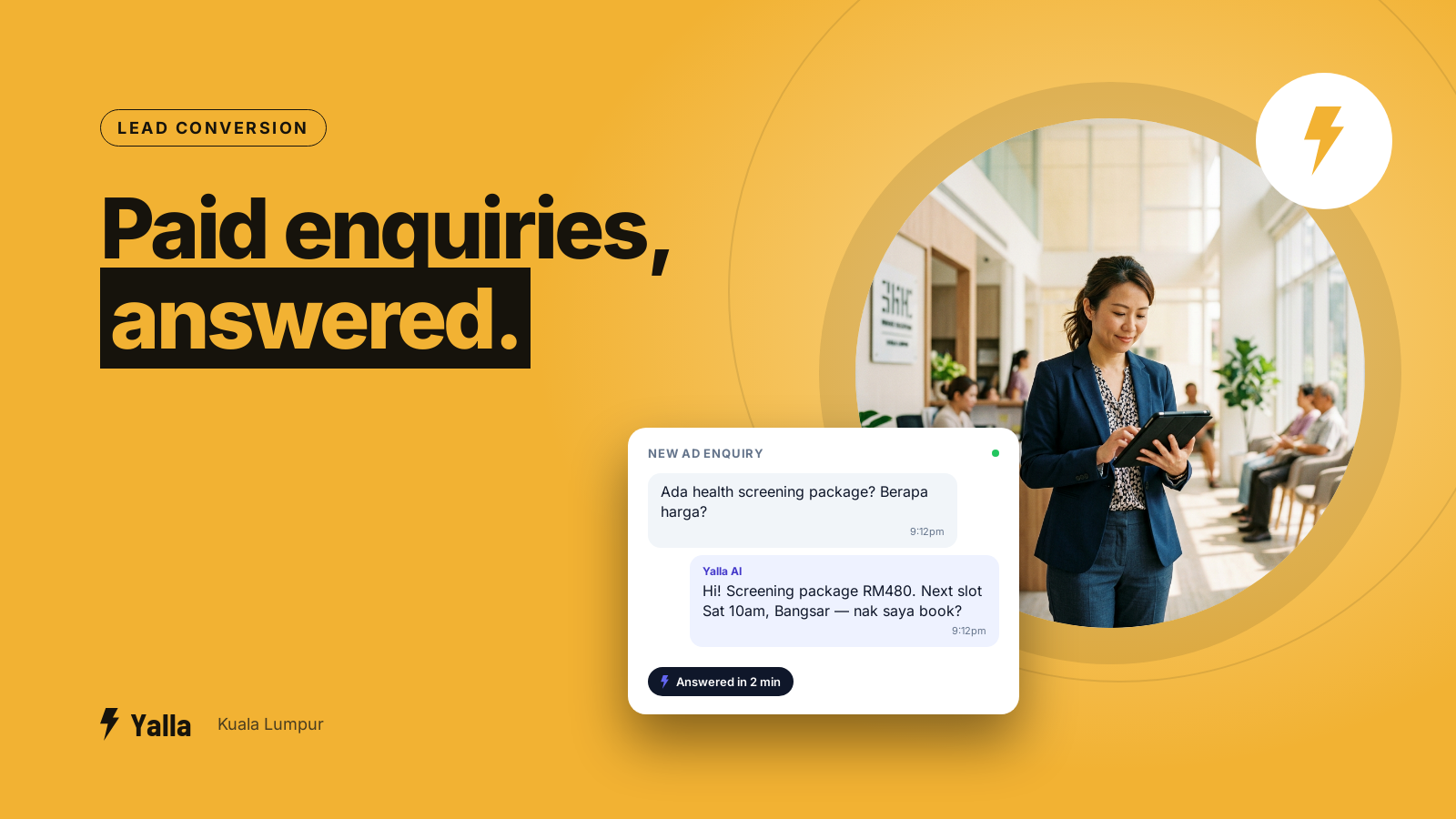
If you run marketing for a private hospital or a multi-branch clinic group in Kuala Lumpur, you already know the uncomfortable version of this. You push RM20,000 a month into Facebook, Instagram and Google for health screening packages and specialist consults. The enquiries land across three branches, on WhatsApp numbers you cannot see, and you only find out an enquiry was dropped when the monthly numbers come in soft and nobody can say why.
That gap, between the budget you spend to make the phone buzz and whether anyone in any branch actually answered it, is exactly what a clinic CRM in Malaysia is built to close. This is a plain guide to the clinic CRM Malaysia healthcare groups actually need: not patient records, not dispensing, but the enquiries you already paid for, across every branch, and whether they turned into booked appointments.
What is a clinic CRM, and how is it different from your HIS or EMR?
A clinic CRM manages enquiries: the people messaging to ask about a screening package, a specialist, a price or an appointment before they are patients. It captures the message, assigns it to a named person at the right branch, makes sure it gets a reply, and follows up if the person goes quiet.
Your HIS or EMR manages patients you already have: medical records, dispensing, billing, MC, panel claims. In Malaysia that is the job of systems like Curo, Aoikumo or Kumodoc, and they do it well.
These are two different problems and a healthcare group needs both. The confusion is expensive, because a group buys a records system, assumes it covers the front of the funnel too, and then watches ad enquiries fall through the gap between marketing and the front desk. If your problem is "we paid for leads and the branches did not reply in time," you have a clinic CRM problem, not a records problem.
Free download
The KL Clinic Enquiry Audit Checklist
A practical companion to this article. Free for your email address.
Get it free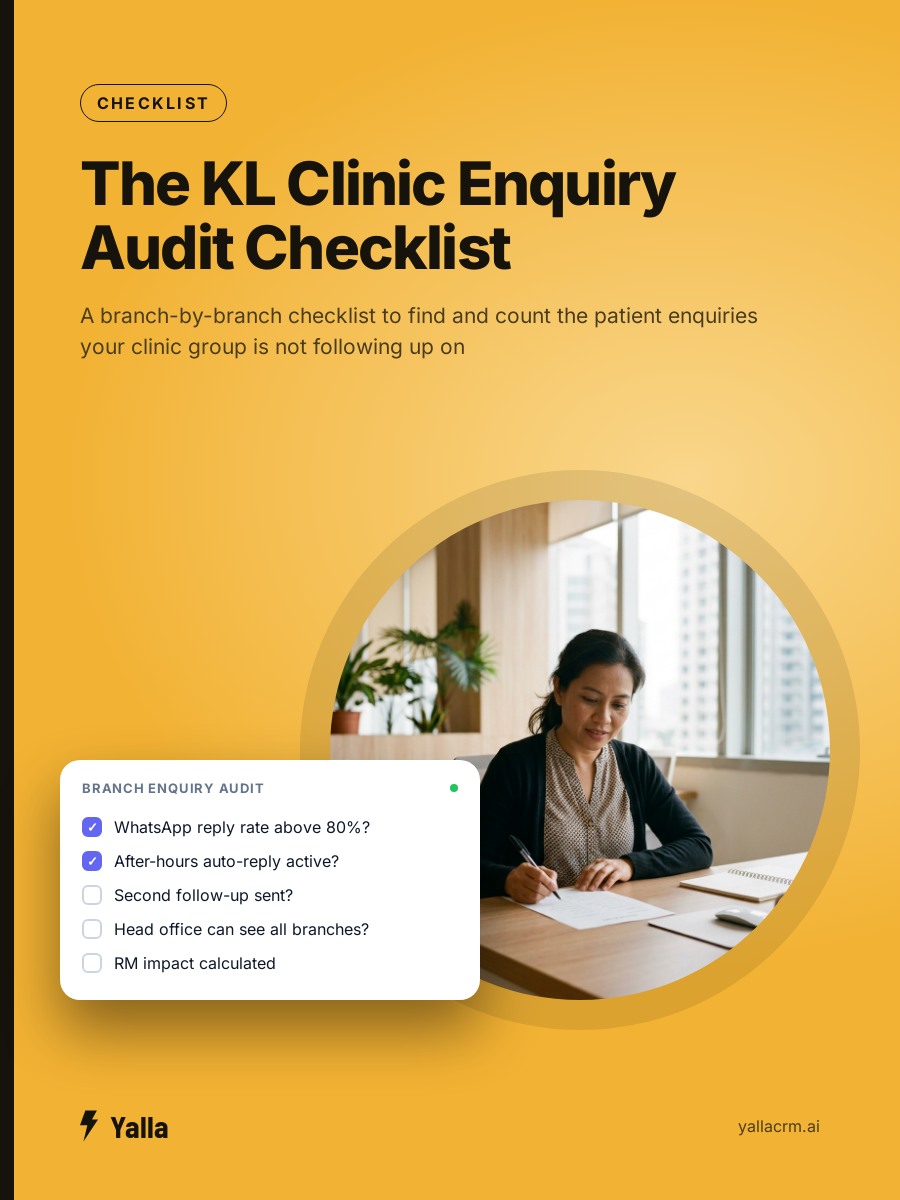
Why do enquiries vanish between the ad and the appointment?
The leak is almost never laziness. It is structure, and in a multi-branch group the structure is worse than in a single clinic:
- Each branch has its own number and its own blind spot. Head-office marketing cannot see the Bangsar branch's WhatsApp or the Cheras branch's Instagram DMs. You find out about a dropped enquiry weeks later, if at all.
- The front desk is doing three jobs. The person answering ad enquiries is also checking in walk-ins and taking calls. Enquiries wait, and in healthcare the person waiting just messages the next clinic.
- After-hours silence. A lot of screening and specialist enquiries arrive after 9pm, when someone is worried and scrolling. If the first reply comes at 10am the next day, they have already booked elsewhere. We wrote about this in why KL leads go cold before you reply and the enquiries that arrive at 2am.
- No second message. Someone asks the price of a health screening package, you send it, they say "ok thanks," and that is the end. Nobody owns the follow-up three days later, so it never happens.
This leak is well documented. Malaysian SME technology writers reported through 2026 that most local firms still run enquiries on WhatsApp and spreadsheets rather than a proper system, and that a large share of leads never get a second follow-up. You do not need the exact percentage to feel it: if even one enquiry in three slips through on a RM20,000 monthly ad budget, that is around RM6,000 of spend reaching nobody.
Where do healthcare enquiries arrive in Kuala Lumpur?
If you only watch one WhatsApp number, you are watching one door while people knock on five, at every branch:
- WhatsApp, from the numbers on your ads, your Google listings and each shopfront.
- Instagram and Facebook DMs, plus comments on ad posts ("price?", "area mana?", "ada screening package?") that never become a conversation because nobody replies to comments.
- TikTok, where comments on a health talk or treatment video are real interest, even though you cannot chat there directly and have to pull people over to WhatsApp.
- Google and your website, where an appointment form fills in and lands in an inbox nobody checks.
A clinic CRM worth paying for pulls all of these, across every branch, into one place. One Malaysian healthcare group we spoke with this quarter was running exactly this across several channels and separate phones with no digital-marketing system tying it together. The problem was never the leads. It was that the leads were scattered and head office was blind to them.
Can one marketing lead see every branch's enquiries?
This is the question that separates a real clinic CRM from a shared WhatsApp. You should be able to open one screen and see, across every branch: how many enquiries came in, how many got a reply within an hour, how many are still sitting unanswered, and which turned into booked appointments.
That visibility is what lets you hold a branch accountable without reading over anyone's shoulder, and it is what tells you which campaign actually produced bookings rather than just clicks. If a branch is sitting on 40 unanswered enquiries, you want to know today, not at month-end. We covered how to do this without it feeling like surveillance in monitoring your team's WhatsApp without spying.
What about the patient database you already have?
Most healthcare groups are sitting on thousands of past patients who came once and were never contacted again. That database is the cheapest marketing you own, and it usually goes unused because reaching out to it by hand is nobody's job.
A clinic CRM lets you run a proper recall or screening campaign to that list: last year's health screening patients, reminded it is time again; dormant patients told about a new specialist or package. Done carefully and with consent, this is often a better return than the next ringgit of ad spend, because these people already trust you. We wrote about the money sitting in the customer database your team is not using.
What should a clinic CRM in Malaysia actually do?
Strip away the feature lists and a clinic CRM has five jobs. If it does these across every branch, it earns its keep:
- Capture every enquiry from WhatsApp, Instagram, Facebook, TikTok comments, your website and Google into one inbox.
- Assign each one to a named person at the right branch so a message is never "everyone's and therefore no one's."
- Reply fast, in the right language. KL enquiries come in Malay, English and Chinese, often mixed in one message. The handling of multilingual enquiries is the difference between a reply and silence.
- Follow up on its own. The person who asked about a package and went quiet should get a nudge without anyone remembering to send it.
- Cut no-shows and give head office one view of enquiries, replies and bookings across all branches.
How much of your clinic can the AI actually reach?
Every CRM has an AI now. The only question is how much of your business it can reach. For a healthcare group, "reach" means the set of things the AI can actually read from and act on: your package list and prices, each branch's calendar, your enquiry history, your channels.
An AI that can only read a canned FAQ will answer "what are your opening hours" and nothing else. An AI that can reach your price list, your appointment slots and your pipeline can tell someone the RM price of a specific screening package, offer the next three slots at their nearest branch, book them in, and hand the enquiry to a human the moment the question turns clinical. That is a different level of useful, and it is not about whose model is cleverer. It is about what the model is allowed to touch.
Yalla is the chat-native CRM where the AI does the work, not just the talking. Yalla Brain acts across pipelines, WhatsApp, Instagram, Facebook, email campaigns and reporting from one instruction, so a front desk that is already stretched is not the thing standing between an ad enquiry and a booked appointment.
When is a clinic CRM not the right tool?
Honest answer, because it decides whether you waste money: a clinic CRM is the wrong purchase if what you actually need is patient records, dispensing, panel billing or MC management. For that you want a proper HIS or clinic management system, and the Malaysian ones named above do it well. A CRM is not a medical records system and should not pretend to be.
It is also the wrong first spend for a single-doctor clinic with light enquiry volume and no one to share an inbox with. If you can comfortably answer every message yourself within the hour, you do not have a leak to plug yet. A clinic CRM earns its keep when there is a team or several branches, more than one channel, and more enquiries than one person can hold in their head.
What does a clinic CRM cost in Malaysia?
Pricing is usually per user per month, and for a healthcare group you are looking at a few hundred ringgit a month per handful of users rather than a five-figure platform fee. The number that matters is not the subscription, it is the comparison. If a group spends RM20,000 a month on ads and recovers even a tenth of the enquiries it currently loses, the tool has paid for itself many times over before you count a single extra screening booking.
Set the sticker price next to your ad budget, not next to zero. The real cost is the RM6,000 of paid enquiries that currently reach nobody.
How to find your clinic's enquiry leak this week
You do not need to buy anything to see the leak. Three steps, about an hour of work:
- Count. For one branch, pull last month's enquiries from WhatsApp, Instagram, Facebook and TikTok comments. Count how many got a reply within an hour, and how many got a second message when they went quiet.
- Compare. Put that number next to the branch's bookings and its share of the ad spend. The gap between enquiries received and enquiries answered is your leak, in ringgit.
- Fix the biggest hole first. For most KL groups it is after-hours silence or the missing second follow-up. Pick one branch, fix one hole, and measure it for a month before you roll anything out group-wide.
Do this once and the business case makes itself, whatever tool you end up choosing.
Frequently asked questions
Is a clinic CRM the same as a WhatsApp Business account?
No. A WhatsApp Business account is one channel and one phone. A clinic CRM brings WhatsApp together with Instagram, Facebook, TikTok comments, your website and Google into one inbox across every branch, assigns each enquiry to a person, and follows up automatically. The CRM is the layer that makes sure the message is answered, not just received.
Can a clinic CRM handle enquiries in Malay, English and Chinese?
Yes, and for a Klang Valley healthcare group it has to. Enquiries routinely arrive in all three, sometimes mixed in one message. A clinic CRM with AI can read and reply in the language the person used, so a Mandarin enquiry at 9pm does not sit unanswered until someone who reads Chinese is back on shift.
Does a clinic CRM replace our HIS or patient records system?
No. Treat them as separate jobs. The CRM owns the enquiry up to the point someone becomes a patient; the HIS owns records, dispensing and billing after that. Some connect through integration, but expecting one to fully replace the other is how groups end up with a gap in the middle.
How does a clinic CRM help head office oversee several branches?
It gives one view across all branches: enquiries received, reply times, unanswered chats and bookings, by branch and by campaign. That lets marketing see which branch is slow and which campaign actually produced appointments, instead of waiting for soft month-end numbers with no explanation.
Free download
The KL Clinic Enquiry Audit Checklist
A practical companion to this article. Free for your email address.
Get it freeYalla is the chat-native CRM where the AI does the work, not just the talking.
See how much of your business it can reach.