
How to Reduce Event No-Shows for KL Seminars and Launches
Half your event registrants never turn up. Here's how to reduce event no-shows for KL seminars and launches with a WhatsApp reminder sequence that gets replies.
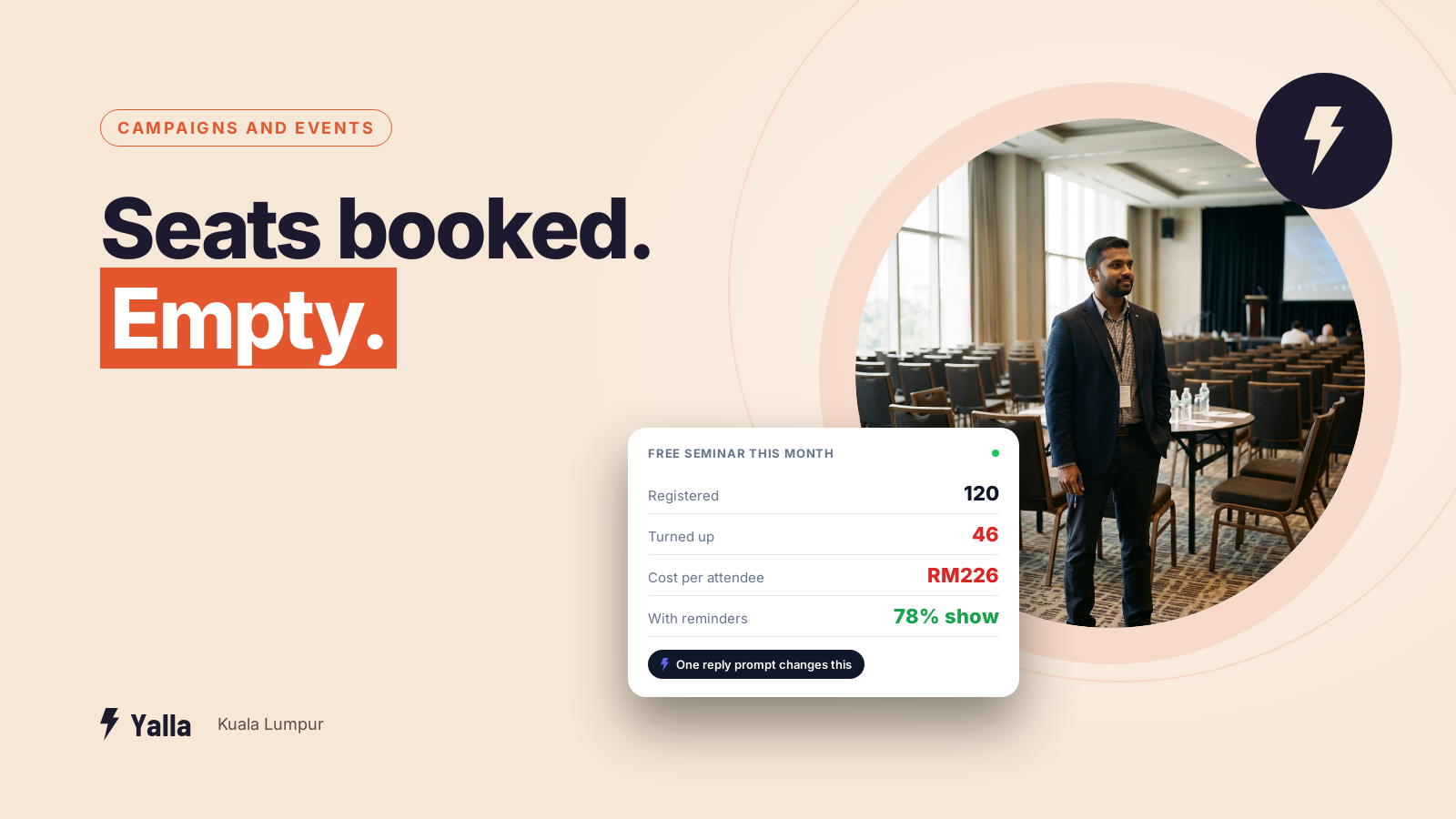
You booked the function room at a hotel near KL Sentral, paid for the F&B, ran the ads, and 120 people registered for your free seminar. On the day, 46 walk in. If that sounds familiar, you are not running a bad event. You are running a normal one, and the gap between registered and attended is the single most expensive number in event marketing that nobody puts on a slide.
This is for the KL marketing manager, event lead or business owner who fills the registration list and then watches half of it evaporate. If your bottleneck is getting enquiries to convert in the first place, this is not your article; this is specifically about people who already registered and then did not turn up. Here is how to reduce event no-shows without hiring anyone or begging people to come.
Why do so many event registrants never show up?
Because registering is free and forgetting is easy. A free event asks nothing of the person who signs up, so signing up costs them nothing to abandon. For free seminars, webinars and open days in the Klang Valley, a no-show rate of 40% to 60% is common, and higher for anything registered more than two weeks in advance.
The reasons are boring and fixable: they forgot, the reminder landed in an unread inbox, the traffic on the Federal Highway looked bad, or they were never that committed and no follow-up ever asked them to commit. None of these is a marketing failure. They are a follow-up gap, and follow-up is a system, not a personality trait.
Free download
The WhatsApp Event Reminder Script Pack for KL Organisers
A practical companion to this article. Free for your email address.
Get it free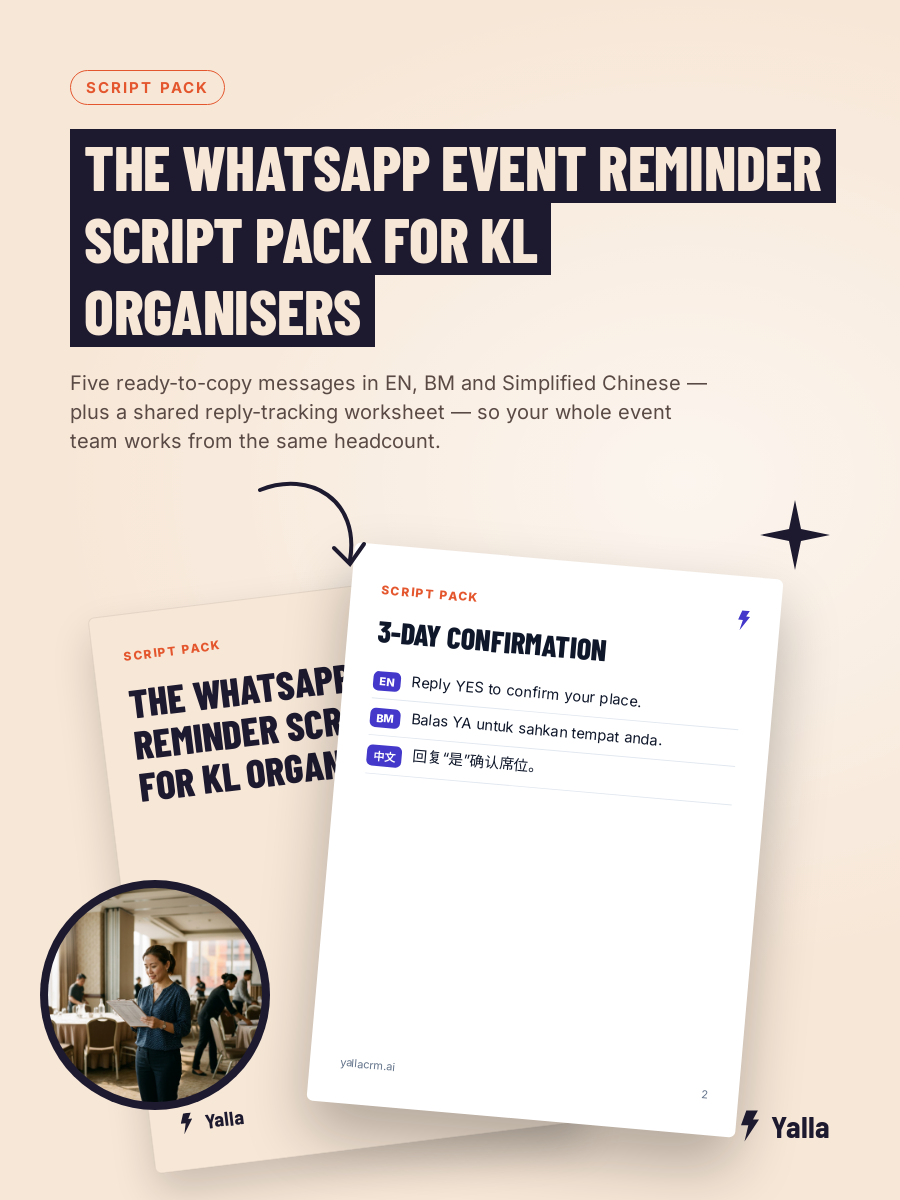
What a no-show actually costs a KL business
Put a ringgit figure on it and the problem stops being abstract.
Say you spend RM3,000 on the function room, RM45 per head on F&B for 120 confirmed, and RM2,000 on ads to fill the room. That is RM10,400 for 120 registrations, or about RM87 per registered person. If only 46 turn up, your real cost per attendee is RM226, and you have catered 74 lunches nobody ate. The event did not get more expensive. Your no-show rate just moved the cost onto the people who bothered to come.
The same maths applies to a property launch preview, an HRD-claimable training taster, a clinic open evening or a school open day. The pattern is identical: money is spent to fill a list, then most of the list is never converted into a body in a seat.
The reminder sequence that reduces event no-shows
One reminder the day before is not a sequence. It is a hope. A reminder cadence that actually moves attendance looks like this, and every message is on WhatsApp, where Malaysians actually read.
- On registration (instant): confirm the spot, send the date, time, venue, a map pin and one line on what they will get. Speed matters; the confirmation should land within seconds, not the next working day.
- Three days before: a short reminder that asks for a reply. "Still coming on Thursday? Reply YES to confirm your seat." A reply is a small commitment, and people who commit turn up.
- The morning of: the practical details. Parking at the venue, the nearest LRT stop, what time doors open, your contact number if they are running late.
- Two hours before: the nudge for the people already on the road or deciding whether to bother. Short, warm, human.
That is four touches, not one, and the middle one is the important one because it converts a passive registration into an active yes.
Why WhatsApp beats email for event reminders in KL
Because your registrants live on WhatsApp and skim email. An event reminder buried in a promotions tab at 9am is not a reminder anyone sees. A WhatsApp message with the venue pin gets opened.
There is a rule to respect, though. WhatsApp only lets you send freely inside a 24-hour window after the customer's last message; outside it, reminders have to go as approved template messages. That is not a reason to avoid WhatsApp, it is a reason to plan the sequence around it, which we explain in the 24-hour window and how to plan follow-ups around it. And if you are messaging a big registration list from a business number, know what gets a number flagged first, covered in what gets a WhatsApp business number blocked.
Getting a confirmation, not just sending a reminder
The difference between a reminder and a confirmation is a reply, and the reply is what predicts attendance.
When someone replies "YES" three days out, two useful things happen. You get a much more accurate headcount for catering, so you stop paying for 74 lunches nobody eats. And you have opened a fresh 24-hour WhatsApp window, which means your morning-of and two-hours-before messages send cleanly. Ask for the reply. A registration list of confirmed yeses is worth more than a longer list of maybes.
For the people who do not reply, that silence is information too. They go into a separate, gentler nudge, and if they still do not turn up, they are your warmest post-event follow-up list, because they raised their hand once already.
What to do about the no-shows anyway
The event is not the end of the no-show. It is the start of the follow-up most businesses never do.
The person who registered and did not attend told you they were interested, then got busy. That is not a dead lead, it is a distracted one. A same-week message with the recording, the slides, or a "sorry we missed you, here is what you missed and the next date" turns a chunk of no-shows into your next event's attendees or into sales conversations. Most KL businesses send nothing, which is the same mistake as never following up an old enquiry, a habit we wrote about in why nobody's job is remembering the follow-up.
The related discipline for appointment-based businesses, clinics, salons, tuition centres, is in how to get people to turn up to appointments and classes. Events and appointments are the same problem at different scales.
What to set up before your next event
You can build the whole thing in an afternoon, and most of it is reusable for every event after.
- Write the four messages now, not the week of the event. Confirmation, three-day reply request, morning-of details, two-hour nudge. Save them as templates you reuse.
- Add one reply prompt. The single highest-leverage change is asking "Reply YES to confirm" three days out. If you change nothing else, change this.
- Decide who watches the replies. Someone has to see the yeses and the "can't make its" and act on them. If several teams work the event, a hospital front desk, marketing and the clinical staff, for instance, make the confirmed list one shared view everyone counts from, not three private phones with three different numbers.
- Draft the no-show follow-up before the event, not after. Have the "sorry we missed you, here is the recording and the next date" message ready to send on the Friday. If you wait until after the event to write it, it never goes out.
Where an AI CRM fits
You can run the whole sequence above by hand for one event. It gets harder across a dozen a year and a registration list in the thousands, especially when several people or departments are working the same list and need to see the same headcount.
The honest version: any decent CRM, or even a scheduling tool, can fire timed reminders. If timed reminders are all you need, you do not need AI for this. It starts to matter when the reminders have to react, when a "YES" updates the headcount, a "can't make it" triggers the recording instead, and an unanswered registrant rolls into next month's invite on its own. That is the difference between sending messages and running a process.
For teams that reach that point, Yalla is the chat-native CRM where the AI does the work, not just the talking, and the shared registration view is the same one every department works from. Whether you need that depends on how many events you run and how many people touch the list.
Frequently asked questions
What is a normal no-show rate for a free event?
For free seminars, webinars and open days in Malaysia, 40% to 60% of registrants not turning up is common, and it climbs the longer the gap between registration and the event. Paid events see far fewer no-shows because the payment itself is a commitment. The fix for free events is to manufacture a smaller commitment, usually a confirmation reply, in the days before.
How many reminders should I send before an event?
Around four across the run-up works better than one the day before: an instant confirmation on registration, a confirmation-seeking reminder about three days out, a details message on the morning, and a short nudge a couple of hours before. The three-day message is the one that matters most, because asking for a reply turns a passive sign-up into an active commitment.
Should event reminders go by email or WhatsApp?
In the Klang Valley, WhatsApp is read far more reliably than email, so the core reminders belong there, with a venue map pin and a clear reply prompt. Remember WhatsApp's 24-hour window: outside it you send approved template messages, so plan the sequence so a registrant's reply reopens the window before your morning-of message.
What should I do with the people who registered but didn't attend?
Treat them as your warmest follow-up list, not a write-off. Within the same week, send the recording or slides and the next date. They raised their hand once, so a distracted no-show is often your easiest next conversation, provided someone actually sends the message.
Free download
The WhatsApp Event Reminder Script Pack for KL Organisers
A practical companion to this article. Free for your email address.
Get it freeYalla is the chat-native CRM where the AI does the work, not just the talking.
See how much of your business it can reach.