
The Sales Follow-Up Sequence That Closes KL Deals
A sales follow-up sequence built for KL teams on WhatsApp: the exact timing, what each message says, and how to chase without burning message costs or the lead.
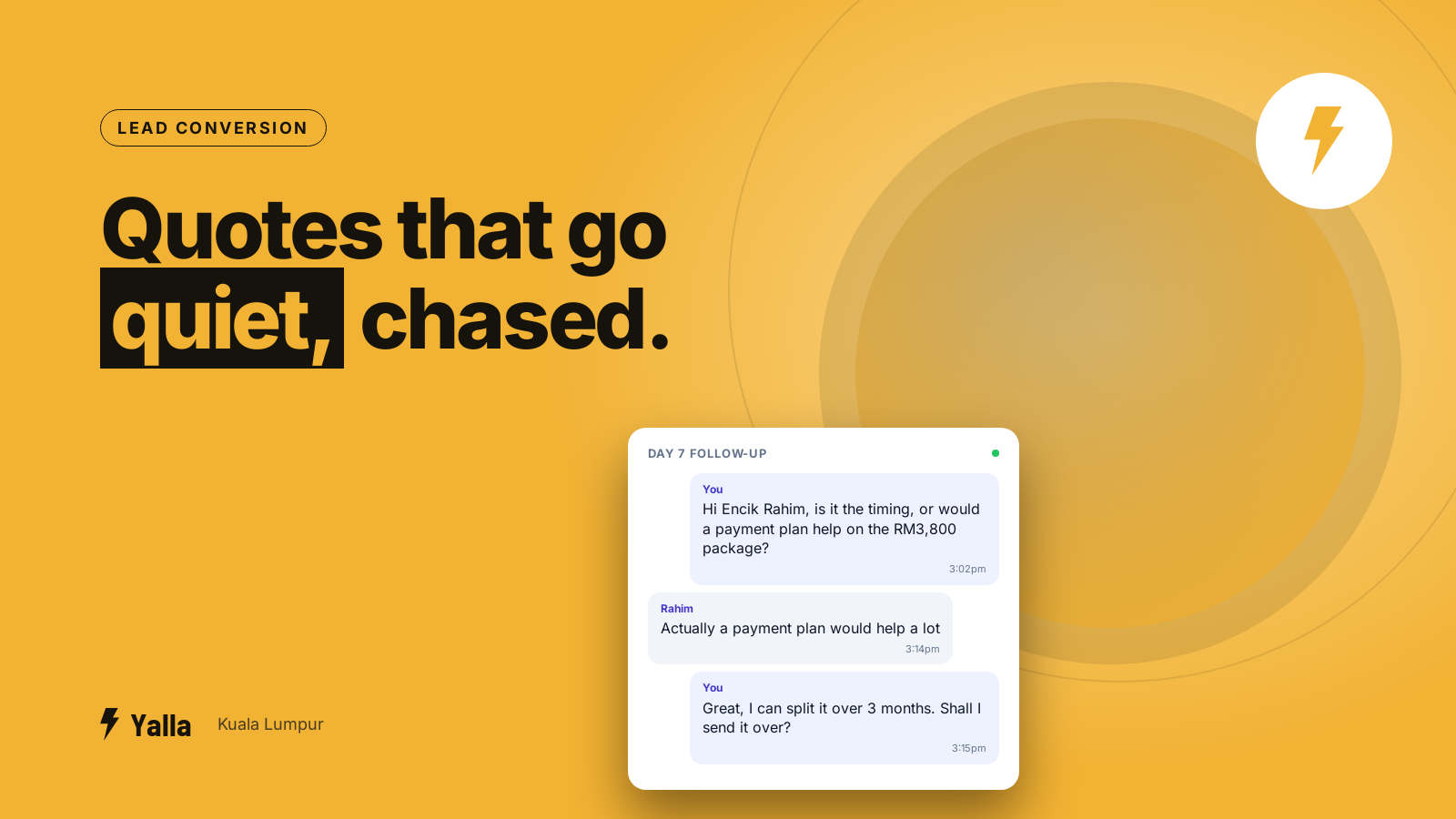
A customer in Kuala Lumpur messages your business, gets a quote for RM3,800, says "let me think about it", and then nothing. Most KL sales teams stop there. The rep means to follow up, gets busy, and three weeks later the deal is dead, not because the price was wrong but because nobody chased. Industry estimates suggest roughly a third of leads are lost to missed follow-up. That is the cheapest revenue you will ever leave on the table, because you already paid to generate it.
A sales follow-up sequence fixes this. It is a planned series of touches, each with a timing and a purpose, so that no lead depends on a busy person remembering it. This guide gives you a sequence you can use on WhatsApp in the Klang Valley, the words for each step, and the rules that keep you from annoying the customer or running up a message bill.
What is a sales follow-up sequence?
A sales follow-up sequence is a fixed schedule of contacts after the first conversation, designed to keep a deal moving until the customer either buys or clearly says no. Instead of "I'll follow up when I remember", it defines exactly when the next message goes out and what it is for: a reminder, a new reason to act, an answer to a likely objection, or a final check-in.
The same idea applies to any considered decision, not just a product sale. A school chasing a parent from enquiry to tour to application, a clinic confirming an appointment, an events team turning a registration into an attendee: wherever there is a gap between first interest and the final decision, a sequence fills it. The examples below use a sales quote, but swap "quote" for "tour" or "booking" and the shape holds.
The point is consistency. A good rep on a good day follows up well. A sequence makes every lead get that same good day, whether the rep is on leave, swamped, or simply forgot. We argued the deeper version of this in nobody's job is remembering the follow-up: the moment follow-up relies on memory, memory loses.
Free download
The KL Sales Team WhatsApp Follow-Up Script Pack
A practical companion to this article. Free for your email address.
Get it free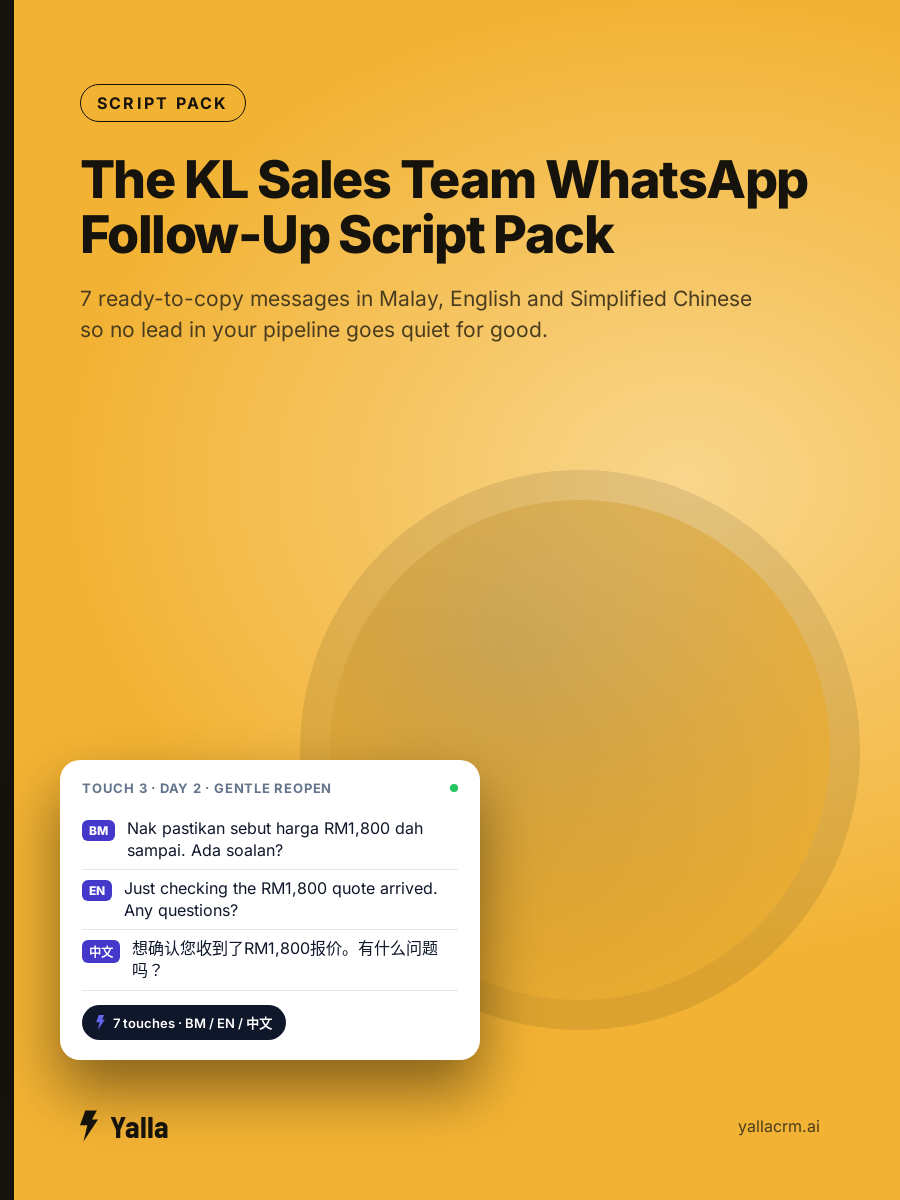
How many times should you follow up before you stop?
Most deals that close do so after several touches, not the first. Yet many KL reps give up after one unanswered message, reading silence as a no when it usually just means "not right now" or "busy". The practical answer is to plan for five to seven touches spread over about a month, then move the lead to a slower nurture rather than dropping it entirely.
We put numbers to this question in how many times should you follow up a lead before you stop. The short version: stopping at one or two is leaving money behind, and chasing daily forever is how you get blocked. The sequence below sits in the sensible middle.
The seven-touch WhatsApp follow-up sequence
Here is a sequence built for how KL customers actually behave on chat. Adjust the ringgit figures and products to your business, but keep the shape and the timing.
| When | Touch | Purpose |
|---|---|---|
| Within 5 minutes | First reply + answer the obvious question | Catch them while they are still deciding |
| Same day | Send the quote or details they asked for | Remove the reason to wait |
| Day 2 | "Did you get the quote? Any questions?" | Reopen the conversation gently |
| Day 4 | Add value: a photo, a case, an availability note | Give a fresh reason to reply |
| Day 7 | Address the likely objection (price, timing) | Handle the real blocker |
| Day 14 | A soft nudge with a light deadline or offer | Create a reason to decide now |
| Day 30 | The honest close: "Should I keep this open?" | Get a yes, a no, or a clear next date |
Touch 1, within five minutes. Speed decides more deals than price. A reply in minutes rather than hours multiplies your chance of winning, because the customer is messaging your competitors in the same sitting. Even a short "Hi, thanks for your enquiry, happy to help, may I ask which model you're after?" keeps you in the race.
Touch 2, the same day. Send the actual quote or details while interest is hot. A quote that takes two days to arrive has already lost to the business that sent one in two hours. If quoting is your bottleneck, we wrote a whole guide on getting an accurate price out the same day.
Touch 3, day two. A light check-in: "Hi Encik Rahim, just making sure you received the quote for the RM3,800 package. Any questions I can answer?" No pressure, just a reopened door.
Touch 4, day four. Do not just say "following up". Bring something: a photo of the product, a short note that a slot or stock is filling, a quick example of another KL customer in a similar spot. A reason to reply, not a nag.
Touch 5, day seven. Name the real objection. Most silence is about price, timing or a decision-maker who is not in the chat. "Is it the timing, or would a payment plan help?" moves things far better than another "just checking in".
Touch 6, day fourteen. A gentle deadline or a reason to act now: an offer that expires Friday, a price that changes next month, the last slot before the school holidays. Honest scarcity, never invented.
Touch 7, day thirty. The clean close. "I don't want to keep messaging if the timing isn't right. Should I keep this open for you, or close it for now?" This wins back more deals than people expect, because it signals you will stop, which paradoxically makes the customer respond.
What should each follow-up message say?
Timing gets the message delivered; the words decide whether it works. Because KL customers message in Malay, English and Chinese, often switching mid-chat, write each touch so it is easy to adapt. Here are ready-to-use scripts for the touches reps most often fumble. Keep them short, name the customer, and reference the exact thing they asked about.
Day two, the gentle reopen:
EN: "Hi Puan Siti, just checking you received the RM3,800 quote I sent yesterday. Happy to walk you through what's included."
BM: "Hi Puan Siti, nak pastikan sebut harga RM3,800 semalam dah sampai. Boleh saya terangkan apa yang termasuk."
Day seven, the objection surface:
EN: "Hi Encik Rahim, is it the price, the timing, or something else holding it up? If a payment plan helps, I can split it over three months."
BM: "Hi Encik Rahim, isu harga, masa, atau lain? Kalau nak bayar ansuran, boleh saya pecahkan tiga bulan."
Day thirty, the honest close:
EN: "I don't want to keep messaging if now isn't the right time. Should I keep this open for you, or close it for now and check back later?"
The pattern in every script is the same: one clear reference to what they wanted, one easy question, no guilt. A generic "any update?" gets ignored; a specific "still want the RM3,800 package held for you?" gets an answer. A school would swap in "still keen on the Year 7 tour on Saturday?"; a clinic, "shall I confirm your Tuesday 3pm slot?". Same shape, different noun.
How do you know if your follow-up sequence is working?
A sequence you do not measure is just a habit. Track four things and you will know exactly where deals stall:
- Reply rate per touch. Which message reopens conversations and which gets silence. If day four is dead, change what it offers.
- Touches to close. The average number of contacts before a won deal. If most wins happen on touch five, giving up at touch two is costing you real money.
- Sequence-to-sale conversion. Of the leads that enter the sequence, how many buy. This is the headline number your sequence exists to move.
- Where it stalls. The touch where most deals go quiet for good. That is the message to rewrite first.
You do not need a data team for this. Even a simple weekly count per salesperson, plotted against how many leads they were handed, shows whether the follow-up is happening or whether leads are dying in someone's inbox. If visibility itself is the problem, that is a separate fix we covered in how to monitor your sales team's WhatsApp without spying.
How do you follow up without burning message costs?
Here is the trap the generic advice misses. On WhatsApp, after a customer's last message there is a 24-hour window in which you can reply freely. Outside that window, messages are billed, and from October 2026 Meta charges for service conversations that used to be free. Rule-based blast tools are notorious for firing eight or more templated messages per flow, which racks up a bill and reads as spam.
A good sequence does the opposite. It sends one or two well-timed, human messages, and it leans on the free 24-hour window wherever it can by replying promptly when the customer re-engages. We explained the window and how to plan around it in the follow-up your sales team can't send after 24 hours. The lesson for your sequence: fewer, better-timed touches beat a firehose, both for your costs and for whether the customer keeps reading.
The follow-up mistakes that kill KL deals
Most of the lost third does not die from bad luck. It dies from a handful of repeatable mistakes:
- "Just checking in" with nothing new. A message that adds no value trains the customer to ignore you. Every touch should carry a reason to reply.
- Giving up after one silence. Silence is rarely a no. Treating it as one is the single most expensive habit on a sales floor.
- The same message to everyone. A copy-paste that ignores what the customer actually asked about reads as spam, especially in a market where people expect a personal reply.
- Chasing on the wrong channel. If the customer only ever uses WhatsApp, an email follow-up vanishes. Meet them where they messaged you.
- Running the sequence on unqualified leads. Seven touches on someone who was never going to buy annoys two people and clogs your pipeline. Qualify first.
- Ignoring the 24-hour window. Letting a hot conversation lapse past 24 hours means your next message is a paid template that may never get read.
Should the sequence be automated or done by a person?
Both, in the right places. The parts that are predictable and time-based, the day-two check-in, the day-four nudge, the reminder that a slot is filling, should run on their own so they never get forgotten. The parts that need judgement, handling a real objection, negotiating a price, reading that a customer is nearly ready, belong to a human.
The mistake at each end: automate everything and you sound like a robot chasing a ghost; automate nothing and you are back to depending on memory, which is where the third leaks out. The right setup lets the system keep the rhythm while the rep brings the judgement. If you have a backlog of old leads that never got any sequence at all, start there, as we described in what to do with the hundreds of leads you never followed up.
Where a follow-up sequence is not the answer
Honesty, because a sequence is a tool, not magic.
Some deals need a phone call, not a seventh message. A RM50,000 B2B deal that has gone quiet usually needs a human to pick up the phone, not another WhatsApp nudge. Use the sequence to earn the call, not to replace it.
A sequence will not fix a bad fit. If the customer was never going to buy, chasing them seven times just annoys two people. Qualify early so your sequence runs on leads worth the effort.
Impulse, one-touch sales do not need thirty days. If you sell a RM30 item people buy on the spot, a long cadence is overkill. The sequence earns its keep on considered purchases where the gap between enquiry and decision is measured in days or weeks.
What this looks like running on its own
Picture Monday morning. Instead of asking each rep who they chased over the weekend, you open one screen and see every live deal, who owns it, and which ones have gone quiet past their next touch. The day-two check-in on Puan Siti's RM3,800 quote already went out on Saturday. The day-seven objection prompt on Encik Rahim's deal is queued for tomorrow. Nobody had to remember either, and nothing was left to a busy person's memory.
That is the practical difference a chat-native system makes. Yalla is the chat-native CRM where the AI does the work, not just the talking: each lead carries its own follow-up schedule, the time-based touches fire on their own, and the judgement calls surface as tasks for a human. And because the same system works across your channels and your pipeline, you can ask for what you need in plain words. Yalla Brain acts across pipelines, WhatsApp, Instagram, Facebook, email campaigns and reporting from one instruction, so "follow up with every quote over RM2,000 that's gone quiet for three days" is one line, not an afternoon of scrolling.
The same cadence runs whether you are chasing a RM3,800 quote, a Year 7 tour booking, or a clinic appointment. The shape does not change. Only the words do.
Frequently asked questions
What is the ideal timing for a sales follow-up sequence?
A practical cadence is: reply within five minutes, send details the same day, then follow up on day two, day four, day seven, day fourteen and day thirty. Early touches are close together while interest is hot; later ones spread out so you stay present without pestering. Adjust the spacing to your sales cycle, but keep the first reply fast and the sequence planned rather than left to memory.
How many follow-ups is too many?
Chasing daily, or sending the same "just checking in" with no new value, is too many and gets you ignored or blocked. Five to seven spaced, purposeful touches over about a month is the sweet spot for most considered purchases. After that, move the lead to a slower nurture rather than hammering it.
Should I automate my sales follow-up on WhatsApp?
Automate the predictable, time-based touches so they never get forgotten, and keep the judgement calls, objection handling and negotiation, with a human. Lean on WhatsApp's free 24-hour reply window and send fewer, better-timed messages to avoid both spam and rising per-message costs. The best setups keep the rhythm automatically while the rep brings the human touch.
What should the first follow-up message say?
Keep it short, specific and helpful: reference exactly what they asked about, confirm they received your quote or details, and ask one easy question. For example, "Hi Puan Siti, just checking you received the RM3,800 quote. Happy to walk you through the payment options if useful." Specific beats a generic "any update?" every time.
How do I measure if my follow-up sequence is working?
Track reply rate per touch, average touches to close, overall sequence-to-sale conversion, and the touch where most deals stall. Even a simple weekly count per salesperson reveals whether follow-ups are actually happening. Rewrite the touch that loses the most deals first, and keep what reopens the most conversations.
Free download
The KL Sales Team WhatsApp Follow-Up Script Pack
A practical companion to this article. Free for your email address.
Get it freeYalla is the chat-native CRM where the AI does the work, not just the talking.
See how much of your business it can reach.