
Sales Team Not Following Up on Leads? Here's the Fix
If your sales team is not following up on leads in KL, you pay twice: for the ad and the lost deal. Here is why it happens and the system that fixes it.
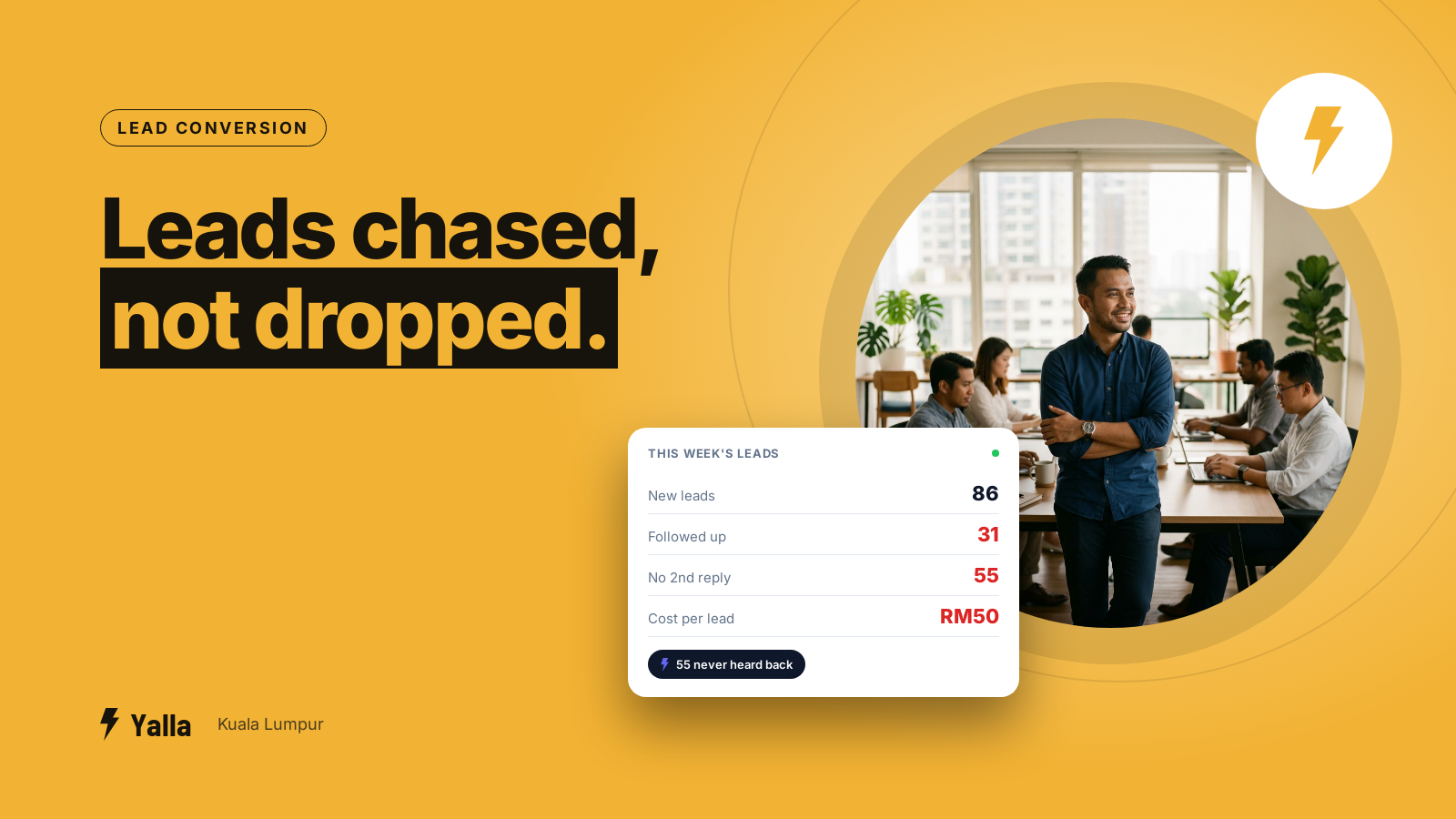
In most Klang Valley businesses, the leads are not the problem. A Petaling Jaya showroom pays RM40 to RM80 to bring in one Facebook or WhatsApp enquiry, the enquiries arrive all day, and then they sit. If your sales team is not following up on leads, you are paying twice: once for the ad that brought the lead in, and again for the deal that quietly goes to the competitor who replied first.
This is not a motivation problem, and more pep talks will not fix it. It is a system problem, and it shows up the same way in a KL property agency, a Shah Alam equipment supplier and a Subang car dealership. Below is why it happens, what it costs you in ringgit, and the follow-up system that does not depend on anyone remembering.
Why is your sales team not following up on leads?
When you look closely, the reps are rarely lazy. They are losing to the way the work is set up:
- Leads live on personal phones. Each salesperson has WhatsApp on their own handset. There is no shared list, so whoever is free grabs a lead, and the rest fall between people. Nobody can say who owns what.
- The volume quietly beats them. A team pulling in 80 to 100 leads a week can realistically chase 20 to 30 properly. The other 60 are not ignored on purpose. They are forgotten.
- Follow-up lives in memory. The second message, the one three days later, depends on a rep remembering. Under pressure, memory is the first thing to go.
- The manager cannot see inside the chats. When conversations sit in private phones, you cannot tell who replied, who went quiet, or which RM50,000 enquiry was dropped until the month closes short.
- Reps stop too early. Most give up after one or two tries because the lead "went cold." Often the lead was simply busy.
Fix the setup and the behaviour changes. Leave the setup alone and even a good team will keep leaking leads.
Free download
The WhatsApp Lead Follow-Up Script Pack for KL Sales Teams
A practical companion to this article. Free for your email address.
Get it free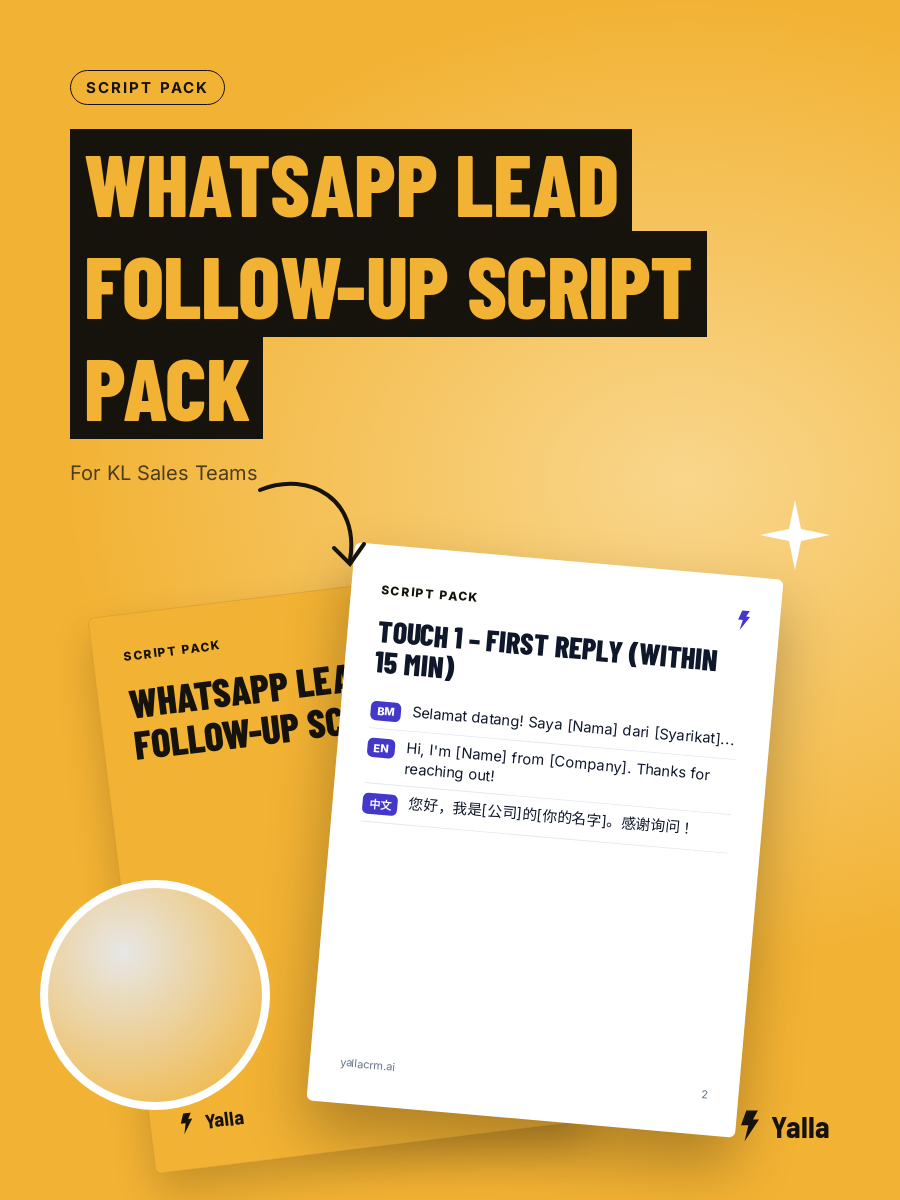
What does an unfollowed-up lead actually cost in ringgit?
Put real numbers on it. Say you spend RM15,000 a month on Facebook and Instagram lead ads at an RM50 cost per lead. That is 300 enquiries.
Industry studies of Malaysian SMEs have put the share of leads lost to slow or missed follow-up at roughly 30%. On 300 leads, that is about 90 enquiries a month that never get a proper second reply. At RM50 each, you spent RM4,500 bringing in people nobody chased, every single month. That is RM54,000 a year of ad budget walking out the door, before you count the deals themselves.
For a dealership closing at RM8,000 a sale, you only need a handful of those 90 to convert to see that the lost revenue dwarfs the wasted ad spend. The enquiry was the expensive part. You already paid for it.
How quickly is "too slow" to follow up?
Speed decides more than most managers think. A 2007 MIT and InsideSales study found you are about 21 times more likely to qualify a lead if you respond within five minutes instead of thirty. A 2011 Harvard Business Review review of 2,241 companies found the average first response took 42 hours, and 23% of firms never responded at all.
Now apply that to Kuala Lumpur, where WhatsApp is how nearly everyone messages a business. An enquiry that lands at 11pm and gets a reply at 8.30 the next morning has already lost its heat. The customer has messaged two other suppliers by breakfast. "Following up" is not only the second and third message. It starts with the first reply, and in chat that window is minutes, not hours. We go deeper on this in why KL leads go cold before you reply.
How many follow-ups does it actually take?
The uncomfortable answer is: more than your team is doing now. A large share of sales happen after the fourth or fifth touch, yet most reps stop at the second because they do not want to be a nuisance. The skill is spacing and relevance, not volume. A quote nudge on day two, a "still deciding?" on day five, and a check-in the following week is a normal rhythm, not harassment. We lay out the full picture in how many times you should follow up a lead before you stop.
Why "just remind the team to follow up" never works
Here is the trap most owners fall into. They notice leads slipping, so they tell the team in the Monday meeting to follow up better. For two weeks it improves. Then it slides back, because follow-up was never assigned to anyone as a job. It sat in the gap between people.
A task that depends on willpower and good intentions will always lose to the forty other things a salesperson is doing. The fix is to take the remembering out of human hands entirely. We wrote about exactly this failure in nobody's job is remembering the follow-up.
A follow-up system that runs without being remembered
A working system has four parts, and none of them rely on a rep's memory:
- Every lead lands in one place. Facebook, Instagram and WhatsApp enquiries flow into a single shared inbox, not twelve personal phones. Nothing can be dropped because nothing is invisible.
- Each lead gets an owner automatically. The moment an enquiry arrives it is assigned to a named salesperson by round-robin or by product, so there is never a "someone will get it" lead. Here is how to route enquiries to the right salesperson.
- Follow-ups fire on a schedule. If a lead has not been replied to in an hour, the rep is reminded. If a quote has gone quiet for two days, a nudge is queued. The sequence runs whether or not anyone remembers.
- The manager can see it all. You can tell at a glance which leads are waiting, who is behind, and where a deal stalled, without asking anyone to send you a report.
This is the job a tool like Yalla is built for. Yalla is the chat-native CRM where the AI does the work, not just the talking: it files the enquiry, assigns the owner and queues the next follow-up in one motion, so none of it waits on a busy rep to remember.
Where does AI help here, and where does it not?
Every CRM has an AI now. The only question is how much of your business it can reach. For follow-up specifically, AI genuinely helps with the mechanical parts: it can draft the second message in Malay, English or Chinese to match how the customer wrote, chase leads that have gone quiet, remind a rep before a quote expires, and sort the hot enquiries from the tyre-kickers so your team spends its hours on the right names.
What it cannot do is rebuild trust after three weeks of silence, or carry a RM200,000 negotiation on its own. Those stay human. And if your sales are email-led, low-volume and relationship-heavy with long contracts, a record-first CRM may fit you better than a chat-native one. The honest test is simple: if most of your enquiries arrive in chat and the bottleneck is speed and consistency, a chat-native system fixes the exact thing that is broken. If they do not, it will not.
What to actually do this week
You do not need a three-month project. In order, these are the steps that move the needle fastest:
- Pick one inbox. Move every enquiry source into a single shared inbox this week so no lead is trapped on a private phone. If you do only one thing, do this.
- Assign an owner to every new lead automatically, with a clear rule for who gets what, so no enquiry is left as "someone's."
- Set a first-response target in minutes, not hours, and tell the team it is now measured.
- Write one follow-up sequence (day 0, day 2, day 5, day 12) and have it trigger on its own.
- Check a live view of waiting leads each morning, so slippage is caught the same day instead of at month end.
Do the first two and you will see the leak shrink inside a fortnight. The rest tightens it.
Frequently asked questions
How do I know if my sales team is actually following up?
If follow-up lives on personal phones, you cannot know, and that is the real problem. Put every enquiry into a shared system where each lead has an owner and a status. When you can see which leads are waiting and for how long, "are they following up?" stops being a question you have to ask.
What is a realistic follow-up cadence without annoying people?
A touch on day zero, day two, day five and around day twelve is comfortable for most buyers, as long as each message is useful rather than "just checking in" repeated. Relevance matters more than count. A nudge tied to a quote, a tour or a deadline reads as helpful, not pushy.
Does automating follow-up make it feel robotic?
It does not have to. Automation decides when a follow-up should happen and drafts a starting point. The rep still edits the tone and adds the detail only they know. You are removing the forgetting, not the human. Customers notice a reply that comes fast and sounds like a person far more than they notice that a reminder was scheduled.
We are a small team. Do we really need a system for this?
Small teams leak the most, because one person off sick means their leads go unanswered for days. A system is what lets three people behave like a reliable front desk instead of three separate phones. The smaller you are, the less you can afford to lose the enquiries you already paid for.
Free download
The WhatsApp Lead Follow-Up Script Pack for KL Sales Teams
A practical companion to this article. Free for your email address.
Get it freeYalla is the chat-native CRM where the AI does the work, not just the talking.
See how much of your business it can reach.