
Deals Stall and Nobody Notices: Build a Sales Pipeline
A sales pipeline tells your team where every deal stands and which ones are stuck. Here is how to build one that your salespeople actually use.
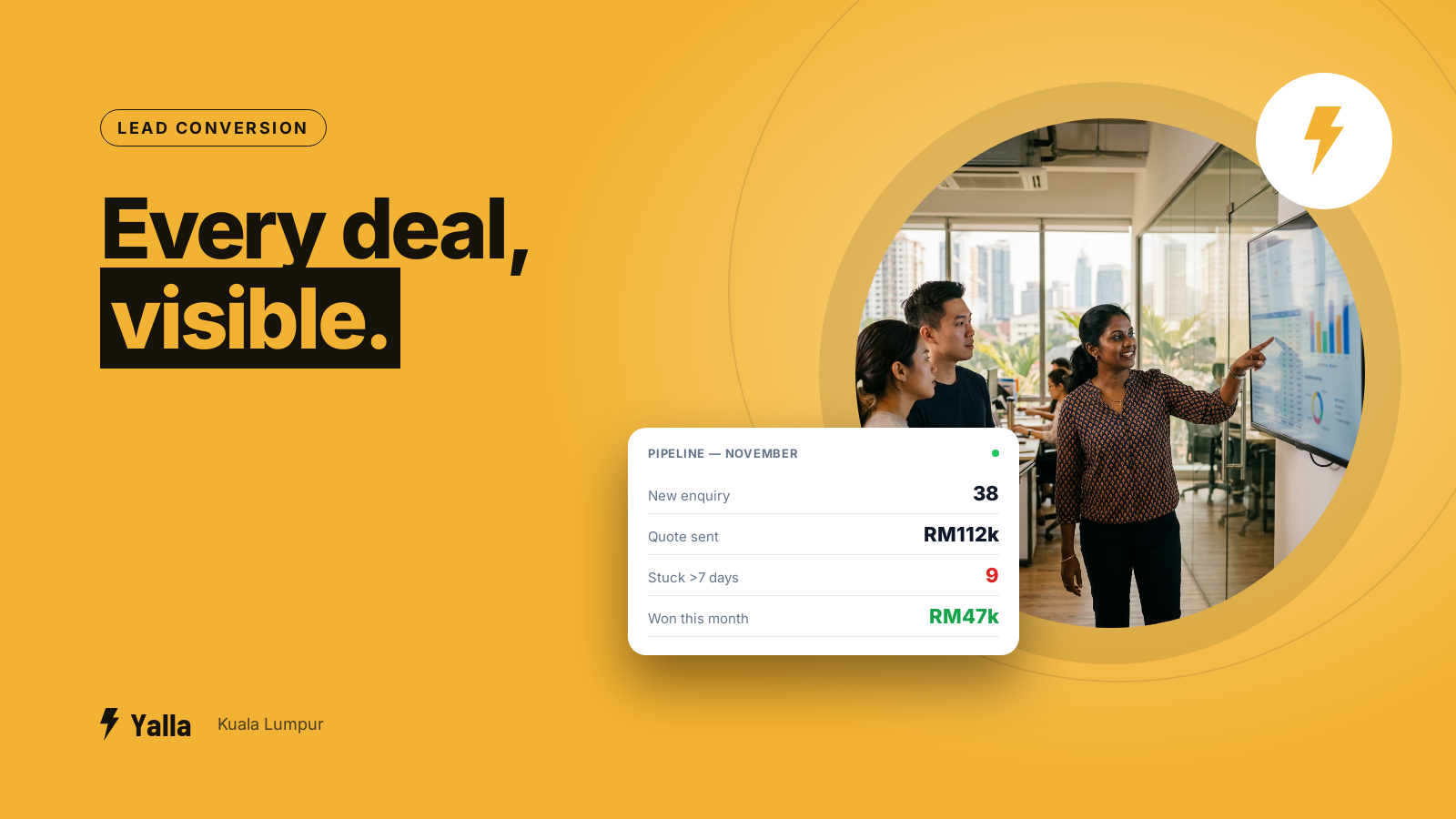
Most sales teams do not lose deals because the product is wrong or the price is too high. They lose deals because nobody can see where each one stands. A quote went out three weeks ago and no one chased it. An enquiry that came in on WhatsApp in Malay got answered, then quietly forgotten. The manager asks "how are we doing this month?" and the honest answer is a shrug. A sales pipeline is the fix for exactly this blind spot, and it is simpler to set up than most owners think.
What is a sales pipeline, really?
A sales pipeline is a visual list of every live deal, sorted by how close it is to closing. Each deal sits in a stage. As the deal moves forward, it moves to the next stage. When you look at the pipeline, you can see in one glance how many deals are at each step and roughly how much revenue is in play.
Think of it as the difference between a drawer full of loose receipts and a spreadsheet that adds itself up. The receipts are the same information. The pipeline is that information arranged so you can actually act on it: who to call today, which quote is going cold, how much might land this month.
For a business juggling enquiries from Facebook ads, Instagram DMs, a website form and several salespeople's phones, the pipeline is the one place where all of that becomes a single, countable queue instead of scattered conversations. It is the difference between managing by memory and managing by sight.
Free download
Sales Pipeline Setup Template for Sales Teams
A practical companion to this article. Free for your email address.
Get it free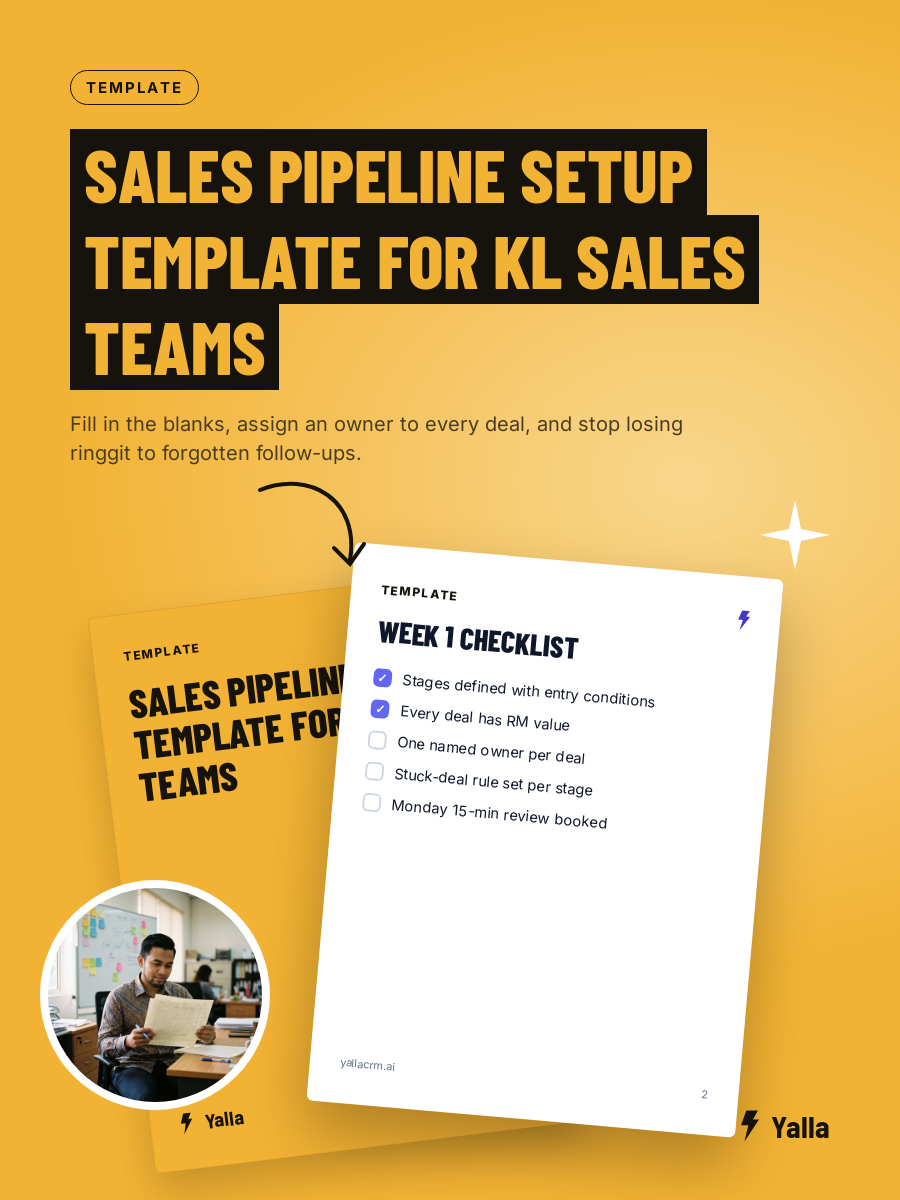
Why do deals stall without a pipeline you can see?
When there is no pipeline, the status of a deal lives in one person's head or one chat thread. That works until the team gets busy. Then the predictable things happen:
- A salesperson sends a quote and assumes the customer will reply. The customer meant to, got busy, and the deal dies in silence.
- Two reps answer the same Instagram enquiry because nobody knew who owned it.
- A lead that said "call me next month" is never called, because the reminder was a mental note.
- The owner only finds out a big deal collapsed after it is already lost.
A pipeline makes stalled deals impossible to hide. A deal that has sat in "Quote sent" for nine days with no movement is a visible problem, not a forgotten one. This is the same leak we covered in why sales teams stop following up on leads — a pipeline is the structure that stops it happening in the first place.
The cost is rarely small. If a five-person team lets four typical deals a month quietly stall, that revenue leaks out every month to nothing more dramatic than forgetfulness. Over a year it dwarfs the cost of any CRM you might buy to stop it.
What stages should a sales pipeline have?
There is no single correct set of stages. The right pipeline mirrors how your business actually sells. Start with five stages and adjust once you see where deals get stuck. A workable default for a small or mid-sized business:
- New enquiry — the lead has arrived (WhatsApp, Facebook lead ad, walk-in, referral) but nobody has qualified it yet.
- Contacted / qualified — you have replied, confirmed they are a real buyer, and understood what they want.
- Quote sent — a price or proposal is with the customer. This is the stage where most deals go quiet.
- Negotiation / follow-up — they have questions, want a discount, or are comparing you with someone else.
- Won or Lost — the deal closed, one way or the other. Marking deals "Lost" with a reason is as valuable as marking them "Won".
A property agency might add a "Viewing booked" stage. A clinic might use "Consultation booked" then "Treatment scheduled". A car dealership often runs separate pipelines for sales and for service, because the two never share stages. One demo team we spoke to wanted enquiries routed into four different pipelines by product line, so each had its own stages and its own owner. That is normal and healthy: a stage only earns its place if a deal genuinely changes hands or state when it gets there.
Keep the number of stages honest. If you cannot describe what has to be true for a deal to leave a stage, that stage is decoration.
What should each deal in your pipeline show?
The stages are the columns. The deals are the cards that move between them. A card is only useful if it carries enough to act on without opening three other apps. At a minimum, each deal should show:
- Who it is — name, contact, and which channel they came in on (WhatsApp, Facebook, walk-in).
- What they want and how much it is worth — the product or service and the deal value, even if it is a rough estimate. Without a value you cannot total the pipeline.
- Who owns it — one named salesperson, never "the team".
- The next action and its date — "send revised quote by Thursday", not a blank.
- The last contact — when you last spoke and what was said, so anyone can pick it up cold.
The deal value is the part most teams skip, and it is the part that turns a pipeline from a to-do list into a revenue forecast. When every deal carries a value, the owner can look at "Quote sent" and see a large sum sitting there, then ask the only question that matters: what is stopping it from closing?
How does a sales pipeline work when leads arrive on WhatsApp?
This is where most growing sales teams actually live, and where a generic pipeline tool starts to creak. Your deals do not begin life as neat records in a CRM. They begin as chats: a "Hi, masih ada stock?" on WhatsApp, a comment on a Facebook ad, a DM in English with a voice note in Chinese attached.
The question that decides whether a pipeline works for you is not "does it have stages" — every CRM has stages. The question is how much of your actual selling the pipeline can see and act on. If the chat lives in one app and the pipeline lives in another, someone has to copy information between them by hand, and that someone will stop doing it within a fortnight. The pipeline then rots, which is the single most common reason pipeline rollouts fail.
A chat-native pipeline treats the conversation and the deal as the same object. When a WhatsApp enquiry arrives, a deal is created at "New enquiry" automatically. When a rep is assigned, the deal shows an owner. When the quote is sent in the chat, the deal can be nudged to "Quote sent". The reply history sits on the deal card, so whoever picks it up has the full context without scrolling through a phone. We go deeper on that in what a lead management system actually does.
Every CRM has an AI now. The only question is how much of your business it can reach — and for a pipeline, "reach" means the set of places a deal can be read from and updated: the WhatsApp thread, the Instagram and Facebook inboxes, the quote, the task reminder, the Friday report. Yalla is the chat-native CRM where the AI does the work, not just the talking. In plain terms, the deal updates itself from the chat, so nobody retypes anything, and the pipeline is still accurate on Friday afternoon when it matters.
What is the difference between a sales pipeline, a sales funnel and a lead list?
These three get used interchangeably and they are not the same thing.
- A lead list is just names and contacts. It tells you who, not where they are in buying. Most teams start here, usually in Excel, and outgrow it fast — the reasons are in why a spreadsheet breaks a growing sales team.
- A sales funnel is a reporting view: of 100 enquiries, how many became quotes, how many became customers. It is about percentages and drop-off across the whole team over time.
- A sales pipeline is the operational view: these specific deals, right now, each at a specific stage, each with an owner and a next action. You work the pipeline day to day; you read the funnel weekly to spot where deals leak.
You need the pipeline to run the team. You need the funnel to improve it. A proper sales dashboard usually shows both.
How do you measure a healthy sales pipeline?
Once the pipeline exists, a handful of numbers tell you whether it is working. You do not need a data analyst; you need to look at five things each week:
- Pipeline value — the total value across all open deals. If you want to close a set amount this month and barely more than that is in the pipeline, you are one lost deal away from missing target.
- Win rate — of deals that reach a decision, how many you win. If it is 1 in 5, you need five live quotes for every sale you want.
- Average deal age — how long deals sit before closing. A rising number means deals are stalling, not dying — which is fixable with follow-up.
- Stage conversion — the share of deals that move from one stage to the next. A big drop between "Quote sent" and "Won" tells you the problem is pricing or follow-up, not lead volume.
- Stuck deals — anything with no activity for your chosen number of days. This is the list you work first, every single week.
The point of these numbers is not reporting for its own sake. It is that they tell you exactly where to spend Monday morning. If stage conversion from enquiry to quote is low, your team is slow to reply, and the case for fixing that is in why leads go cold before you reply. If the drop is later, the problem is closing.
How do you build a sales pipeline your team will actually use?
The hard part of a pipeline is never the setup. It is adoption. A pipeline only works if deals are kept up to date, and salespeople will only keep it up to date if doing so costs them almost no extra effort. Get this wrong and you have a beautiful empty pipeline by week three.
- Start with the five stages above, not fifteen. Add stages later, only when you can name what moves a deal between them.
- Make updating the pipeline a by-product of the work, not extra admin. If a rep has to leave the chat, open another system and re-type the deal, they won't. Choose tools where answering the customer and moving the deal happen in the same place.
- Put one owner on every deal. An unowned deal is a deal nobody chases. Auto-assign new enquiries so there is never a gap — see how to route enquiries to the right salesperson.
- Set a rule for stalled deals. For example: any deal in "Quote sent" with no reply for five working days triggers a follow-up task. Faster is usually better.
- Review the pipeline together once a week. Fifteen minutes looking at what is stuck does more than any motivational talk.
Run it for a month before you add complexity. A simple pipeline that the team actually updates beats an elaborate one they ignore. The demo teams who struggle with pipelines almost never struggle with the software — they struggle because updating it was treated as extra work instead of part of the conversation.
What are the most common sales pipeline mistakes?
Most pipeline problems in growing businesses come down to a short list of avoidable habits:
- Too many stages. Twelve columns look thorough and guarantee nobody keeps them current. Start lean.
- Deals with no value. If cards have no value figure, you have a task list, not a pipeline, and you cannot forecast anything.
- Never marking deals Lost. Deals that quietly sit forever make the pipeline look healthier than it is. Closing a deal as Lost, with a reason, is how you learn why you lose.
- No single owner. "The team will follow up" means nobody will.
- Treating the pipeline as a manager's report. If reps see it as surveillance rather than their own working list, they will resent it and neglect it. Build visibility without making it feel like spying — more on that balance in monitoring a sales team's WhatsApp without spying.
Where is a sales pipeline not the answer?
Honesty matters here. A pipeline is not magic, and it is the wrong first move for some businesses.
- If you close one or two large deals a quarter through long relationships, a heavyweight pipeline tool is overkill. A shared document and a calendar reminder may be enough.
- If your sales are genuinely transactional with no follow-up — someone walks in, pays, leaves — you need a point-of-sale system and stock control, not a deal pipeline.
- If your selling is email-led with complex, multi-stakeholder deals, a record-first CRM built for email threads may fit your workflow better than a chat-native one.
- And a pipeline will not fix a team that has no follow-up habit at all. The tool exposes the problem; the manager still has to act on what it shows.
For a business with a team fielding daily enquiries across WhatsApp and social, though, a pipeline is usually the highest-leverage thing you can put in place. It turns "I think we're doing okay" into "nine deals are live and three of them are stuck".
Frequently asked questions about sales pipelines
How many stages should a sales pipeline have?
For most small and mid-sized businesses, five stages is the sweet spot: New enquiry, Contacted/qualified, Quote sent, Negotiation, and Won or Lost. Fewer than four and the pipeline tells you little; more than seven and reps stop keeping it current. Add a stage only when you can clearly state what has to happen for a deal to leave it.
What is the difference between a sales pipeline and sales pipeline management?
The sales pipeline is the structure — the stages and the deals sitting in them. Sales pipeline management is the ongoing work of keeping it accurate and acting on it: assigning owners, chasing stalled deals, and reviewing drop-off weekly. The pipeline without the management is just a tidy list that slowly goes out of date.
Can I run a sales pipeline from WhatsApp?
Not from the standard WhatsApp Business app alone — it has no stages, no deal owners and no reporting. You run a pipeline by connecting WhatsApp to a CRM that creates and updates deals from the chat itself, so your team sells in WhatsApp while the pipeline stays current behind it. That is the point of a chat-native CRM.
How much does a sales pipeline tool cost?
It varies widely. WhatsApp-based CRM platforms vary widely in monthly cost depending on users and features, with AI capabilities often reserved for higher tiers. Before paying, confirm whether the pipeline updates itself from your chats or expects your team to enter deals by hand — that single difference decides whether the tool gets used.
Does a sales pipeline replace a sales funnel report?
No, they work together. The pipeline is the live, deal-by-deal view you work each day. The funnel is the aggregate report that shows where deals leak across the team over time. Use the pipeline to run today; use the funnel to decide what to fix next month.
How often should you update your sales pipeline?
In real time, if the tool allows it — the moment a quote goes out or a customer replies. The whole value of a pipeline is that it is accurate when you glance at it, and a pipeline updated once a week is already out of date by Tuesday. This is why chat-native tools that move deals automatically beat manual entry: the update happens as a by-product of the conversation, not as a separate chore nobody has time for.
Free download
Sales Pipeline Setup Template for Sales Teams
A practical companion to this article. Free for your email address.
Get it freeYalla is the chat-native CRM where the AI does the work, not just the talking.
See how much of your business it can reach.
