
Leads Slipping Through? What a Lead Management System Does
Paid-for enquiries scatter across WhatsApp, Facebook and a spreadsheet nobody owns. Here is what a lead management system does for a KL sales team, in ringgit.
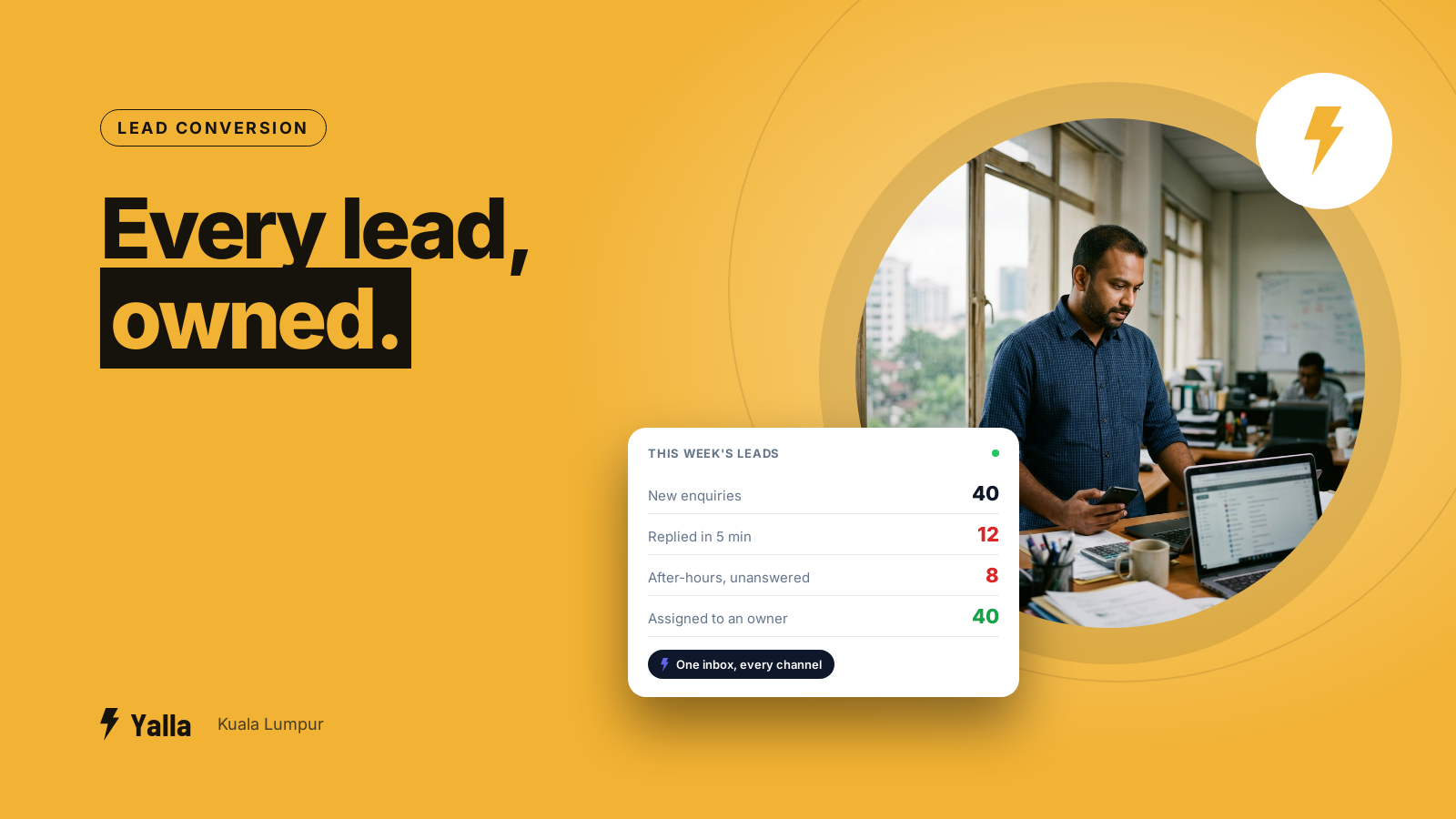
You spend real ringgit getting people to message your business. A Facebook ad here, a Google listing there, a booth at a Klang Valley trade show. The enquiries come in, and then what? For most growing KL sales teams the honest answer is: they land in three different WhatsApp accounts, a shared inbox nobody fully owns, and a spreadsheet someone updates when they remember. That gap between "lead arrives" and "lead gets handled" is exactly what a lead management system is built to close.
This article is for the owner or sales manager of a Kuala Lumpur business with a team: four, five, ten people who are supposed to be following up enquiries. If you are a solo operator with a handful of leads a month, you do not need this yet. If leads are arriving faster than your team can track them, read on.
Why do leads slip through a growing sales team?
When one person handles every enquiry, nothing gets lost because it is all in their head. The trouble starts the moment you add a second and third person. Now a lead can arrive and sit, because each person assumes someone else has it. Three patterns show up again and again on our KL demos:
- Leads scatter across channels. WhatsApp, Instagram, Facebook, the website form, a phone call. No single list, so no one can see the full picture.
- Nobody owns the follow-up. The first reply goes out, the customer says "let me think about it", and the chase quietly dies because remembering it was nobody's actual job.
- Everyone chases the wrong leads. Without a way to tell a serious buyer from a browser, your team spends equal energy on both, and the hot ones go cold while they type long replies to tyre-kickers.
Each of these is a leak, and every leak is paid-for ringgit walking out the door. A lead management system exists to seal them.
Free download
The Lead Management Checklist for KL Sales Teams
A practical companion to this article. Free for your email address.
Get it free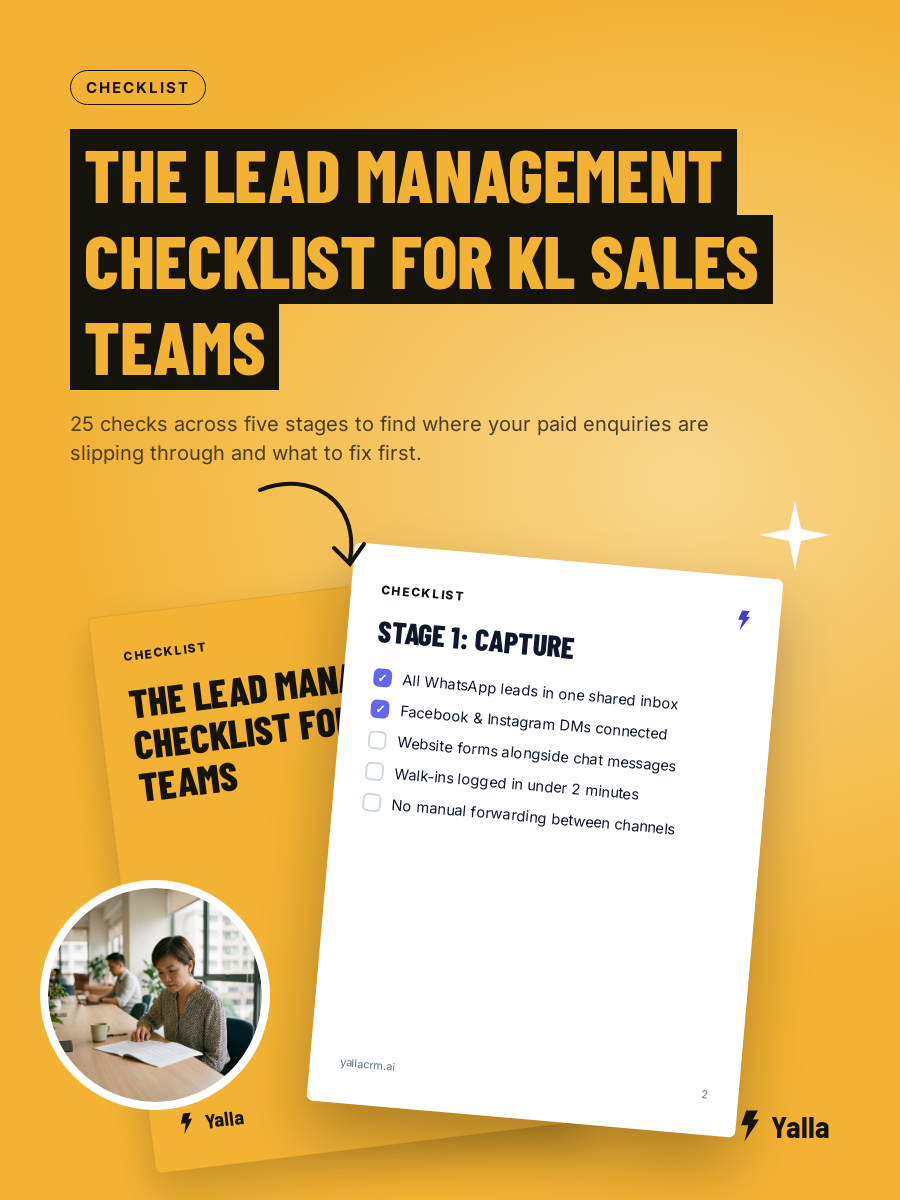
What is a lead management system?
A lead management system is software that captures every enquiry into one place, assigns each one to a specific person, helps the team judge which leads are worth chasing, and tracks each lead through to a won or lost outcome. It is the layer between your marketing, which creates enquiries, and your sales team, which is supposed to convert them.
People use "lead management system", "CRM" and "sales pipeline" almost interchangeably, and the overlap is real. The distinction worth keeping: a CRM is the broad system of record for every customer relationship, while lead management is the specific job of getting a new enquiry from "just arrived" to "handled" without it falling through a crack. A good CRM does lead management well. A tool that only stores contacts does not.
What are the five stages every lead should move through?
Strip away the feature lists and a lead management system earns its keep on five jobs, in order:
- Capture. Every enquiry, from every channel, lands in one inbox. WhatsApp, Instagram and Facebook messages, website forms, Facebook and Google lead ads, phone enquiries logged by hand.
- Assign. The moment a lead arrives it goes to a named person by a rule, not to whoever happens to be looking. No lead sits unclaimed.
- Qualify. Each lead is sorted by how ready it is to buy, so the team knows where to spend its energy first.
- Follow up. The system runs or reminds the follow-up sequence, so a quiet lead gets chased whether or not anyone remembers.
- Report. You can see how many leads came in, from where, who handled them, and what converted, in ringgit.
Most teams are strong at step one and weak at everything after it. That is why enquiries pile up but sales do not. We go deeper on getting off spreadsheets in managing leads in Excel and why it breaks a growing team.
How does a lead management system decide who gets each lead?
This is the question that comes up on nearly every team demo. You have one enquiry line or a shared inbox and several salespeople, and right now the fast ones grab leads while the slow ones coast, or worse, a lead sits because everyone assumed someone else took it.
Routing rules fix this. Each incoming enquiry is assigned automatically:
- Round-robin shares leads evenly so no one hoards and no one coasts.
- By product or service sends each enquiry to the person who actually knows that line.
- By area or language routes a Malay enquiry to a Malay-speaking rep, or a Cheras lead to the person who covers Cheras.
The assignment is logged, so when a deal closes you know whose lead it was, and when a lead goes unanswered you know who let it drop. That is the difference between a team and a free-for-all. The mechanics are in who owns this lead: routing enquiries to the right salesperson.
How do you know which leads to chase first?
On a recent KL onboarding call, a team's whole process came down to one instruction: classify every contact as cold, warm or hot, then add the qualified ones to the pipeline. That is lead qualification, and it is the stage most teams skip.
Not every enquiry is a buyer. Some are ready now, some are months away, some will never buy. A lead management system lets you sort them, by budget, by timeline, by how they answered a qualifying question, so your team pours its hours into the hot ones and keeps the warm ones on a lighter automatic nurture. The payoff is simple: faster replies to the people most likely to buy, and no serious lead going cold while a rep writes an essay to someone just looking. We cover how to grade them in which leads your team should chase first, and why speed matters so much in why leads go cold before you reply.
What does a lead management system cost in KL?
It ranges. Basic shared-inbox tools start around RM100 to RM300 a month for a small team. Full systems with WhatsApp automation, routing and pipelines usually sit between RM300 and RM1,500 a month depending on users and features. Enterprise platforms built for email-led sales can run into several thousand ringgit a month and still need a separate tool bolted on to handle WhatsApp.
The figure that matters is not the subscription. It is the cost of the leads you are already losing. If your average sale is worth a few thousand ringgit and one or two paid-for enquiries slip through unanswered every week, the leak is far bigger than any monthly fee. Price the tool against the deals currently dying in an unread chat, not against zero.
What should you ask before you buy one?
Before you pay for anything, put these five questions to the vendor and watch how straight the answers come back:
- How exactly do WhatsApp, Facebook and Instagram enquiries reach the system, and how fast?
- Can leads be auto-assigned by a rule, and is every assignment logged against a name?
- Can I see, per salesperson, how many leads they were given and what they did with them?
- Does follow-up run automatically, or does someone still have to remember to send it?
- What is the real cost per user per month in ringgit, all in, including any add-ons?
If a vendor goes vague on any of these, that vagueness is your answer.
Where a lead management system is not the answer
Honesty makes the rest believable, so here is where you should hold off:
- You have very few leads. If you get a handful of enquiries a month, your phone and a tidy habit are enough. A system adds cost and admin you do not need yet.
- Your sales run on email and formal proposals. If your deals are built on long email threads and documents rather than chat, a record-first CRM will fit better than a chat-native one.
- You need a deeply custom data model. If you track unusual objects and relationships, a flexible platform like Attio will bend further than a lead-focused tool.
- You have strict enterprise compliance needs. Large organisations with procurement and audit requirements sometimes land on Salesforce for reasons that have nothing to do with lead speed.
For most KL teams, though, the problem is not a custom data model. It is leads going unanswered, and that is exactly what a lead management system is for.
How does Yalla fit?
Picture a five-person team in Puchong spending RM4,000 a month on Facebook and Instagram ads. They get around 40 enquiries a week. On a normal week, eight of those land after 7pm, and by morning half have already booked with whoever replied first. That is not a people problem. It is a system problem, and it is the one Yalla is built for.
Yalla is the chat-native CRM where the AI does the work, not just the talking. Yalla Brain acts across pipelines, WhatsApp, Instagram, Facebook, email campaigns and reporting from one instruction, so a quiet lead gets chased, a new enquiry gets assigned, and the pipeline updates without anyone copying details between apps at 9pm. It is built for the KL business with a team and real ad spend, where the leak is follow-up, not note-taking. If you are weighing the category itself, what a WhatsApp CRM is and when a business needs one walks through the trade-off.
FAQ
What is the difference between a lead management system and a CRM?
They overlap heavily. A CRM is the broad system of record for every customer relationship, from first enquiry to repeat business. Lead management is the specific job of moving a new enquiry from "just arrived" to "handled" without it slipping through. Most CRMs include lead management; the thing to check is whether a given tool does that job well, or just stores contacts.
Can a small KL team of four or five people use one?
Yes, and that is often the point at which it starts to pay off. Once more than one or two people share leads, you need routing and visibility more than a solo operator does. Most tools price by user, so a four or five-person team sits at the affordable end, often a few hundred ringgit a month.
Does a lead management system work with WhatsApp enquiries?
The ones built for this market do. Because so many KL enquiries arrive on WhatsApp, Instagram and Facebook, a useful system captures those messages directly, assigns them, and runs follow-up in them, rather than treating WhatsApp as a separate app your team checks on the side.
How is this different from just using a shared inbox?
A shared inbox puts everyone in one message list, which helps, but it does not assign ownership, grade leads, or track them through to a sale. A lead management system adds the routing, qualification, follow-up and reporting on top, so you know not just what was said, but who owns each lead and what it converted to.
Free download
The Lead Management Checklist for KL Sales Teams
A practical companion to this article. Free for your email address.
Get it freeYalla is the chat-native CRM where the AI does the work, not just the talking.
See how much of your business it can reach.