
Which Leads Should Your KL Team Chase First? Lead Scoring
Too many enquiries, too little time? Lead scoring tells a KL sales team which WhatsApp leads to chase first, using a simple hot, warm and cold model.
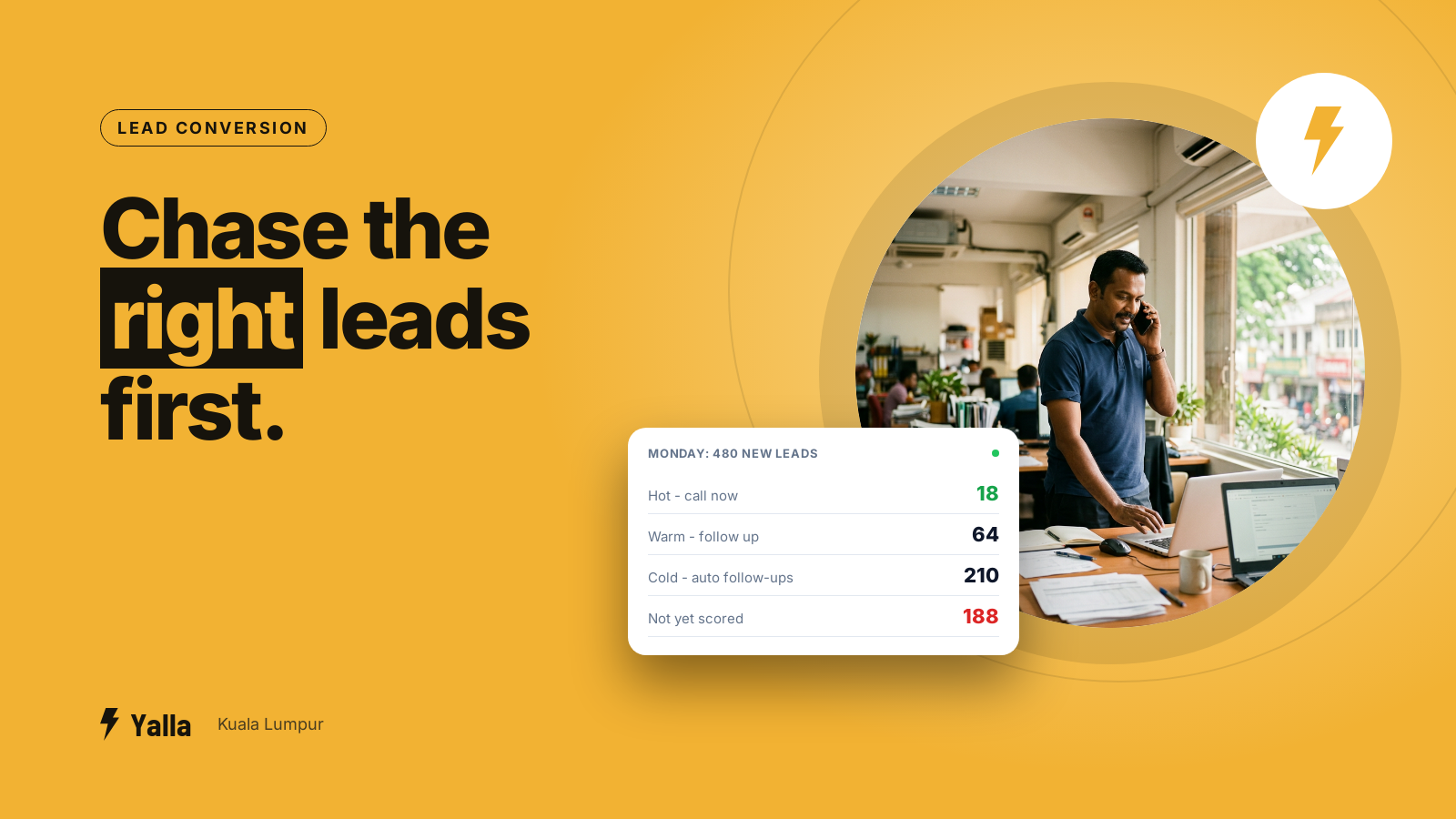
A Kuala Lumpur sales team rarely loses deals because the leads are bad. It loses them because 480 enquiries landed this month across WhatsApp, Facebook and the website, and nobody could say which 18 were ready to buy today. Lead scoring is how you find those 18 before they go cold. This guide is for any KL or Klang Valley team buried in enquiries, whether you run a five-person renovation crew in Petaling Jaya, a hospital group in Bangsar, or an admissions office at a school in Mont Kiara, and are spending your best hours on people who were never going to buy.
What is lead scoring, in plain terms?
Lead scoring just means deciding which enquiries are worth your time right now and which can wait, then putting them in that order. You look at who the person is and what they have actually done, and the ones most ready to buy go to the top for a call straight away. Everyone else waits their turn.
You do not need a 100-point system or any software to begin. For most KL businesses, three groups is enough: hot, warm and cold. The point is not to be precise. It is that any two people looking at the same list agree on who to call before lunch.
Free download
The Lead Scoring Worksheet for KL Sales Teams
A practical companion to this article. Free for your email address.
Get it free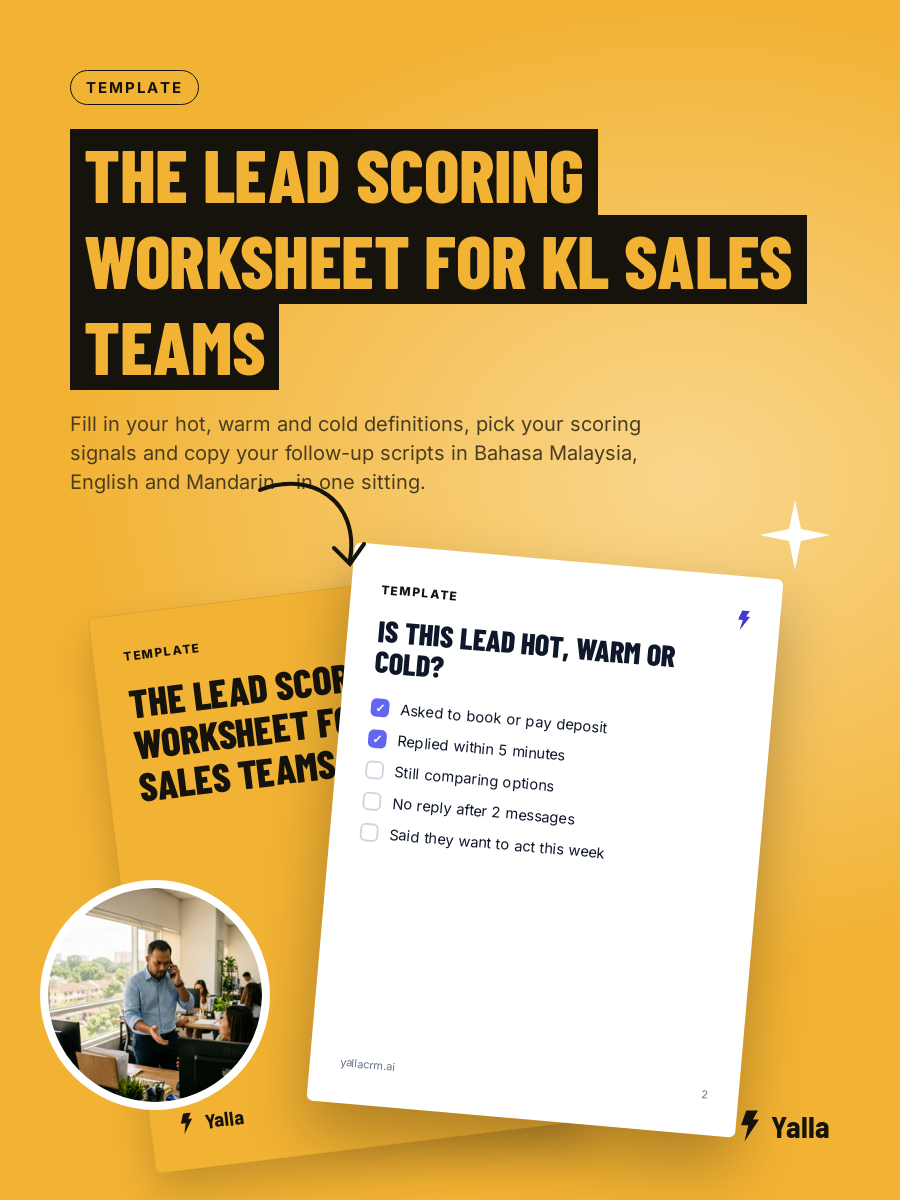
Why do KL teams lose deals they already paid for?
Because the enquiries that matter are hidden inside the ones that do not. A dealership or a hospital group running Facebook and Instagram ads in the Klang Valley might get 300 to 500 enquiries a month. Spend RM8,000 on ads and the cost of each enquiry is real money. But a rep answering in the order messages arrive treats a "just checking your price" tyre-kicker exactly the same as someone who said "can I come this Saturday with my deposit".
A five-person renovation or aircon-servicing team in Petaling Jaya feels this hardest. The WhatsApp pings all day, everyone is "busy", and yet the homeowner who asked for a site visit this weekend is still waiting at 4pm because three people each assumed someone else had replied. One of our logged search queries said it plainly: a business "gets hundreds of leads from ads, WhatsApp and Instagram, and some never get a follow-up." When everything looks the same in the inbox, the ready-to-buy enquiry waits behind forty that were not, and by the time someone replies the customer has booked with whoever answered first. Speed matters, but speed on the wrong enquiry is just busywork. See our piece on why KL leads go cold before you reply for the cost of a slow first response.
Hot, warm or cold: a simple scoring model you can use this week
You do not need software to start. Here is a three-group model a KL team can agree on in one meeting.
| Group | What it looks like | What the team does |
|---|---|---|
| Hot | Asked about price, booking, stock, a deposit, a site visit or a tour; wants to act this week | Reply within 15 minutes; a named person owns it |
| Warm | Serious questions, comparing options, no firm timeline yet | Reply same day; follow up on a set schedule over two weeks |
| Cold | "Just asking", browsing, wrong fit, or went quiet after one message | Automatic follow-up messages; no staff time until they reply again |
The discipline is in the second column. A hot enquiry that waits a day is no longer hot. A cold one that eats an hour of a rep's day is money you chose to spend. Once the three groups are agreed, the question each morning stops being "who messaged" and becomes "who is hot".
What should you actually score in Malaysia?
Scoring works when the signals you pick genuinely predict a sale for your business. Two things matter.
Who they are. Are they in your service area? A Shah Alam enquiry for a Shah Alam clinic is worth more than one from Johor. Is the budget realistic? For a school, is the child the right age for an open intake? Did they come from a campaign that usually converts, or from a viral post that only brings browsers?
What they do. This is the stronger signal. Someone who asks "how much", "do you have stock", "can I book a site visit", or "can I pay deposit" is telling you they are close. A parent who asks for the registration form is closer than one asking only for fees. Someone who opens your WhatsApp, reads, and replies within minutes is warmer than someone who went quiet for a week.
Weigh what they do more heavily than who they are. A perfect-fit lead who never replies is worth less than an imperfect one asking to come in on Saturday. If you want to go deeper on reading intent from a first message, see how to qualify WhatsApp leads automatically.
By hand or automatic: which should a small team use?
By hand means a person marks each enquiry hot, warm or cold themselves. It is free and it works fine at low volumes, say under 50 a week. The problem is it breaks when you get busy and it goes out of date. Nobody re-marks an enquiry when the customer replies three days later, so the label lies.
Automatic means the system reads the enquiry and the behaviour and marks it for you, then changes the mark as the customer acts. This is where an AI CRM earns its keep. Every CRM has an AI now. The only question is how much of your business it can reach. An AI that can only see form fields will miss the WhatsApp message where the customer said "I want to pay today". One that can read the chat, the ad it came from and how fast they replied marks it on what actually happened.
For a team handling 300-plus enquiries a month across channels, marking by hand is a job nobody has time to keep doing. Automatic is the only version that survives a busy week.
How scoring changes your team's morning
Without it, the morning is a scroll: open WhatsApp, start at the top, reply until a manager interrupts. With it, the morning is a list: here are the 18 hot enquiries, assigned, with the last message visible, sorted by who has waited longest. The team works the list top down. The warm ones move on an automatic follow-up sequence. The cold ones get the odd automatic message until one of them replies "actually, is it still available" and jumps straight back to hot.
For that renovation team, it means the homeowner who wants a Saturday site visit is at the top of the list by 9am, owned by one named person, instead of lost under forty "how much ah" messages.
A hospital group usually has a second problem: the new ad leads land in the same place as an old patient list nobody ranks. The fix is one shared pipeline with department filters, not four separate systems. The group sees a single scorecard, for example 14 hot, 40 warm and 120 cold on a Monday, while marketing sees only its ad leads, the call centre sees only the hot ones to phone, and each clinic sees its own patients. One scored view, filtered per team, so a fresh screening enquiry and a dormant patient are never worked the same way.
For an admissions office the list reads "9 families who asked to book a tour, not yet contacted". Enquiries arrive on one shared phone in Malay, English and Chinese, so here is the part that matters: the AI reads the language each message comes in, replies in that same language, and still marks it on the same hot, warm, cold rules, so a Chinese-language "boleh book tour this Saturday?" is flagged hot exactly like an English one and never lost because nobody on shift read that language (more on handling enquiries across languages). It also shows you the drop-off. Fill in your own funnel: ____ enquiries lead to ____ tours booked, which lead to ____ enrolments. If the biggest fall is enquiry to tour, your hot families are not being called fast enough; if it is tour to enrolment, the follow-up after the visit is the leak.
This is also how a manager finally sees the truth. Instead of "we're busy", the list shows 18 hot enquiries and only 12 touched by 11am, and the gap is the money walking out. Routing each enquiry to the right salesperson is what stops a hot one sitting unowned while everyone assumes someone else has it.
How to start this week
You can run this without buying anything first. Copy the block below into a shared note or the top of your pipeline and fill in the blanks:
- Hot = asked about price, booking, deposit, a site visit or a tour, wants to act this week. Reply in 15 minutes. Owner: ____
- Warm = serious, still comparing, no timeline. Reply same day. Follow up again on: ____
- Cold = just asking or gone quiet. Automatic follow-ups only. Check again in: ____ days
Then:
- Agree those three definitions with the team in one meeting.
- Mark every new enquiry against them by hand for five working days.
- Each morning, work the hot list first, every enquiry assigned and owned, before anyone opens the general inbox.
- Check three numbers weekly: how many hot enquiries came in, how many got a reply within 15 minutes, and where enquiries drop off.
After a fortnight you will know whether marking by hand can keep up. For most teams past 300 enquiries a month it cannot, and that is the point to automate it, not the point to start.
Where scoring is not the answer
Scoring is not a fix for not enough leads. If you get 20 enquiries a month, you do not have a prioritising problem, you have a demand problem, and scoring software is premature. Reply to all 20 well.
It is also the wrong first project if your sales live in email with long, multi-person deals and formal proposals. A CRM built around the email thread and the deal record will serve that better than a chat-first tool. And if you want a deep scoring model with dozens of weighted fields and years of sales history behind it, a HubSpot or Salesforce setup is built for that and Yalla is not pretending to be. Most KL SME teams do not need that. They need hot, warm, cold, done honestly, every day.
Where a tool helps, and where Yalla fits
Here is the part software actually does. Enquiries from WhatsApp, Instagram, Facebook and your website land in one inbox. The system reads each one and marks it hot, warm or cold on what the customer said and did, assigns it to a person, and keeps the warm and cold ones getting their follow-ups so nobody has to remember. A manager can ask, in plain words, for every hot enquiry not contacted today and get the list back.
That is the job Yalla is built for. On a Monday morning it means your hot enquiries are already marked, assigned and sorted by who has waited longest; the warm ones are already getting their next message; and a quote that went quiet last week is back near the top because the customer just replied "still available?". The result is the morning list instead of the morning scroll. For a KL team paying real ringgit for every enquiry, that is the difference between working the leads and losing them.
FAQ
What is a good lead scoring model for a small business?
Start with three groups: hot, warm and cold. Hot asked about price, booking or payment and want to act this week. Warm are serious but have no timeline. Cold are browsing or went quiet. Agree what each group means and what the team does for each, then use it every day. Add more detail later, once the habit sticks.
Is lead scoring the same as qualifying a lead?
They are related but not the same. Qualifying decides whether an enquiry is worth pursuing at all. Lead scoring puts the ones worth pursuing in order so you work the best first. In practice a WhatsApp CRM does both in one pass: it qualifies the enquiry, then marks it hot, warm or cold.
Can AI score leads from WhatsApp chats?
Yes, when the AI can read the chat itself, not just a form. An AI that sees the full conversation, the ad it came from and how fast the customer replied can mark an enquiry hot, warm or cold and update it as they respond. An AI that only sees form fields will miss the message where the customer actually said they want to buy.
How often should lead scores be updated?
Every time something changes. A score is only useful if it reflects the latest behaviour. A warm enquiry that replies "can I come Saturday" should become hot the moment that message lands, not at the next weekly review. This is the main reason marking by hand fails at volume and automatic wins.
Free download
The Lead Scoring Worksheet for KL Sales Teams
A practical companion to this article. Free for your email address.
Get it freeYalla is the chat-native CRM where the AI does the work, not just the talking.
See how much of your business it can reach.